|
ABEL GRIMMER - TOWER OF BABEL - PAGE 7
|
Federal
Reserve - The
Biggest Theft in
World History |
Sinkhole |
-
After the financial Panic of 1907, Congress began to seek a preventative solution so that a banking panic or run would never happen again.
- In order to accomplish this, they passed the Aldrich-Vreeland Act in 1908.
- The Act authorized the Treasury to issue emergency currency and created the National Monetary Commission to research permanent banking reform.
- It was a temporary fix that highlighted the need for a central bank, a goal pursued by the Commission and its chairman, Senator Nelson Aldrich, leading to the
Aldrich Plan.
Void |
- Seeing that they didn't have the votes for the
Aldrich Plan to win in
Congress, there were too many skeptical of a private central
bank, the Republican leadership never brought the bill to
a vote.
- Not to be defeated, the bankers quietly decided to move to track two,
the Democratic alternative.
- They began financing Woodrow
Wilson as the Democratic nominee for the presidential
candidate in 1912.
|
Woodrow Wilson ran for president and was elected twice, first in a three-way race in 1912, winning with his "New Freedom" platform amid a Republican split, and again in 1916, running on a platform of keeping America out of World War I with the slogan "He Kept Us Out of War".
(Assistant)
|
Lies and more lies |
- During the presidential campaign of 1912, the Democrats
were careful to pretend to oppose the Aldrich bill.
- The Aldrich bill was condemned
by the party platform, when Woodrow Wilson was nominated.
- The men who ruled the Democratic party promised the people that if they were returned to power there would be no central bank established while they held the reins of government.
-
Congressional representative Louis T. McFadden of Pennsylvania, himself a
Democrat, as well as chairman of the House Banking and
Currency Committee explained it 20 years after the fact.
|
Thirteen months later that promise was broken, and
the Wilson administration, under the tutelage of those
sinister Wall Street figure who stood behind Colonel
House, established here in our free country the
worm-eaten monarchical institution of the 'king's
bank' to control us from the top downward, and to
shackle us to the cradle to the grave.
(Louis T. McFadden)
|
Federal Reserve
System |
- Once Wilson was elected, the head committee members,
J.P. Morgan, Paul Warburg and Bernard Baruch and company,
advanced a new plan which Warburg named the Federal Reserve
System.
- The Democrat leadership hailed the new bill
called the Glass-Owen, as something radically different
than the Aldrich bill.
- But in fact, the bill was
virtually identical in every important detail.
- It was the compromise between two main proposals: Congressman Carter Glass' vision for a decentralized, regional system and Senator Robert L. Owen's push for stronger government control, incorporating ideas from William Jennings Bryan.
|
The law created the Federal Reserve System, the central banking system of the United States. Following the 1912 elections, in which Democrats gained control of Congress and the presidency, President Wilson, Congressman Carter Glass, and Senator Robert Latham Owen introduced legislation to create a central bank.
(Assistant)
|
Public Domain via
Wikimedia Commons
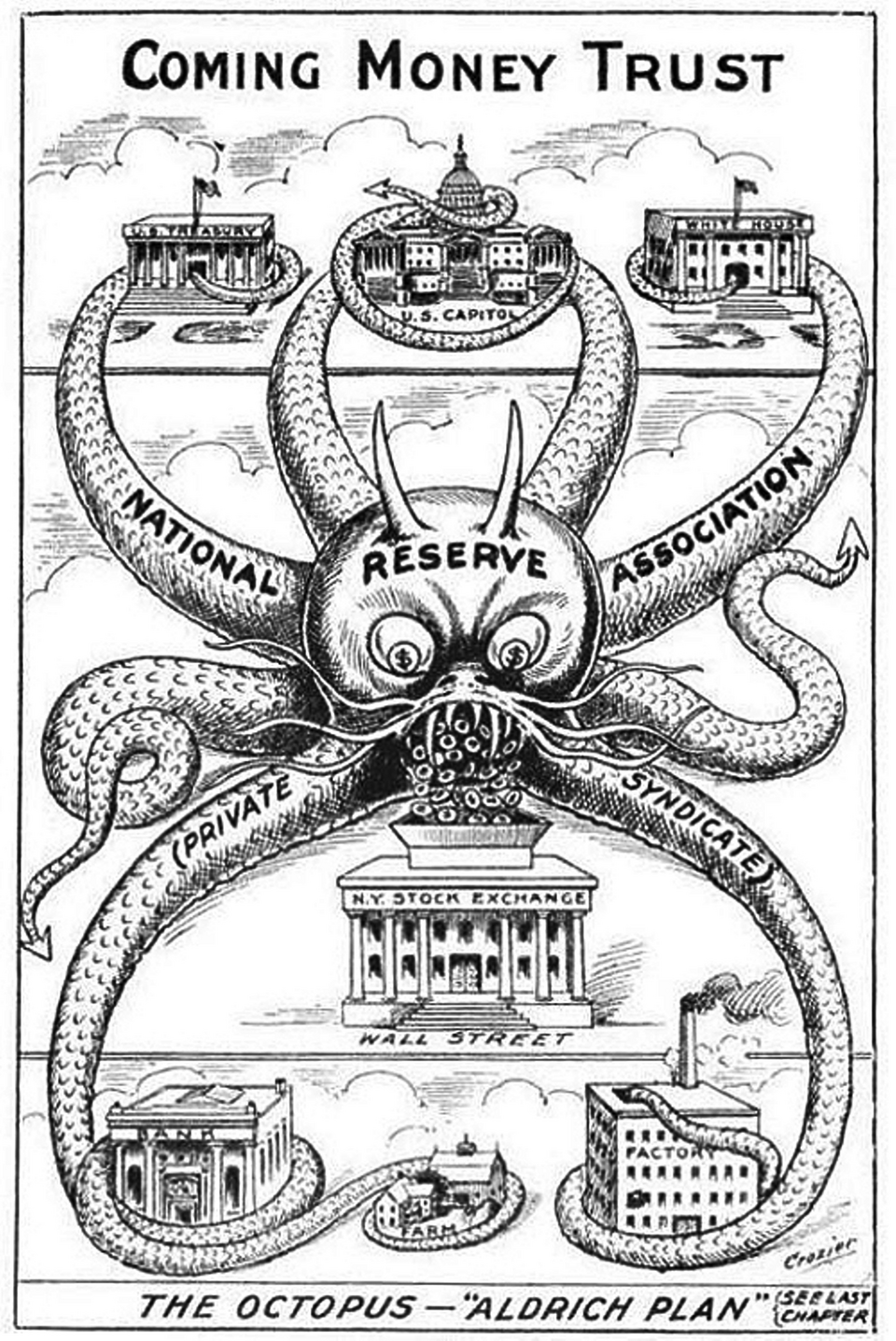
The Octopus plan |
- So vehement were the Democratic denials of similarity
that Paul Warburg, the father of both bills, had to step in to
reassure his friends in Congress that the 2 bills were
virtually identical.
- This admission was for private
consumption only and publicly the money trust trotted out
Senator Aldrich and Frank Vanderlip, the president of
Rockefeller's National City Bank of New York.
- Vanderlip
was one of the 7 who came up with the plan while meeting on Jekyll
Island to propose the new Federal Reserve system.
|
Brushing aside the external differences affecting the
'shells,' we find the 'kernels' of the two systems
very closely resembling one another.
(Paul Warburg)
|
Forest through the
trees |
- Years later, however, Vanderlip admitted that the two
measures were virtually identical.
- Vanderlip stated that,
'Although the Aldrich Federal Reserve Plan was
defeated when it bore the name Aldrich, nevertheless its
essential points were all contained in the plan that finally
was adopted.'
- As Congress neared a vote, they called Ohio
attorney, Alfred Owen Crozier (1863–1939) to testify and he noted the
similarities between the Aldrich bill and the new Glass-Owen
bill.
- The bill granted just what Wall Street and the big
banks had been striving to obtain for 25 years, private
instead of public control of currency.
|
If the Glass-Owen bill does this as completely as the
Aldrich bill. Both measures rob the government and the
people of all effective control over the public's
money, and vest in the banks exclusively the dangerous
power to make money among the people scarce or plenty.
(Alfred Crozier)
|
Deceptive from the
start |
- During the debate on the measure, senators complained
that the big banks were using their financial muscle to
influence the outcome.
- There are bankers in this country
who are enemies of the public welfare said one senator.
-
What an understatement, despite the charges of deceit and
corruption, the bill was finally snuck through the Senate on
December 22, 1913, after most senators had left town for the
holidays, note, this is a common practice even to this day in
Congress.
- The senators had all been assured by the
leadership that nothing would be done until long after the
holiday recess.
Invisible
government |
- On the day the bill was passed, Minnesota congressman,
Charles A. Lindbergh Sr., Republican, prophetically warned his
countrymen that the Act establishes the most gigantic trust on
earth.
- He told them when the president signs the bill,
the invisible government by the monetary power will be
legalized and that the people might not know it immediately,
but the day of reckoning was only a few years removed.
-
The worst legislative crime of the
ages is perpetuated by this bill.
- On top of all this,
only weeks earlier, Congress had finally passed a bill
legalizing income tax.
Unlimited federal
debt plan |
- Why was the income tax law important?
- Because
bankers finally had a system which would run up a virtually
unlimited federal debt.
- How would the debt be repaid,
never mind the principal?
- Remember, a privately owned
central bank creates the principal out of nothing, the federal
government was small then and up to that time it had subsisted
merely on tariffs and excise taxes.
- Just as with the Bank
of England, the interest payments had to be guaranteed by
direct taxation of the people.
- The money changers knew
that if they had to rely on contributions from the states,
eventually the state legislatures would revolt and either
refuse to pay the interest on their own money, or at least
bring political pressure to bear to keep the debt small.
Unconstitutional
tax |
- It is interesting to note that in 1895, the Supreme
Court had found a similar income tax law unconstitutional.
- The Supreme Court even found a corporate income tax law
unconstitutional in 1909.
- As a result, Senator Aldrich
hustled a bill through Congress for a constitutional amendment
allowing income tax.
- The proposed 16th Amendment to the
Constitution was then sent to the state legislatures
for approval.
- Some critics claim that the 16th Amendment
was never ratified by the required three-quarters of the
states.
- In other words, the 16th Amendment was never
constitutional, although the
authors of Google AI want you to believe it is.
|
The 16th Amendment to the U.S. Constitution,
ratified in 1913, grants Congress the power to levy an income tax on individuals and corporations from any source, without needing to divide it among states based on population (apportionment), which was a major shift from the old rules and established the modern federal revenue system. It was passed to overturn a Supreme Court decision (Pollock v. Farmers' Loan & Trust Co.) that had struck down a federal income tax, allowing for a more flexible way to fund the government beyond war-time needs.
(Assistant)
|
|
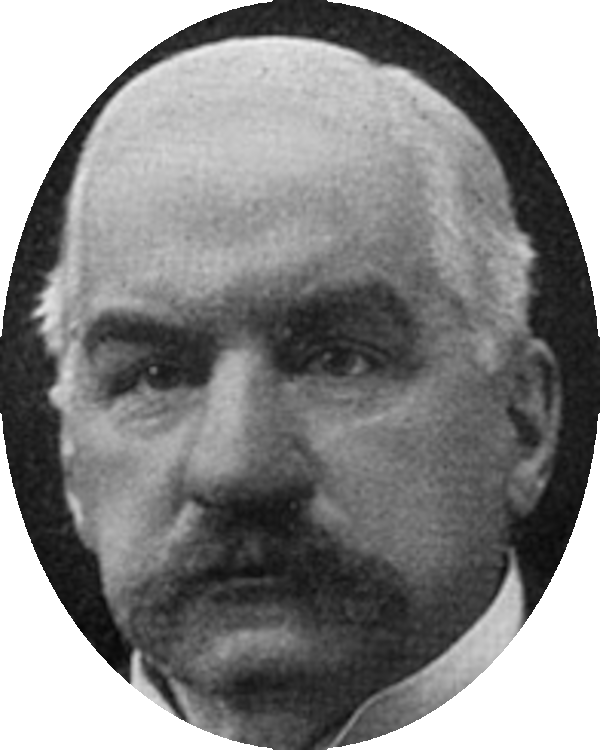
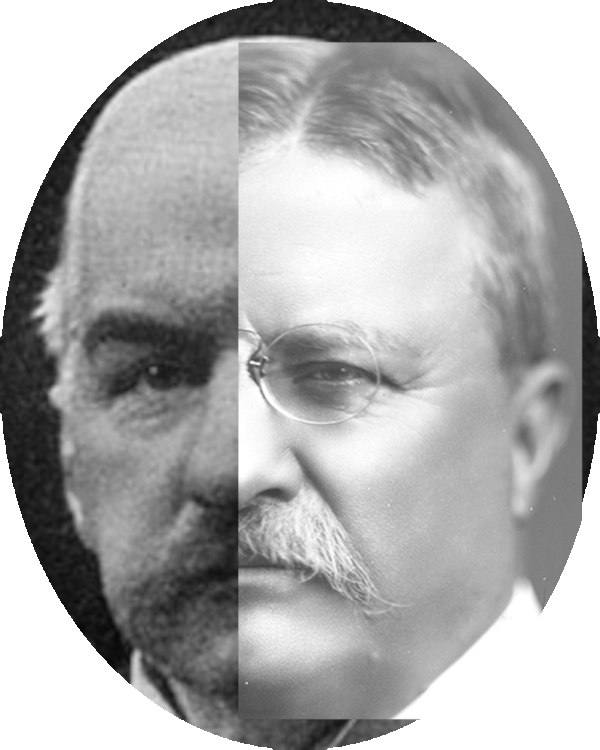
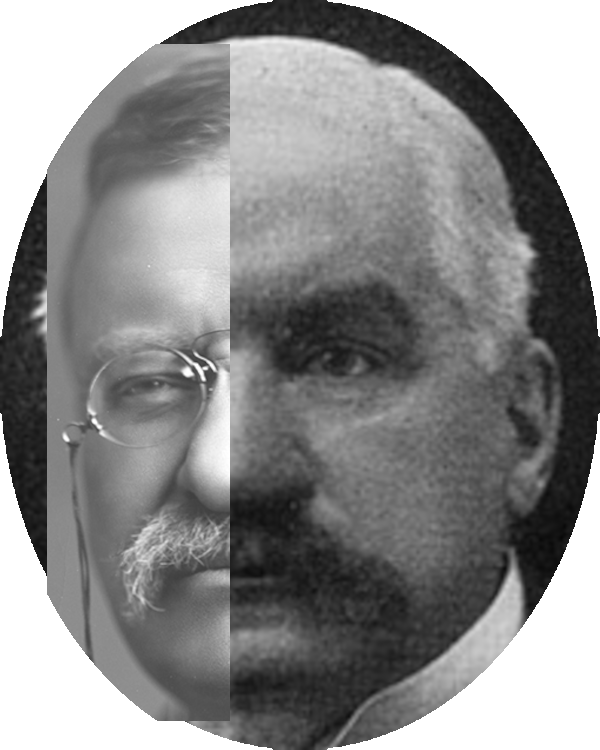
J.P. Morgan as Theodore Roosevelt |
 |
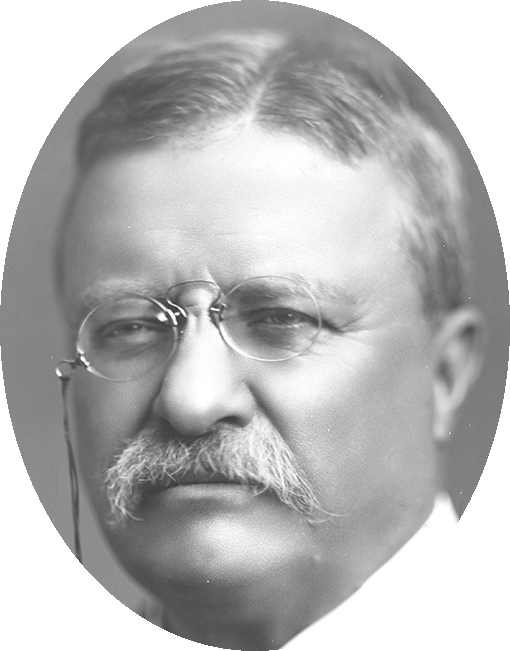 |
John Pierpont Morgan
1837-1913
4/17
3/31
Banker |
Theodore Roosevelt Jr.
1858-1919
10/27
1/6
26th president |
 |
 |
|
33rd
degree square deal |
- Teddy Roosevelt previously was involved in New York politics, including serving as the state's 33rd governor for two years.
- He served as the 25th vice president under President William McKinley for six months in 1901, assuming the presidency after McKinley's assassination.
- How amazing.
Public domain, via Wikimedia Commons
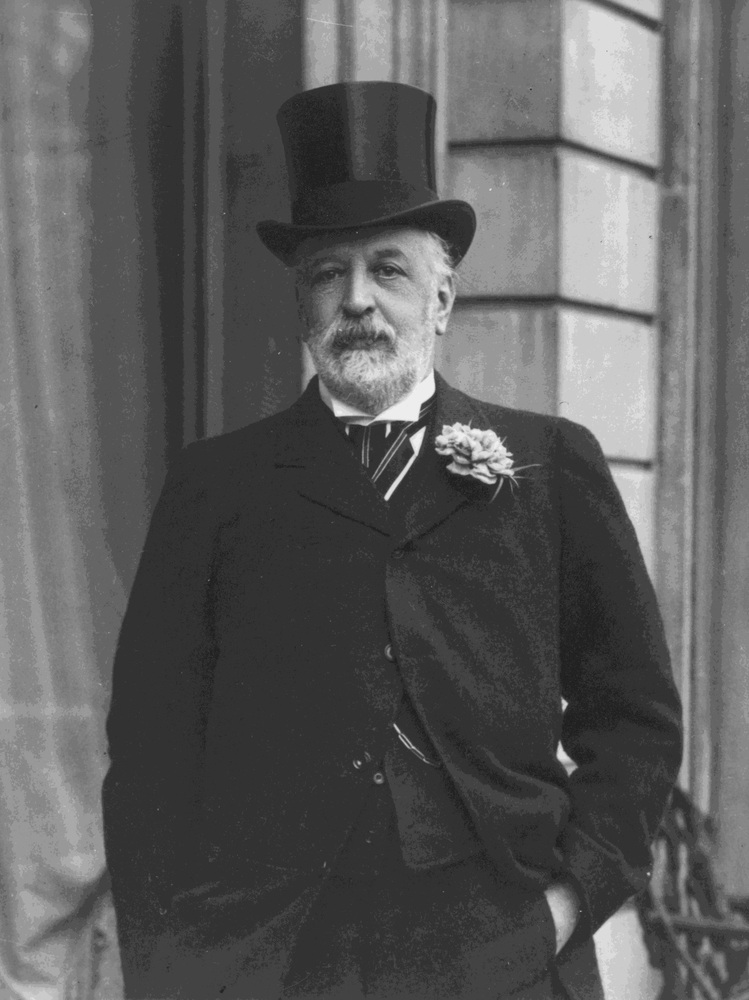
Natty Rothschild |
-
Nathaniel Mayer ('Natty') 1st Lord Rothschild (1840-1915), took over the senior partnership of N M Rothschild & Sons in 1879.
- Under Natty and his brothers, the bank arranged many international loans, and developed mining interests in the New World.
- Natty was a Member of Parliament (MP), and became the first Jewish peer in 1885, taking the title Lord Rothschild of Tring.
- Theodore Roosevelt Jr. (1858-1919) served as the 26th President of the United States from 1901 to 1909.
- As a leader of the Republican Party, he became a driving force for the Progressive Era in the United States in the early 20th-century.
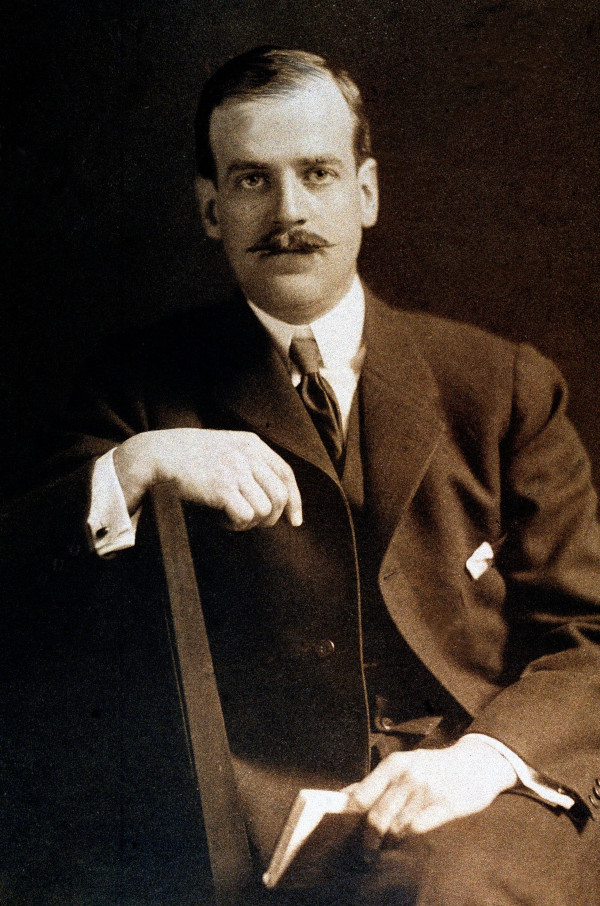
Teddy the Rough
Rider |
-
Teddy Roosevelt served as Assistant Secretary of the Navy under William McKinley, resigning after one year to serve with the Rough Riders during the Spanish-American War.
- He had to kick up another war and this was all part of their
Knights of the Golden
Circle masonic plan to take over North and South America
and turn them into massive slave states.
- Havana (Heaven)
was going to be their capital and we know was JFK was up to.
- Teddy returned to America and celebrated as a 'war hero,'
such a joke because he was a hero only to the greedy Rothschild.
|
Returning a war hero, he was elected Governor of New York in 1898. In the Presidential election of 1900, Roosevelt was chosen as McKinley's running mate, and helped McKinley to a landslide victory based on a platform of peace, prosperity, and conservatism. Following the assassination of President McKinley in September 1901, Roosevelt succeeded to the office. During the years of his presidency, he continued to promote progressive policies. (Teddy
Roosevelt in March 1922)
|
Museum of the City of New York/Getty Images
August Belmont
Jr. and masonic hand
signs |
- It is not known when Lord Rothschild and Teddy Roosevelt first became acquainted.
- Very little of Natty’s original correspondence exists; some tantalizing fragments survive.
- It is possible that the house of Rothschild came to the attention of Roosevelt when he was Governor of New York in the late 1890s; a prime mover in the development of the New York subway system was the Rothschilds’ agent in the United States, August Belmont Jr., who set up the Interborough Rapid Transit Company in 1902.
|
In the election of 1904, Roosevelt famously promised to give every American a "square deal". In November 1904, The White House sent this note to Natty, “with hearty thanks for your congratulations” which was presumably sent in reply to a telegram from Natty to the President on his re-election earlier that month. After leaving office in 1909, Roosevelt went on safari in Africa and toured Europe, meeting Natty and other members of the Rothschild family in London in 1910. (rothschildarchive.org)
|
|
Colonel Dick Taylor as
August Belmont Sr. |
 |
 |
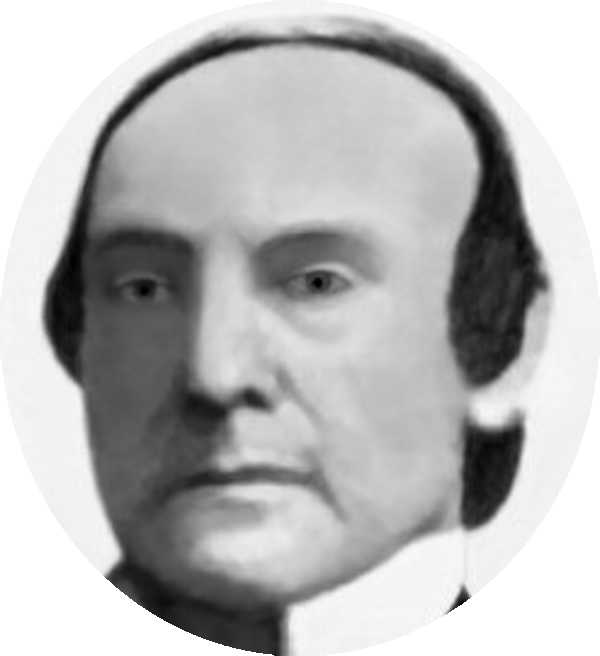
Colonel Edmund Dick Taylor
1804-1891
10/18
12/4
Abe Lincoln's buddy |
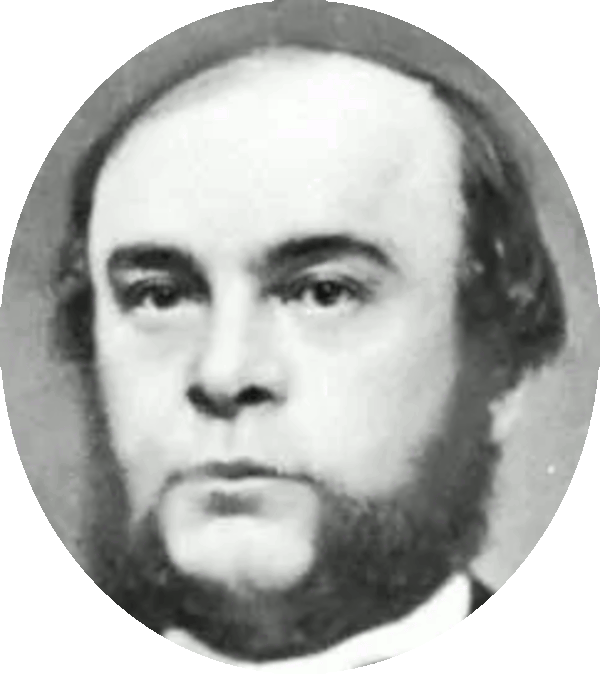
August Belmont Sr.
1816-1890
12/8
11/24
German-born American banker |
 |
 |
|
Colonel's fried chicken |
- His father, August Belmont Sr. was the longest serving president of the Democratic National Committee.
Gray day |
- The 1912 presidential campaign was to prove shockingly eventful for
Teddy Roosevelt.
- The campaign was bitterly contested, with Democrat Woodrow Wilson the eventual victor.
- Failing to win the presidential nomination against his Republican rival William Howard Taft, Roosevelt created the Progressive Party (Bull Moose Party), which nominated him and ran candidates for other state offices.
- In April 1912, Natty's son, Charles Rothschild (1877-1923) wrote to his French cousins “No doubt you have received from August Belmont
Jr. all the news of the Presidential Election, the chances of the two rivals Taft and Roosevelt seems to be extraordinarily even, but the fact that the latter pledged himself not to stand again for the Presidency has caused some Republicans to
vote Democrat!”
Square deal shot |
- On October 14, 1912, while campaigning in Milwaukee,
Teddy Roosevelt was shot by a saloon-keeper named John Flammang Schrank.
- The bullet lodged in his chest after passing through the speech and glasses case he was carrying in his jacket.
- Roosevelt correctly concluded that since he was not coughing blood, the bullet had not reached his lung, and declined suggestions to go to the hospital immediately.
- Instead, he delivered his 90-minute scheduled speech
with blood seeping into his shirt and Roosevelt carried the bullet with him for the rest of his life, as it was deemed too dangerous to attempt removal.
- Natty, whose brother Leopold (1845-1917) had been the target of an assassination attempt outside New Court in April 1912, wrote to Roosevelt to express his horror of this attack and sent his best wishes.
|
Lord Rothschild and Roosevelt shared similar political views; a muscular conservatism. Natty would have approved of Roosevelt’s accomplishments which included a commitment to conservation and the environment, and his expansion of the United States Navy. Roosevelt’s successful efforts to end the Russo-Japanese War of 1904-1905 won him the 1906 Nobel Peace Prize, and the approbation of the Rothschilds, who were only prepared to enter into business with Japan after the war had ended, issuing a major loan in Paris as well as London and the United States on behalf of the Japanese government in 1905. (rothschildarchive.org)
|
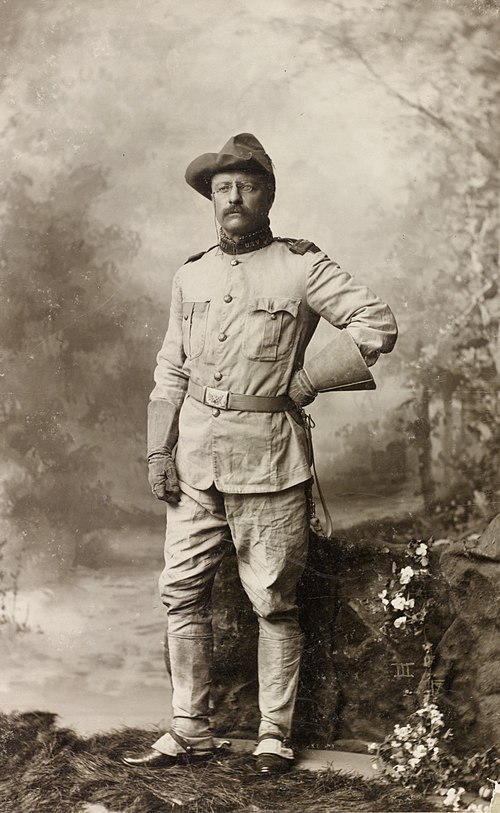
Public Domain via
Wikimedia Commons
Rough Rider was
Rothschilds 'hero'
and he looks like a
spoiled rich boy |
- Teddy Roosevelt was the first President to appoint a Jewish cabinet member, Secretary of Commerce and Labor, Oscar Solomon Straus (1850-1926), who served from 1906 to 1909.
- Concerned with the plight of European Jews, Natty warmly supported this appointment. On July
2, 1906, Natty wrote to his French cousins.
|
Mr Oscar Strauss lunched with me: I have known him for many years, not personally, but we have corresponded together; he is a strong American, a great Hebrew by race, religion & feeling, and he is an intimate friend of Roosevelt, & although he does not wish it known, will probably soon be a member of Roosevelt's Government: at any rate he hopes and thinks so … it is very important that Mr Strauss should get the office Roosevelt wants to give him; because not only would it be a sign to Russia, but it would facilitate a great deal many questions connected with the immigration of Russians & Poles into America. (rothschildarchive.org)
|
No debate |
- The money changers were in no mood to debate the fine
points.
- By October of 1913, Senator Aldrich had pushed the
income tax bill through Congress.
- Without the power to
tax the people directly and bypass the states, the Federal
Reserve bill would be far less useful to those who wanted to
drive America deeply into their debt.
- A year after
passage of the Federal Reserve bill, Congressman Lindbergh
explained how the Fed created what we have come to call the
'business cycle' and how they use it to their advantage.
|
To cause high prices, all the Federal Reserve Board
will do will be to lower the rediscount rate,
producing expansion of credit and a rising stock
market; then when businessmen are adjusted to these
conditions, it can check prosperity in mid-career
arbitrarily raising the rate of interest. It can cause
the pendulum of a rising and falling market to swing
gently back and forth by slight changes in the
discount rate, or cause violent fluctuations by a
greater rate variation and in either case it will
process inside information as to financial conditions
and advance knowledge of the coming change, either up
or down.
(Charles A. Lindbergh)
|
Dangerous Rough
Rider camp out |
- Congressman Lindbergh felt that it was the strangest,
most dangerous advantage ever placed in the hands of a special
privilege class by a government that ever existed.
- The
system is private, conducted for the sole purpose of obtaining
greatest possible profits from the use of other people's
money.
- Lindbergh stated, 'They know in advance when to
create panic to their advantage, they also know when to stop a
panic because inflation and deflation work equally well for
them when they control finance.'
- Congressman Lindbergh
was correct on all points.
- What he didn't realize is that
most European nations had already fallen prey to the central
bankers decades or even centuries earlier.
Brick wall |
- Only one year later, Congressman Lindbergh remarked,
'Already the Federal Reserve banks have cornered the market in
gold and gold certificates.'
- But he was not the only
critic of the Fed, Congressman Louis T. McFadden, the chairman of
the House Banking and Currency Committee from 1920 to 1931,
remarked that, 'the Federal Reserve Act brought about a
super-state controlled by international bankers and
international industrialists acting together to enslave the
world for their own pleasure.'
- Notice how McFadden saw
the international character of the stockholders of the Federal
Reserve.
- Another chairman of the House Banking and Currency
Committee in the 1960s, Wright Patman from Texas stated that,
'In the U.S. today we have in effect two governments.'
Slave away |
- Even the inventor of the electric light, Thomas Edison,
joined the fray in criticizing the system of the Federal
Reserve and said, 'If our nation can issue a dollar bond, it
can issue a dollar bill.'
- The element that makes the bond
good, makes the bill good, also, and the difference between
the two is the bond lets money brokers collect twice the
amount of the bond and an additional 20%, whereas the currency
pays nobody but those who contribute directly in some useful
way.
|
It is absurd to say that our country can
issue $30 million in bonds and not $30 million in
currency. Both are promises to pay, but one fattens
the usurers and the other helps the people. (Thomas
Edison)
|
Intrusive system |
- Three years after the passage of the Federal Reserve
Act, even President Wilson began to have second thoughts
about what had been unleashed during his first term.
-
Woodrow felt that some of the biggest men in the U.S. in the
field of commerce and manufacture, were afraid because they
knew there was a power, so organized, so subtle, so watchful,
so interlocked, so complete, so pervasive, that they had
better not speak above their breath when they condemn it.
|
We have come to be one of the worst ruled,
one of the most completely controlled governments in
the civilized world, no longer a government of free
opinion, no longer a government by a vote of the
majority, but a government by the opinion and duress
of a small group of dominant men. (Woodrow
Wilson)
|
Leader |
- Before his death in 1919, former president Teddy
Roosevelt warned the American people what was going on with
the international bankers (notice now he tells them so they
can write glowing reports for history books).
- At that same time, the mayor
of New York, John Hylan, also blasted those he saw taking
control of America, it's political machinery, and its 'news' press.
- Hylan described how the international bankers seized our
executive officers, our legislative bodies, our schools, our
courts, our newspapers and every agency created for the public
protection.
- At the head of this 'octopus' are the
Rockefeller and their Standard Oil interest and a small group
of powerful banking houses.
|
These international bankers and Rockefeller Standard Oil interests control the majority of newspapers and the columns of these papers to club into submission or drive out of public office officials who refuse to do the bidding of the powerful corrupt cliques which compose the invisible government. (Teddy
Roosevelt in March 1922)
|
Secrecy |
- Before his death in 1924, President Wilson realized the
full extent of the damage he had done to America when he
confessed, 'I have unwittingly ruined my government.'
- So
finally, the money changers, those who profit by manipulating
the amount of money in circulation, had their very own
privately owned central bank installed again in America.
-
The major newspapers, which they also owned, hailed passage
of the Federal Reserve Act of 1913, telling the public that
'now depressions could be scientifically prevented.'
- But
the fact of the matter was that now depressions could be
scientifically created.
Up and down and
homeless living
under the bridge |
- The power was now centralized to a tremendous extent so
now of course it was time for a planned war, a really big war,
in fact, the First World War.
- But to the central bankers,
the political issues of war don't matter nearly as much as the
profit potential and nothing creates debts like warfare.
-
England was the best example during that time, during the
119-year period between the founding of the Bank of England
and Napoleon's defeat at Waterloo, England had been at war for
56 years.
- And much of the remaining time the country had
been preparing for war.
Rothschild |
- In World War I, the German Rothschilds loaned money to
the Germans, the British Rothschilds loaned money to the
British, and the French Rothschilds loaned money to the
French.
- In America, J.P. Morgan was the sales agent for
war materials to both the British and the French.
- Six
months into the war, Morgan became the largest consumer on
earth after spending $10 million a day on war materials.
-
His offices at 23 Wall Street were mobbed by brokers and
salesmen trying to cut a deal.
- In fact, it got so bad
that the bank had to post guards at every door and at the
partner's homes as well.
- Many other New York bankers made
out as well from the war.
Very profitable |
- President Wilson appointed Bernard Baruch to head the
War Industries Board.
- Both Baruch and the Rockefellers
profited by some $200 million during the war.
- $200 million in 1945 has the same buying power as approximately $3.6 billion (specifically $3,599,733,333.33) in 2025.
- However,
profits were not the only motive there was also revenge.
-
The money changers never forgave Czar Alexander II of Russia
for his support of Abraham Lincoln and his Greenback dollars
during the Civil War.
- Also, Russia was the last major
European nation to refuse to give into the privately owned
central bank scheme.
Public Domain via
Wikimedia Commons
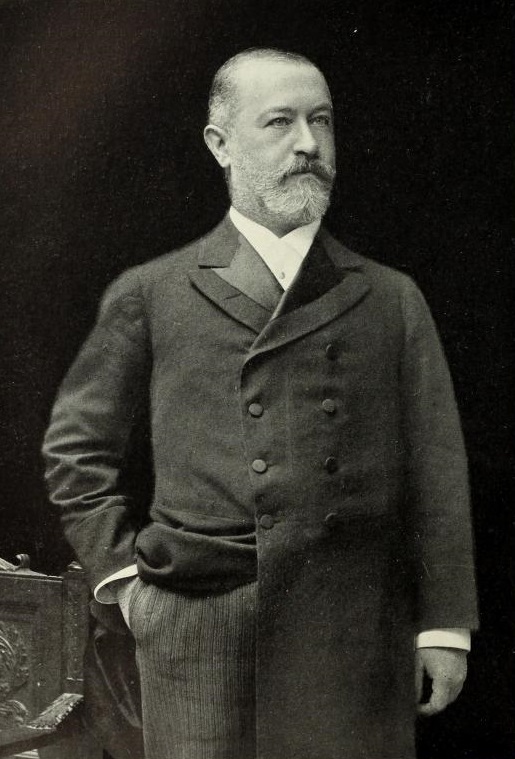
Jacob Schiff with
masonic hidden hand |
- Can you imagine any mother who would allow their child
to put their hand in their pocket in an official portrait?
- They would quickly tell their child to take their hand out
of their pocket and stand up straight.
- Three years after World War I broke out, the Russian
revolution toppled the Czar and installed the scourge of
communism.
- Jacob Schiff (1847-1920) of Kuhn, Loen & Company
had bragged from his death bed that he had spent $20 million
to defeat the Czar.
- $20 million in 1940 has the same buying power as approximately $462.8 million in 2025.
- Money was funneled from England to
support the revolution as well.
- Why would some of the
richest men in the world financially back communism, the
system that was openly vowing to destroy the so-called
capitalism that made them wealthy?
- Communism, or more
accurately, socialism, is not a movement of the downtrodden
masses, but of the economic elite.
|
If one understands that socialism is not a
share-the-wealth program, but in reality a method to
consolidate and control the wealth, then the seeming
paradox of super-rich men promoting socialism becomes
no paradox at all. Instead, it becomes logical, even
the perfect tool of power-seeking megalomaniacs. (Gary
Allen)
|
|
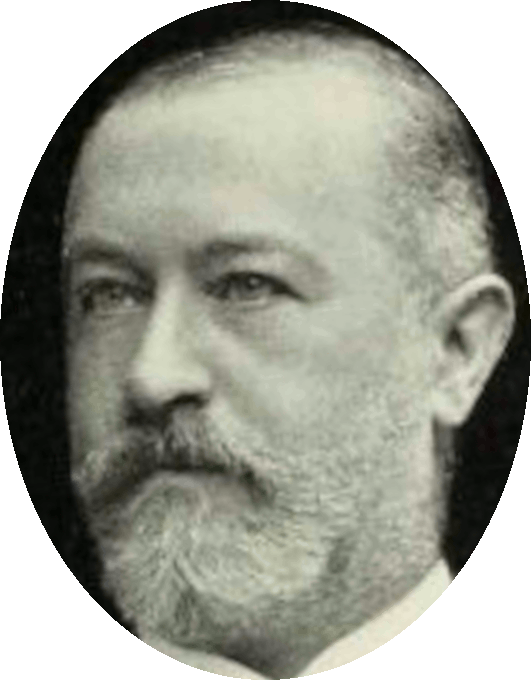
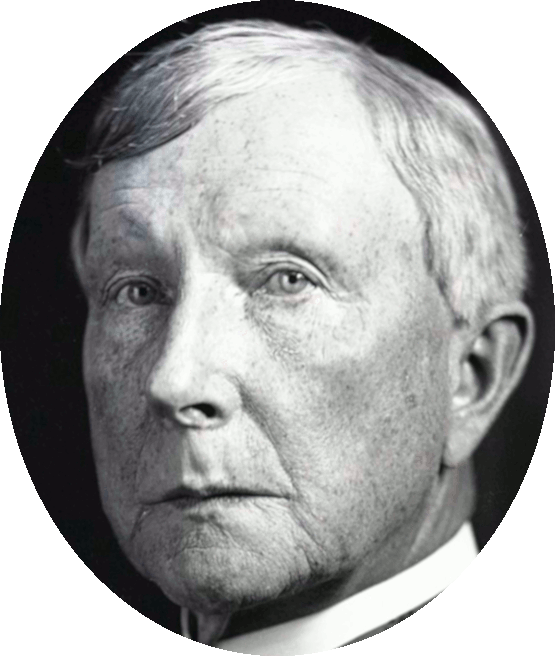
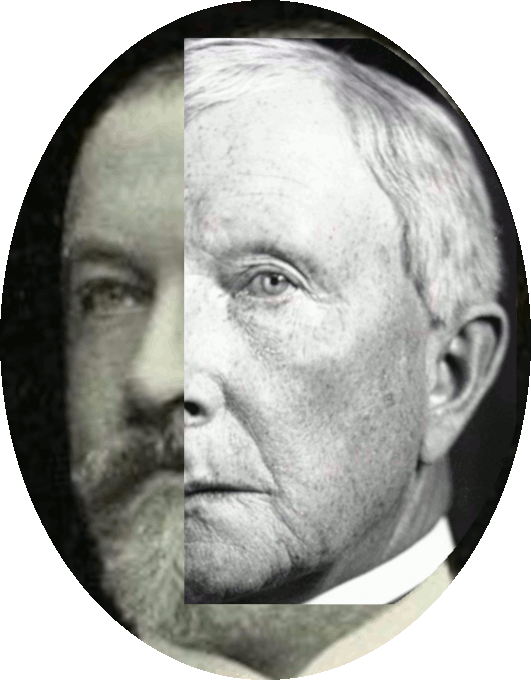
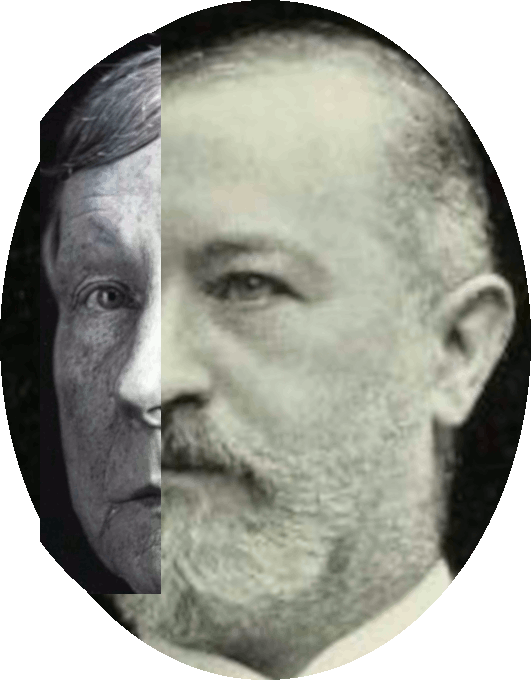
Jacob Schiff as John D. Rockefeller |
 |
 |
Jacob Henry Schiff
(ne Jakob Heinrich Schiff)
1847-1920
1/10 9/25 |
John Davison Rockefeller
1839-1937
7/8
5/23 |
 |
 |
|
Megalomaniac |
- Jacob Schiff was German-born American banker, businessman, and
'philanthropist.'
- His family shared a home called the
'Green Shield' with the Rothschild family in Frankfurt.
- He helped finance the expansion of American railroads and the Japanese military efforts against Tsarist Russia in the Russo-Japanese War.
|
Power from any source tends to create an appetite
for additional power. It was almost inevitable that
the super-rich would one day aspire to control not
only their own wealth, but the wealth of the whole
world. To achieve this, they were perfectly willing to
feed the ambitions of the power-hungry political
conspirators who were committed to the overthrow of
all existing governments and the establishments of a
central world-wide dictatorship. (W. Cleon
Skousen)
|
Barrel of a gun |
- What if these revolutionaries get out of control and try
to seize power from the super-rich, after all, it was Mao
Zedong who in 1938 stated, 'political power comes out of the
barrel of a gun.'
- The Wall Street London Axis elected to
take the risk and the master planners attempted to control
revolutionary communist by feeding them vast quantities of
money when they obeyed, and contracting their money supply or
even financing their opposition if they got out of control.
.jpg)
Public domain, via
Wikimedia Commons
Vladimir Lenin |
- Vladimir Lenin (1870-1924) began to understand that
although he was the absolute dictator of the Soviet Union, he
was not pulling the financial strings.
- Someone else was
silently in control.
|
The state does not function as we desired. The car
does not obey. A man is at the wheel and seems to lead
it, but the car does not drive in the desired
direction. It moves as another force wishes. (Vladimir
Lenin)
|
'Elite' banker pigs
and thieves |
- Who was behind it? Representative Louis T. McFadden
explained it this way, 'The course of the Russian history has
been greatly affected by the operations of the international
bankers and the Soviet government has been given U.S. Treasury
funds by the Federal Reserve Board, acting through the Chase
Bank.'
- Can you believe the demons who run these central
banks and steal from the entire world have the nerve
to call McFadden anti-semitic, it's pure hypocrisy.
- In
other words, these demonic creeps think they can tell everyone
to sit down and shut up while they RAPE everything but that is
not happening, they will reap what they have sown.
Corrupt and
dishonest 'elite'
asses |
- England had also drawn money through the Federal Reserve
banks and re-lent it at high rates of interest to the Soviet
government.
- The Dnieprostroy Dam was built with funds
unlawfully stolen from the U.S. Treasury by the corrupt and
dishonest Jewish Federal Reserve Board and banks, thieves.
- In other words, the Fed and the Bank of England at the
behest of the international banking thieves who controlled
them, were creating a monster.
- One that would fuel 7
decades of unprecedented communist revolution, warfare, and
most importantly, debt.
|
The Russians have proved now by their destruction of the great dam at Dniepropetrovsk that they mean truly to scorch the earth before Hitler even if it means the destruction of their most precious possessions ... Dnieprostroy was an object almost of worship to the Soviet people. Its destruction demonstrates a will to resist which surpasses anything we had imagined. (Wikipedia)
|
'Elite' banking
thieves |
- In case you think there's some chance the money changers
got communism going and lost control, in 1992, the Washington
Times reported that 'Russian President Boris Yeltsin was upset
that most of the incoming foreign aid was being siphoned off,
straight back into the coffers of Western banks in debt
service.'
- No one in their right mind would claim that a
war as large as World War I had a single cause.
'Elite' banking
thieves getting what
is due |
- Wars are complex with many causative factors.
- But
on the other hand, it would also be equally foolish to ignore
as a prime cause of World War I, those who would profit the
most from the war.
- The role of the demonic money changers
and thieves is no wild conspiracy theory.
- They have a
motive, a short-ranged self-serving motive (extreme greed) as
well as a long-range political motive of advancing
totalitarian governments.
- With the money changers
maintaining the financial clout to control whatever politician
might emerge as the leader.

'Elite' money
grifters |
- The money changers ultimate political goal for the world
was the Great Depression.
- Shortly after World War I, the
overall political agenda of the money changers began to be
clear.
- Now that they controlled national economies
individually, the next step was the ultimate form of
consolidation, world government.
- The new world government
proposal was given top priority at the Paris Peace Conference
after the war.
- It was called the League of Nations a
group of elite grifters.
- But much to the surprise of
chief grifters, Paul Warburg and Bernard Baruch, who attended
the conference with President Wilson, the world was not ready
to dissolve world boundaries, nor will it ever be, especially
so these thieves who believe that because they're so 'elite'
they're allowed to steal everything.
|
The League of Nations was the first global intergovernmental organization, founded after World War I (1920) to ensure world peace and promote cooperation, but it ultimately failed to prevent World War II and was replaced by the United Nations (UN) in 1946, inheriting many of its agencies. Proposed by U.S. President Woodrow Wilson, its headquarters were in Geneva, Switzerland, but the U.S. never joined, weakening its authority. (Assistant)
|
Nationalism beats
strong |
- Nationalism still beats strong in the human breast.
-
For example, Lord Curzon, the British foreign secretary called
the League of Nations, 'a good joke,' even though it was the
stated policy of the Jews in the British government to support
it.
- To the humiliation of President Wilson, Congress wouldn't
ratify the League of Nations nonsense either.
- Despite the
fact it had supposedly been ratified by many other nations, we
see how that works too, lies.
- Without money flowing from
the U.S. Treasury, the League died.
- After World War I,
the American public had grown more than tired of the
internationalist grifters trying to bully everyone and steal
from them.
- They were also tired of the policies of
Democrat Woodrow Wilson who was in bed with them.
.jpg)
Harris & Ewing, photographer, Public domain, via Wikimedia Commons
Warren G. Harding
with masonic hand
sign |
- In the presidential election of 1920, Republican Warren
Harding (1865-1923), won a landslide victory with over 60% of
the vote.
- However, like all these politicians, the signs
are not good and if you noticed, it was the Republicans who
were in bed with the international money changers, they just
dragged Woodrow Wilson along because of his ignorance.
-
Truth is, we can not trust either side.
- Harding was an ardent foe of both
Bolshevism and the League of Nations nonsense.
- Rooted in Marxist theory, Bolshevism emphasized a disciplined, centralized party to guide workers and peasants toward a classless society, rejecting private property, religion, and nationalism for internationalism.
|
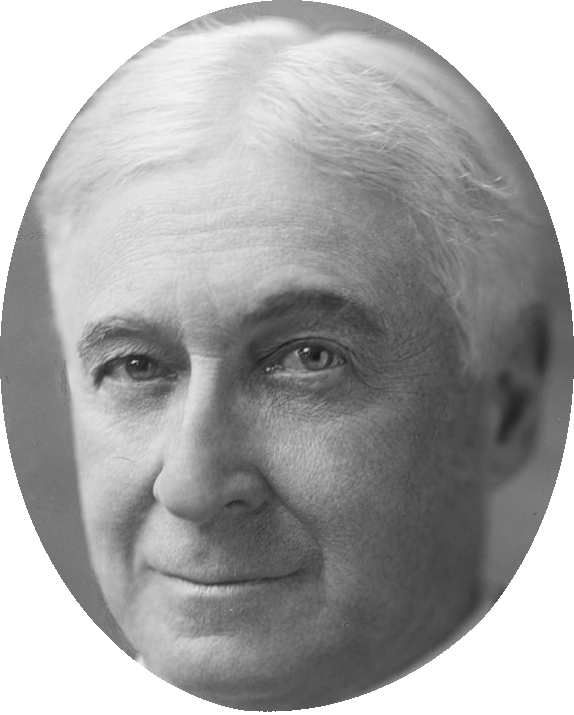
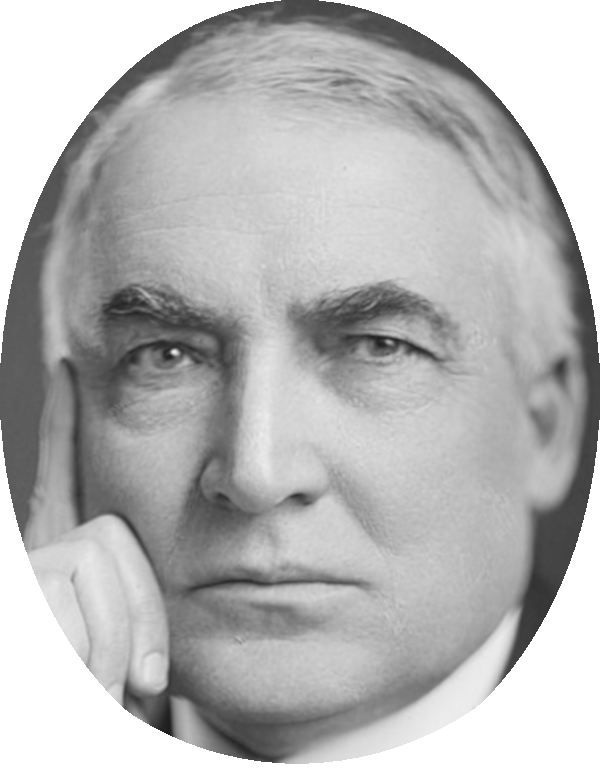
Bernard Baruch as Warren G. Harding |
 |
 |
Bernard Mannes Baruch
1870-1965
8/18
6/20
Wall Street financier |
Warren Gamaliel Harding
1865-1923
11/2
8/2
29th president |
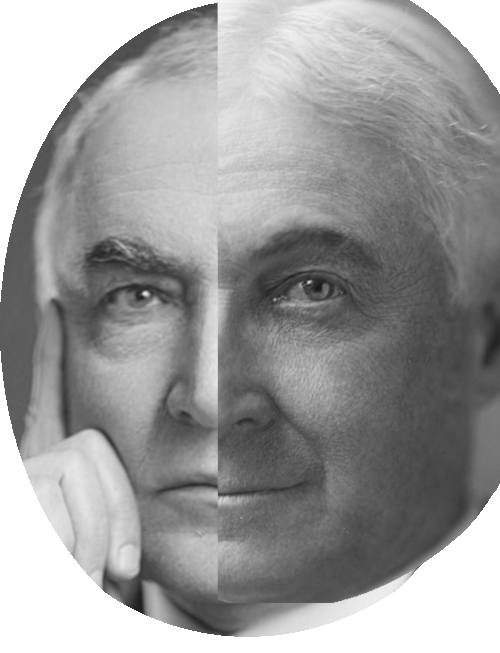 |
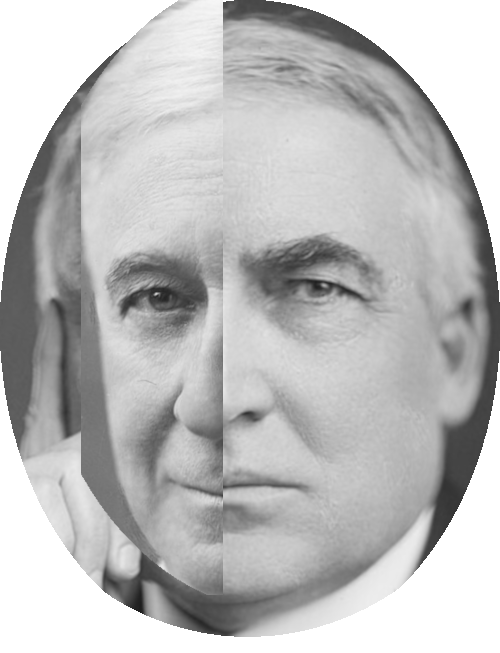 |
|
Ohio gang nepotism |
- Harding appointed friends and acquaintances to federal positions.
- Some proved ineffective in office, such as Daniel R. Crissinger, a Marion lawyer whom Harding made Comptroller of the Currency and later a governor of the
Federal Reserve Board.
- The Veterans' Bureau scandal was known to Harding in January 1923 but, according to
President Wilson, 'the president's handling of it did him little credit.'
- Harding allowed the corrupt director of the bureau, Charles
R. Forbes, to flee to Europe, though he later returned and
served prison time, or so they say.
- Still others of these associates proved corrupt and were later dubbed the
'Ohio Gang.'
|
The Teapot Dome Scandal was a major 1920s U.S. political corruption case where Interior Secretary Albert B. Fall secretly leased naval oil reserves in Teapot Dome, Wyoming, and California to private oil companies (like Sinclair and Doheny) for bribes, bypassing competitive bidding. This led to Senate investigations, Fall's conviction (making him the first cabinet member jailed for crimes in office), and significant damage to the Harding administration, highlighting vast corruption and influencing future congressional oversight. (Assistant)
|
Scandal |
- Harding's
election which began a 12-year run of Republican presidents in
the White House, led to an unprecedented era of prosperity
known as the Roaring 20s.
- Despite the fact that the war
had brought America a debt 10 times larger than its Civil War
debt, still the economy surged.
- Gold had poured into the
country during the war and it continued to do so afterwards.
- Harding was one of the most popular presidents at the time of his death,
however after he died, a number of scandals were exposed that greatly damaged his reputation.
|
Bolshevism is the radical communist ideology and movement led by Vladimir Lenin, advocating for the violent overthrow of capitalism through a vanguard party, seizing power (the "dictatorship of the proletariat"), and establishing a socialist state based on collective ownership, as seen in Russia's October Revolution (1917). Its policies included nationalizing industries, abolishing private land, and worker control, forming the basis for the Soviet Union. (Assistant)
|
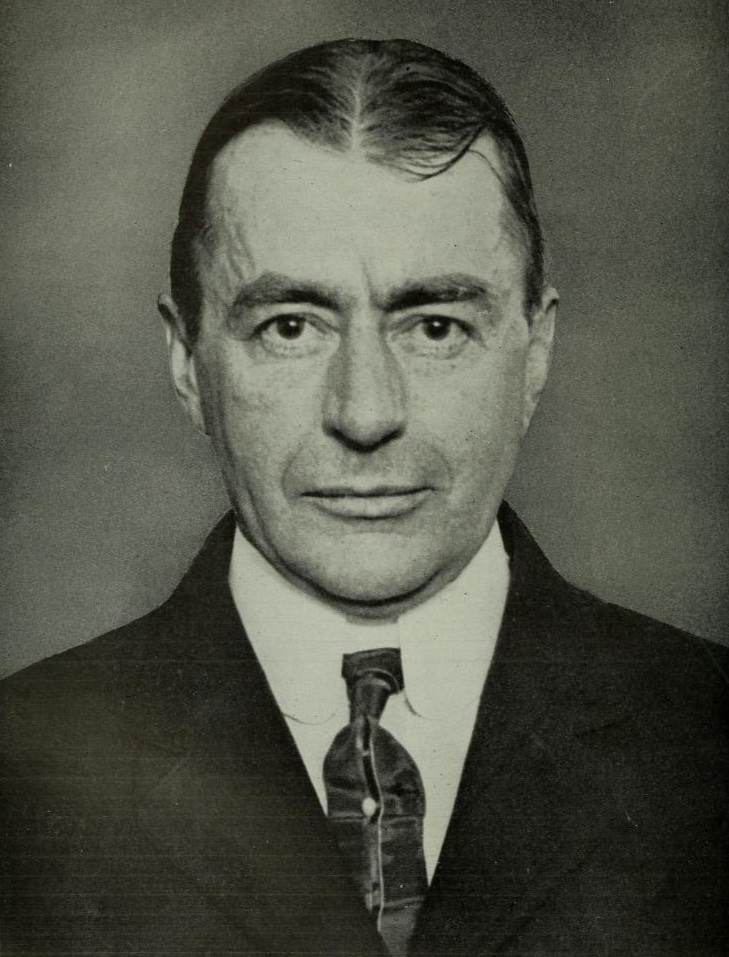
Paul Thompson, Public domain, via Wikimedia Commons
Benjamin Strong
Jr. |
- In the early 1920s, the governor of the Federal Reserve
Bank of New York, Benjamin Strong Jr. (1872-1928), met extensively with the
secretive eccentric governor of the Bank of England, Montigue
Norman.
- Norman was determined to replace the gold that
England had lost to the U.S. in World War I and return the
Bank of England to its former position of dominance in world
finance.
-
Strong served as Governor of the Federal Reserve Bank of New York for 14 years until his death.
- He exerted great influence over the policy and actions of the entire Federal Reserve System and indeed over the financial policies of all of the United States and Europe.
|
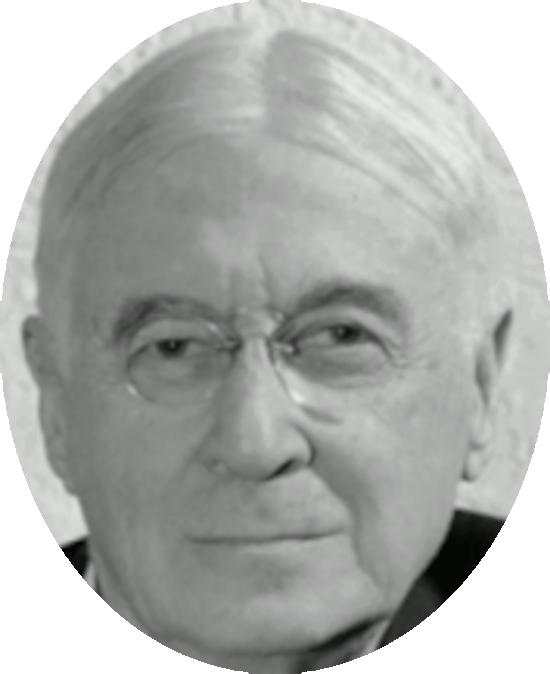
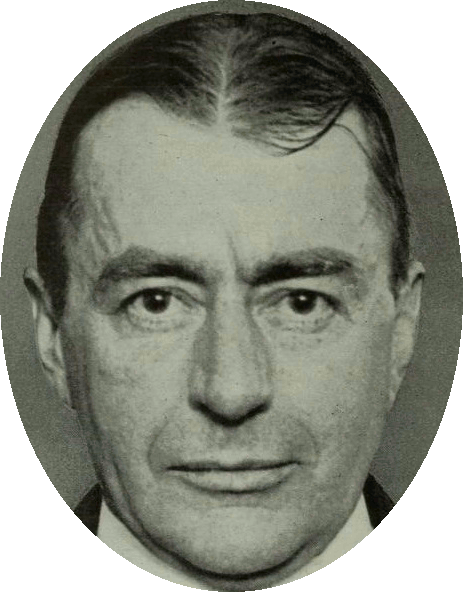
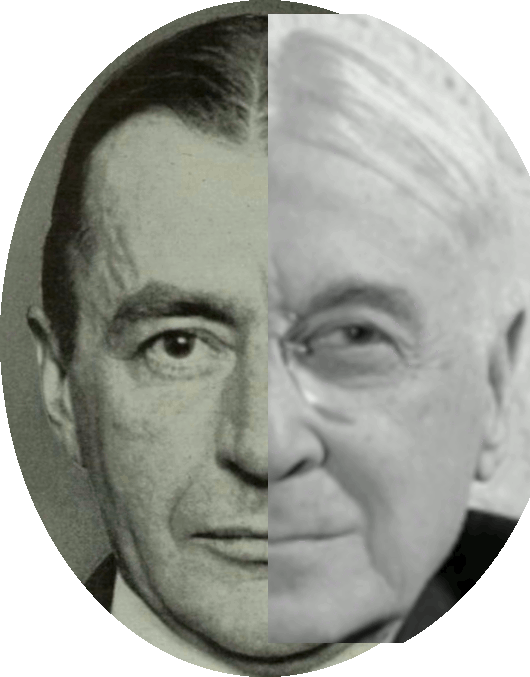
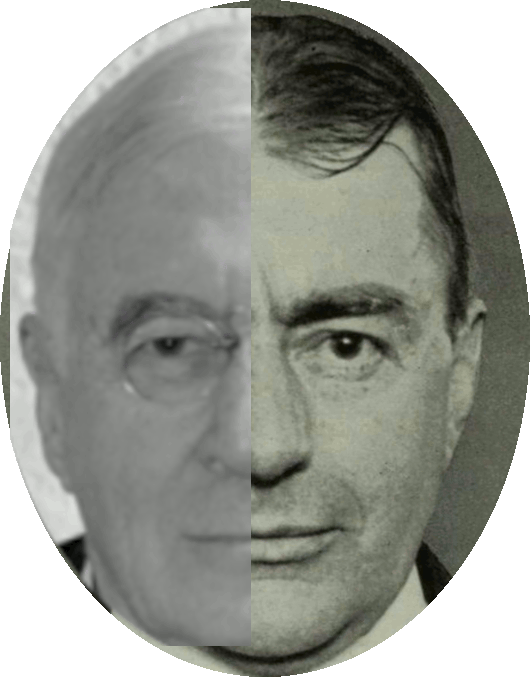
Bernard Baruch as Benjamin Strong Jr. |
 |
 |
Bernard Mannes Baruch
1870-1965
8/18
6/20
Wall Street financier |
Benjamin Strong Jr.
1872-1928
12/22
10/16
Federal Reserve Governor |
 |
 |
|
Strongmen |
- At the time, the American economy, rich with gold, might
get out of control again, just like it had done after the
Civil War.
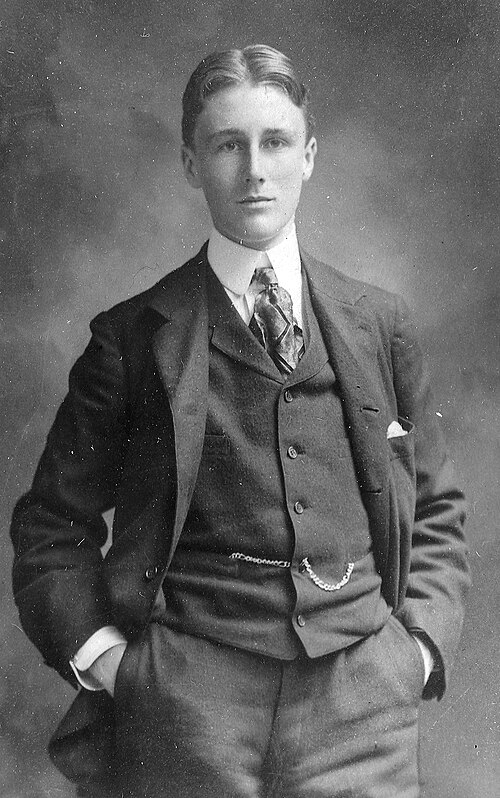
Franklin D. Roosevelt Library, Public domain, via Wikimedia Commons
Franklin Delano
Roosevelt at age 18 |
- During the presidential election of 1920, Warren
Harding and Calvin Coolidge ran against James Cox, the governor
of Ohio, and the little known Franklin D. Roosevelt (1882-1945)
who had been Woodrow Wilson's assistant Secretary of the Navy.
-
After his inauguration, Harding worked quickly to kill the
League of Nations.
- Harding moved quickly to remove
domestic taxes and raise tariffs to record heights and this
was a revenue policy in which most of the Founding Fathers
would certainly have approved.
- On his 2nd year in office
Harding took ill on a train trip in the West and suddenly
died, although no autopsy was performed, the cause was said to
be either pneumonia or food poisoning.
.jpeg)
Harris & Ewing, Public domain, via Wikimedia Commons
John Calvin Coolidge Jr. |
- During the next 8 years, under the presidencies of
Warren G. Harding and Calvin Coolidge (1872-1933), the huge
federal debt built up during World War I was cut 38%, down to
$16 billion which was the greatest percentage drop in U.S.
history.
- $16 billion in 1925 has the equivalent purchasing power of approximately $296.2 billion in 2025.
Homefront |
- When Calvin Coolidge took over he continued Harding's
domestic economic policy of high tariffs on imports while
cutting income taxes.
- As a result, the economy grew at
such a rate that net revenue still increased, and of course,
that had to be stopped.
- Just as they had done so many
times before, the money changers decided it was time to crash
the American economy.
- The Federal Reserve began flooding
the country with money and they increased the money supply by
62% during these years and money was plentiful.
- This is
why it was known as the Roaring 20s.
Leading men |
- Meanwhile, there was much talk going around how these
international bankers practically controlled both political
parties and wrote political platforms.
- And how they used
the leading men of private organizations and resorted to every
device to place nomination for high public office only
to candidates that would be amenable to the dictates of
corrupt big business.
- But you have to wonder why didn't
people listen to such strong warnings and demand that Congress
reverse its 1913 passage of the Federal Reserve Act?
- You
also have to wonder why no one in government ever did anything
about it, they just complained, or perhaps it was all a
smokescreen.
Prosperity |
- It was the 1920s and a steady increase in bank loans
contributed to a rising market, just as it is today, in times
of prosperity, no one wants to worry about economic issues.
- There was a dark side to all this prosperity, businesses
expanded and became strung out on credit.
- Speculation in
the booming stock market became rampant and although
everything looked rosy, it was a castle made of sand.
-
When all was in readiness in April 1929, Paul Warburg, the
'father' of the Federal Reserve, sent out a secret advisory
warning his friends that a collapse and nationwide depression
was certain.
Economic issues |
- In August 1929, the Fed began to tighten money.
- It
is not a coincidence that the biographies of all the Wall
Street giants of that era; John D. Rockefeller, J.P. Morgan
and Bernard Baruch all marvel that they got out of the stock
market just before the crash and put all their assets in cash
or gold.
- On October 24, 1929, the big New York bankers
called in their 24-hour broker call loans.
- This meant
that both stock brokers and customers had to dump their stocks
on the market to cover their loans no matter what price they
had to sell them for.
- As a result, the market tumbled and
that day was known as Black Friday, or the Wall
Street crash of 1929.
- Notice today, they have used that
name to reel in holiday shoppers who are made to believe
they're getting a 'deal.'
- Much like FDRs 'New Deal' was
just another smokescreen that enabled the money changers to
steal even more from us.
- And of course whoever authored
Google AI wants you to believe it was all good.
|
The New Deal was President Franklin D. Roosevelt's (FDR) expansive series of programs and reforms from 1933-1938, designed to combat the Great Depression through Relief, Recovery, and Reform, fundamentally reshaping the U.S. government's role by creating jobs (CCC, WPA), stabilizing the economy (FDIC, banking reforms), and establishing social safety nets (Social Security Act), leaving a lasting legacy on American life and governance. (Assistant)
|
Stock Exchange |
- At the height of the selling frenzy, Bernard Buruch
brought Winston Churchill into the visitors gallery of the New
York Stock Exchange to witness the panic and impress him with
his power over the wild events down on the floor.
-
Congressman Lewis T. McFadden blamed both the Fed and the
international bankers for orchestrating the crash.
- It was
not accidental, it was a carefully contrived occurrence.
-
The international bankers sought to bring about a condition of
despair here, so that they might emerge as rulers of us all.
- But McFadden went event farther, he openly accused them of
causing a crash in order to steal America's gold.
- In
February 1931, in the midst of the depression McFadden wrote that it
can hardly be disputed that the statesman and financiers of
Europe are ready to take almost any means to reacquire rapidly
the gold stock which Europe lost to America as the result of
World War I.
Stock Exchange
torched |
- A broker named Curtis Dall who worked for Lehman
Brothers was on the floor of the Stock Exchange that day, and
in 1970 he wrote that the crash was triggered by the planned
sudden shortage of call money in the New York Money Market.
- Actually, it was the calculated 'shearing' of the public by
the world-money powers triggered by planned sudden shortage of
call money.
- Within a few weeks, $3 billion of wealth
simply seemed to vanish and by the next year, $40 billion had
been lost.
- $40 billion in 1929 has the purchasing power
of roughly $758 billion to over $760 billion in 2025.
- But did it really disappear, or was it simply
consolidated in fewer hands?
Money changer |
- What did the Federal Reserve do? Instead of moving to
help the economy out by quickly lowering interest rates to
stimulate the economy, the Fed continued to brutally contract
the money supply further, deepening the depression.
- By
1929 the Fed reduced the money supply by an additional 33%.
- Although most Americans were never told that the Fed was the
cause of the Great Depression, this is well known among top
economists.
- Milton Friedman, an economist at Stanford
University said the same thing in a National Public Radio
interview in 1996.
- Also, pay attention to the Mansonic
numbers they use everywhere, 33%, 1933, 1996, it's all very
demonic because they're using black magic.
|
The Federal Reserve definitely caused the Great
Depression by contracting the amount of currency in
circulation by one-third from 1929 to 1933. (Milton
Friedman)
|
Masonic gold |
- The money lost by most Americans during the depression
didn't just vanish, it was redistributed into the hands of
those who were forewarned (insider trading) by Bernard Buruch
just before the market crashed.
- Lucky them, they were
able to run out and purchase gold which is always a safe place
to put your money especially during a depression.
-
However, America's money also went overseas, incredibly, as
Herbert Hoover was trying to rescue banks and prop up
businesses, with millions of Americans starving as the
depression deepened, millions of dollars were spent rebuilding
Germany from damage sustained during World War I.
- But I
would question whether any of these presidents were trying to
solve anything because they're all shape shifting demons, for
instance, Donald Trump played Thomas Jefferson and Abe Lincoln
and Elon Musk played Ronald Reagan, it's not crazy, it's the
real thing.
- Fred Trump played Hitler.
- None of these
fallen angel shape shifters ever die.
German bank |
- Eight years before Hitler would invade Poland,
Congressman McFadden once again warned Congress that
American's were paying for Hitler's rise to power.
- The
international German bankers have subsidized the Government of
Germany and they also supplied every dollar of the money
Adolph Hitler used in his lavish campaign to build up a threat
to the government of Brüning.
|
After World War I, Germany fell into the hands of the German international bankers.
They bought her and now they own her lock, stock and barrel and they have purchased her industries and have mortgages on her soil, they control her production, and her public utilities.
(Louis T. McFadden)
|
Adolf Hitler
1889-1945
4/20 4/30
Dictator |
Frederick Christ Trump Sr.
1905-1999
10/11
6/25
Real estates |
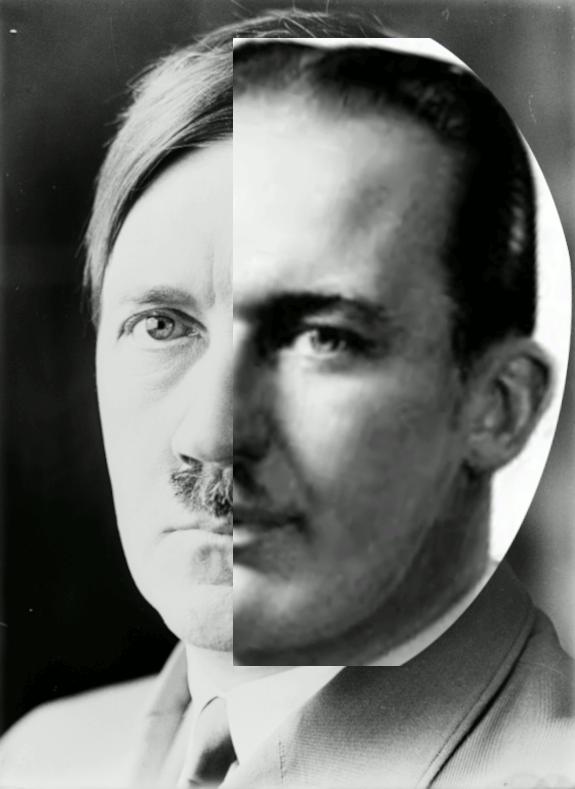 |
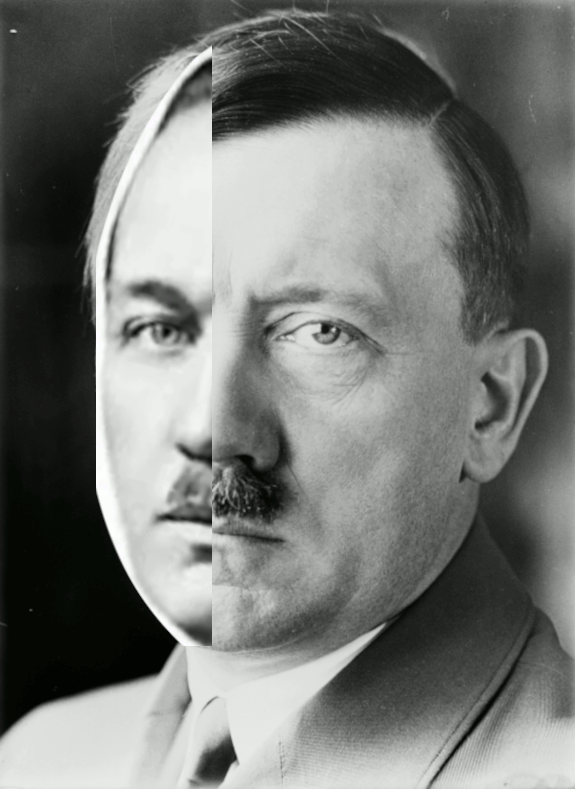 |
|
Nazi |
- When Brüning failed to
obey the orders of the bankers, Hitler brought it force to
scare the Germans into submission.
Adolf Hitler
1889-1945
4/20 4/30
Dictator |
Frederick Christ Trump Sr.
1905-1999
10/11
6/25
Real estates |
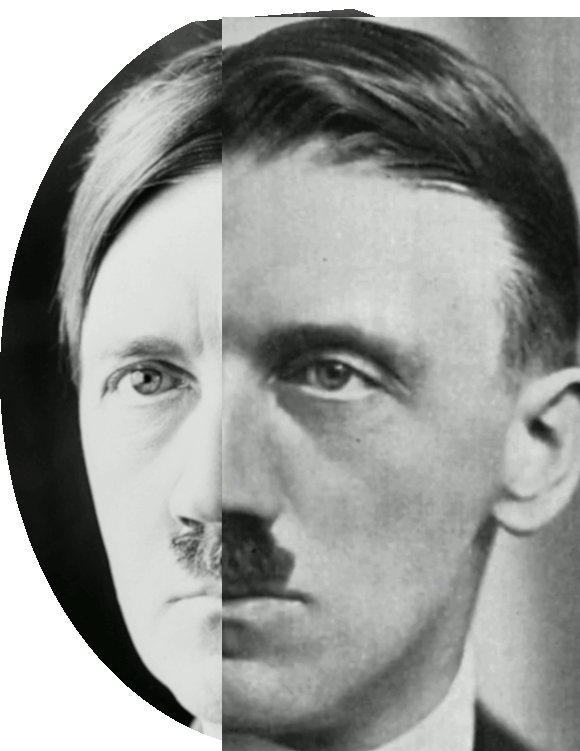 |
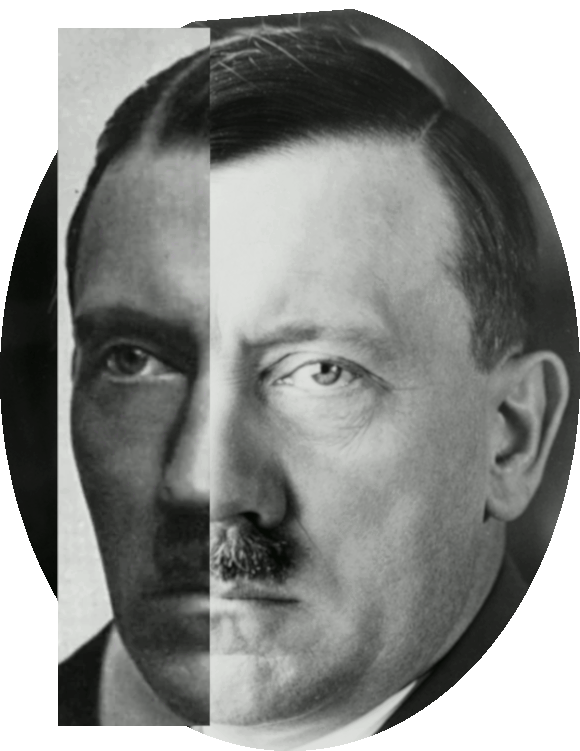 |
Jewish
Nazi's going after Jews to make them martyrs
Trying to blame their heinous crimes on
Americans |
- This German American Fred Trump, Donald’s father, was perfectly comfortable walking around like this in 1950, five years after Nazi Germany fell.
Dunkirk |
- Youtube -
Found the mustache man
- Fittest Flat Earther.
|
Dunkirk has two main meanings: a seaport in northern France and a noun referring to a desperate, last-ditch effort to avoid total defeat. The latter comes from the Dunkirk evacuation in 1940 during World War II, when over 330,000 Allied soldiers were rescued from the beaches under enemy fire. The name "Dunkirk" itself literally means "church in the dunes". (Assistant)
|
.jpg)
Bundesarchiv, Bild 183-1989-0630-504 CC-BY-SA 3.0, CC BY-SA 3.0 DE , via Wikimedia Commons
Heinrich Brüning |
- Heinrich Aloysius Maria Elisabeth Brüning (1885-1970) was a German Center Party politician and academic, who served as the chancellor of Germany during the Weimar Republic from 1930 to 1932.
- A political scientist and Christian social activist, he entered politics in the 1920s and was elected to the Reichstag in 1924.
- In 1930, he was appointed interim chancellor, just as the Great Depression took hold.
- His austerity policies in response were unpopular, with most of the Reichstag opposed, so he governed by emergency decrees issued by President Paul von Hindenburg, overriding the Reichstag.
- This lasted until May 1932, when his land distribution policy offended Hindenburg, who refused to issue any more decrees.
- Brüning resigned in response to the refusal.
- After Hitler took power, Brüning fled Germany in 1934.
Freemason |
- Through the Federal Reserve Board over $30 billion of
American money was pumped into Germany and that paid for all
their war spending which is worth $709.4 billion in 2025.
- They spent a lot for modernistic
dwellings, great planetariums, gymnasiums, swimming pools,
fine public highways, and perfect factories.
- All of this
was accomplished with American money and given to Germany via
this corrupt masonic Federal Reserve Board.
|
The Federal Reserve Board has pumped so many billions
of dollars into Germany that they dare not name the
total.
(Louis T. McFadden)
|
Freemason spending
spree |
- Franklin D. Roosevelt was swept into office during the
1932 presidential election.
- Once Roosevelt was in office,
sweeping emergency banking measures were immediately
announced, which did nothing but increase the Fed's power over
the money supply.
- Then and only then, did the Fed begin
to loosen the purse strings and feed new money out to the
starving American people.
- At first FDR railed against the
money changers as being the cause of the depression.
-
However, that is what he said on his March 4, 1933, inaugural
address.
- But just 2 days later FDR declared a bank
holiday and closed all banks.
|
Practices of the unscrupulous money changers stand
indicted in the court of public opinion, rejected by
the hearts and minds of men... The money changers have
fled from their high seats in the temple of our
civilization. (Franklin D. Roosevelt)
|
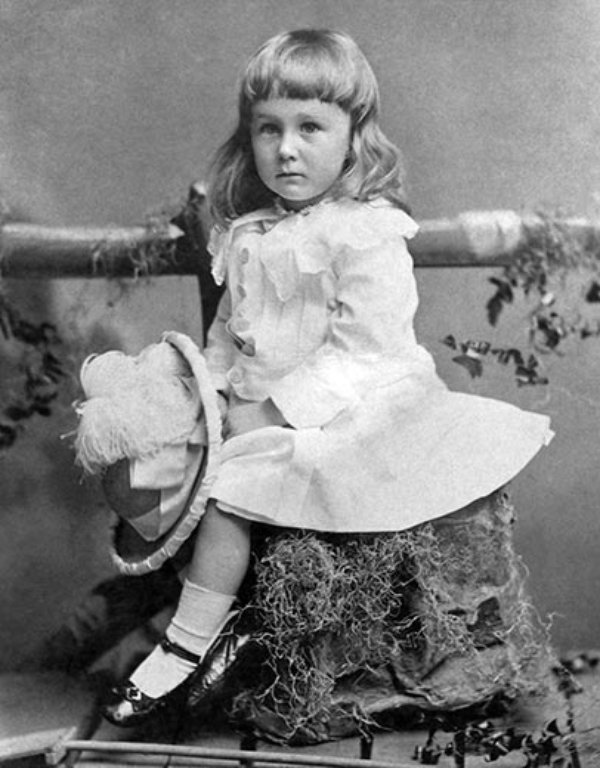
Public domain, via Wikimedia Commons
Franklin Delano
Roosevelt 1884 |
- Lord Rothschild visited the White House to meet President
Franklin Roosevelt in 1939, indicating a relationship between the powerful families, but this was a courtesy call, not a family reunion.
- Rothschild also visited Hitler (Fred Trump) as well when
he was here.
|
Franklin D. Roosevelt (FDR) was not directly related by blood or marriage to the prominent Rothschild banking family; however, the Rothschilds, through their American representative August Belmont Jr., were involved in New York finance while FDR was in politics, and Lord Rothschild later visited FDR, showing a professional/social connection, not kinship. (Assistant)
|
|
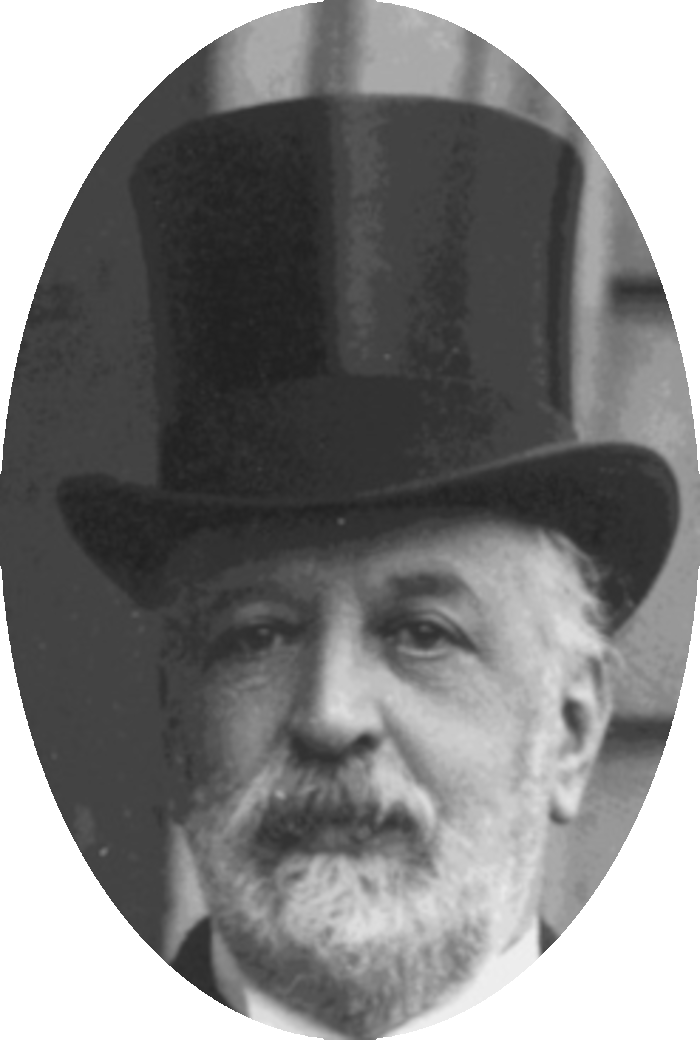
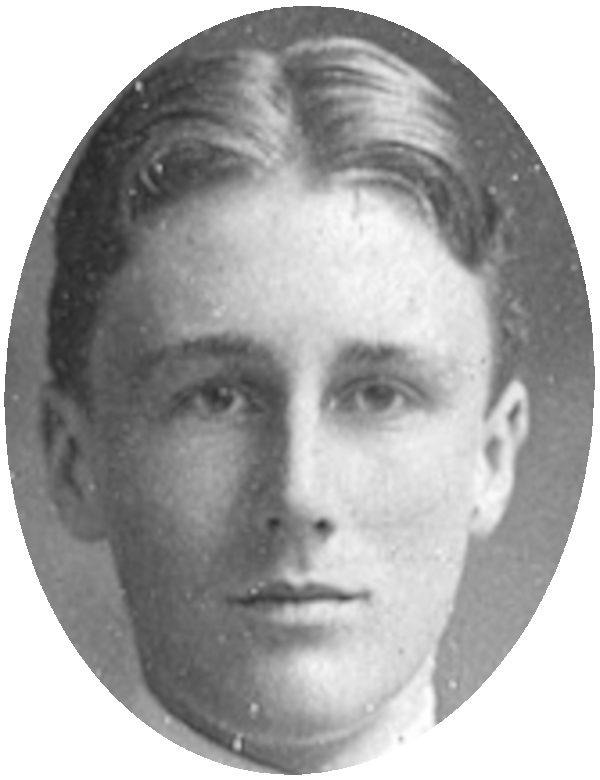
Natty Rothschild as Franklin D. Roosevelt |
 |
 |
Nathaniel Mayer ('Natty')
1st Lord
Rothschild
1840-1915
11/8
3/31
Banker |
Franklin Delano Roosevelt
1882-1945
1/30
4/12
32nd president |
 |
 |
|
3 terms |
- Franklin Roosevelt was not 'directly' related to
the Rothschilds but he was joined at the hip.
- He was
indirectly related though.
- The Rothschilds had significant financial interests in the U.S., with their agent, August Belmont Jr., involved in NYC infrastructure (like the subway) as FDR rose in NY politics, suggesting business interaction.
Corrupt banking law |
- Later in 1933, FDR outlawed private ownership of all
gold bullion and gold coins with the exception rare coins.
- Most of the gold in the hands of the average American was in
the form of gold coins.
- The new decree was in effect, a
confiscation.
- Those who didn't comply, risked as much as
10 years in prison and a $10,000 fine, the equivalent of
$250,000 today.
- Out in small town America, some people
didn't trust Roosevelt's order.
- Many were torn between
keeping their hard-earned wealth or obeying the government.
- Those who did turn in their gold were paid the official
price for it, $20.66 per ounce.
Unpopular law |
- So unpopular was the confiscation order that no one
anywhere in government would take credit for authoring it.
- No congressmen claimed it and at the signing ceremony, FDR
made it clear to all present that he was not the author of it
and publicly stated that he had not ever read it!!!
- Even
his Secretary of Treasury claimed he'd never read it either!!!
- He claimed it was what the 'experts' wanted.
- FDR
convinced the public to give up their gold by saying that
pooling the nation's resources was necessary to get America
out of the depression.
- And if you believe that, we have
some swamp land to sell you.
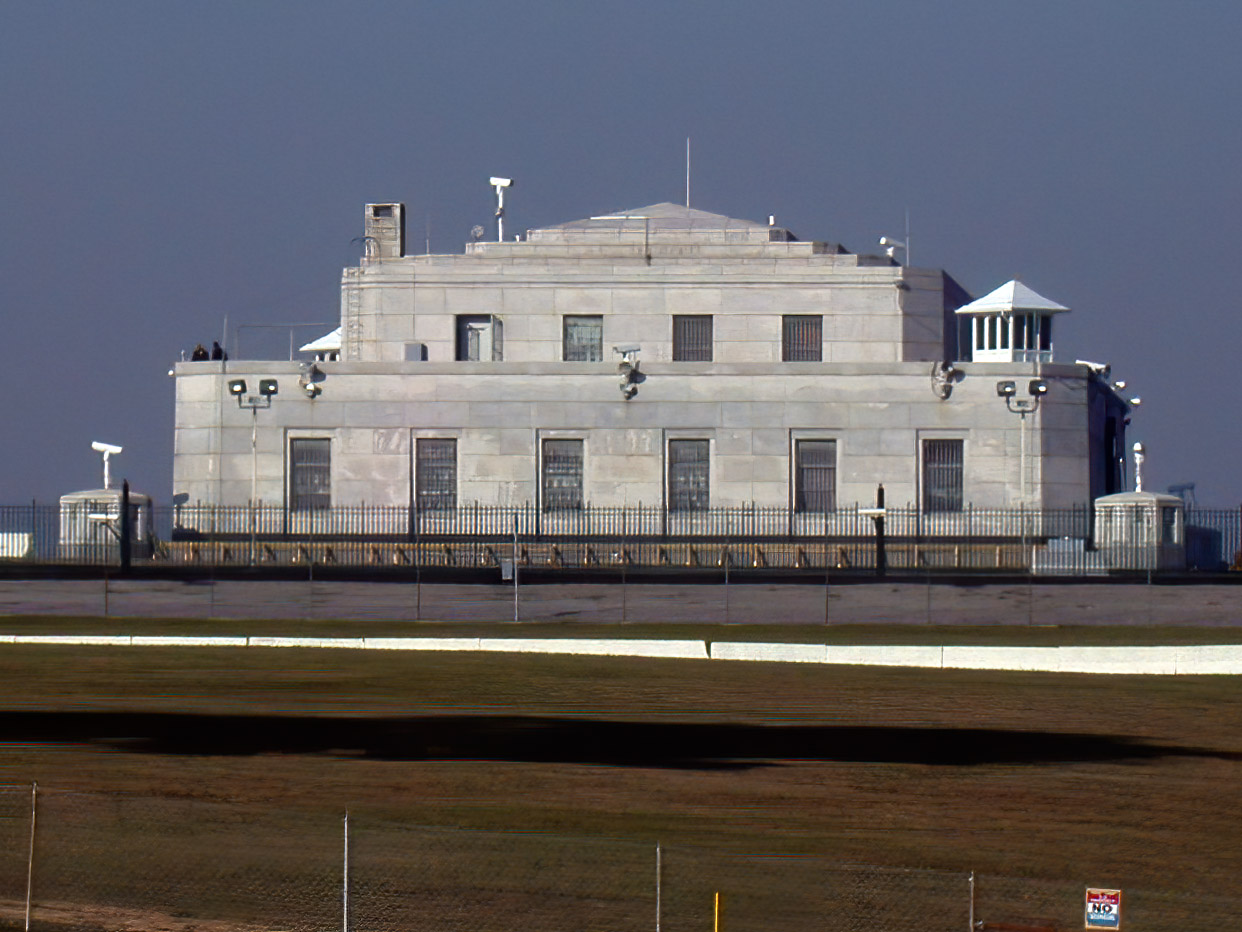
Original author=Cliff, CC BY-SA 4.0 , via Wikimedia Commons
U.S. Gold
Bullion Depository |
- With great fanfare, FDR ordered a new bullion
depository, built to hold the mountain of gold the U.S.
government had illegally confiscated.
- The ripoff of the
ages was about to proceed.
- In 1935, once the gold had all
been turned in, the official price was suddenly raised to $35
per ounce, but the catch was, only foreigners could sell their
gold at the new higher price.
- The money changers who had
heeded Paul Warburg's insider trading note and gotten out of
the stock market and bought gold at $20.66 per ounce and then
shipped it to London, could now bring it back and sell it to
the U.S. government.
- They were able to nearly double
their money while the average American starved.
- By 1936, the U.S. Gold Bullion Depository at was
completed and in January 1937, the gold began to flow into it.
- The Depository sits in the middle of the Fort Knox military
reservation, 30 miles southwest of Louisville, Kentucky.
-
A faraway view from was as close as the journalist was permitted
to get to the depository, despite years of letters to Congress
asking for permission to allow the film crew inside.
- The
4-acre grounds immediately surrounding the building are
guarded by an electrified steel fence.
- The structure is
surrounded by an open moat and equipped with 4
machine gun armed guard pill boxes at each corner.
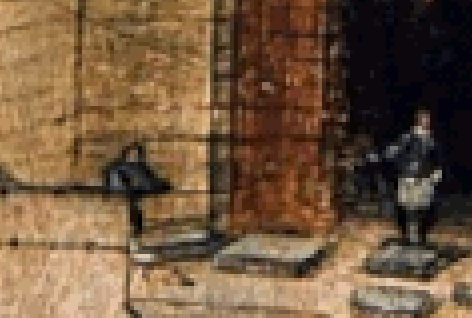
Masonic bullion
depository |
- When the gold began arriving at the depository on
January 13, 1937, there was unprecedented security.
-
Thousands of official guests watched the arrival of a 9-car
railroad train from Philadelphia, guarded by armed soldiers,
postal inspectors, Secret Servicemen and guards from the U.S.
Mint.
- It was all great theater, America's gold supply
from across the land had been pulled, supposedly for the
public benefit, and then safely tucked into Fort Knox.
-
However, all that security would soon be breached by the
government itself.
- Now the stage was set for a really big
war, one which would pile up debt far beyond World War I.
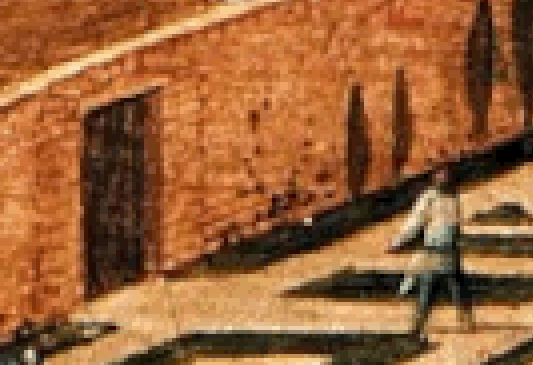
World War II |
- In 1944 alone, the U.S. national income was $183
billion, yet $103 billion alone was spent on World War II.
- $183 billion in 1944 has the same buying power as approximately $3.37 Trillion today
in late 2025.
- This was 30 times the spending rate during World War I.
-
In fact, the American taxpayer picked up 55% of the total
Allied cost of the war.
- But equally important, virtually
every nation involved in World War II greatly multiplied their
debt.
- In the U.S. for example, federal debt rose from $43
billion in 1940, up to $257 billion in 1950, an increase of
598%.
- Between 1940 and 1950, Japanese debt swelled 1,348%
and French debt grew 583%, while Canadian debt swelled 417%.
-
After the war, the world was now divided into 2 economic
camps, communist economies on the one hand, versus monopoly
capitalists on the other.
- They were set to fight it out
in one perpetual and highly profitable arms race.
|
The major Allied powers in World War II were the United Kingdom, the United States, the Soviet Union, and China, often called the "Big Four," who fought against the Axis powers (Germany, Italy, Japan). (Assistant)
|
Monopoly
capitalists |
- It was finally time for the central bankers to embark on
their 3-step plan to centralize the economic systems of the
entire world and finally bring about their 'global' government
or New World Order.
- The phases of this plan were; Step
one, central bank domination of national economies worldwide.
- Step
two, centralize regional economies through organizations such
as the European Monetary Union and regional trade unions such
as NAFTA.
- Step three, centralize the world economy
through a world central bank, a world currency, and ending
national independence through abolition of all tariffs by
treaties like GATT.
- The first step was completed long ago
and the next two steps are far advanced, nearing completion.
|
The General Agreement on Tariffs and Trade (GATT) was a 1947 treaty creating rules for free trade, aiming to lower tariffs and barriers to boost post-WWII recovery, functioning as an organization through negotiation rounds (like the Uruguay Round) that reduced barriers and resolved disputes. Its main principles were non-discrimination (Most Favored Nation, National Treatment) and gradual tariff reduction, ultimately evolving into the World Trade Organization (WTO) in 1995, which institutionalized these rules with more comprehensive commitments. (Assistant)
|
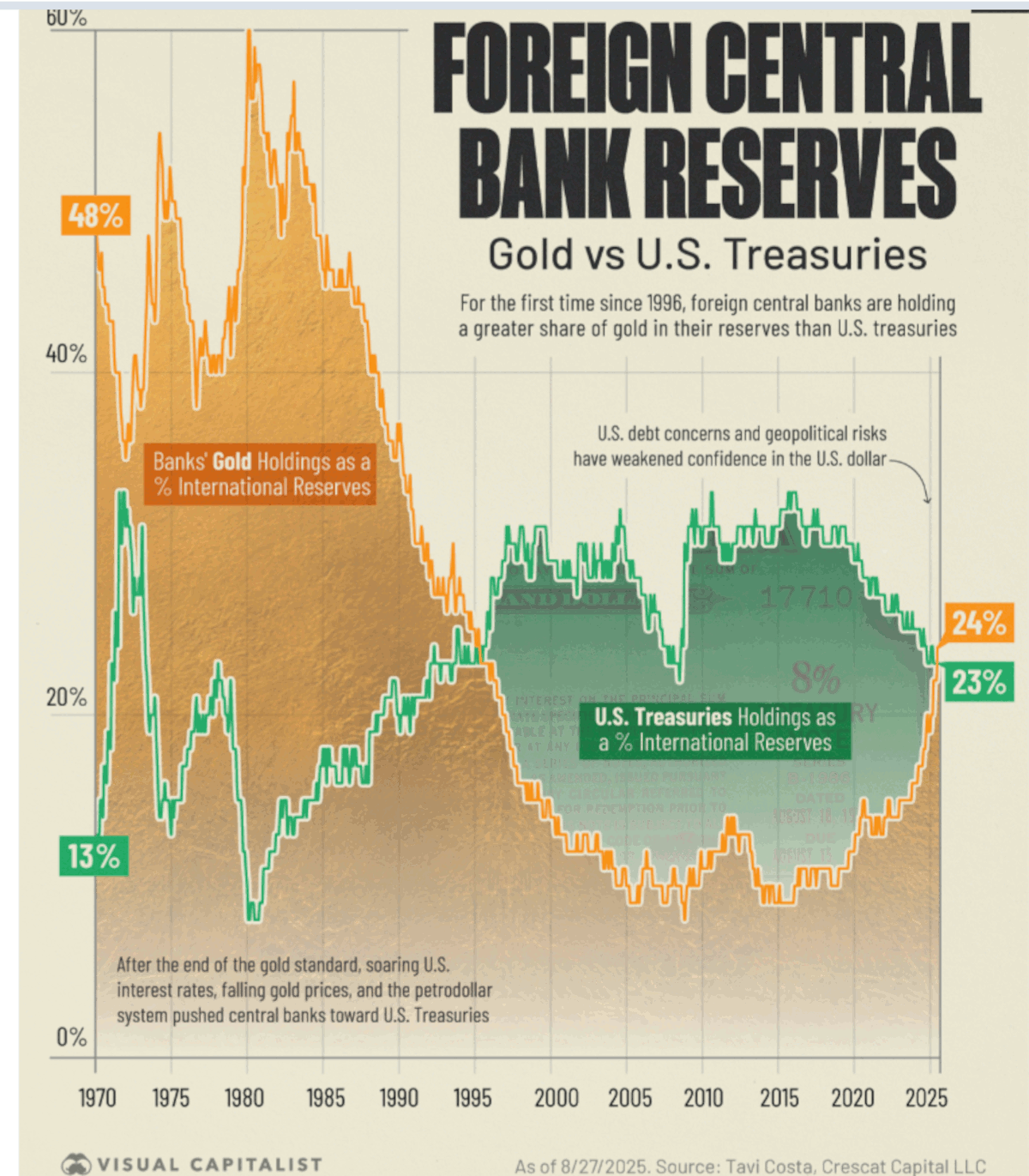
Central Banks Now Hold More Gold Than U.S. Treasuries |
- What about gold? Among central banks, the largest holder
of gold is now the IMF.
- The IMF and central banks now
control two-thirds of the world's gold supply, giving them the
ability to manipulate the gold market.
- Central banks had crossed a symbolic line: their combined gold reserves now exceeded their U.S. Treasury holdings for the first time in nearly three decades
by 1980.
- Remember the money changers golden rule, 'He who has the
gold makes the rules.'
|
The International Monetary Fund (IMF) is a global organization of 191 member countries that promotes monetary cooperation, financial stability, international trade, high employment, and sustainable economic growth, working to reduce poverty worldwide by providing economic surveillance, policy advice, and temporary financial assistance to countries facing balance of payments issues, acting as a lender of last resort. (Assistant)
|
More masonic
capitalists |
- Before we get into solutions to our problem, let's
examine what happened to all that gold in Fort Knox.
-
Because if we don't understand that the gold has been stolen,
we'll allow ourselves to be herded into the wrong solution, a
gold backed currency.
- Most Americans still believe that
the gold is still at Fort Knox.
- At the end of World War
II, Fort Knox contained over 700 million ounces of gold, an
incredible 70% of all the gold in the world.
- How much
remains? No one knows despite the fact that federal law
requires an annual physical audit of Fort Knox gold, the
treasury has consistently refused to conduct one.
- The
truth is, a reliable audit of however much gold remains there
has not been conducted since President Eisenhower ordered one
in 1953 when the last full, physical audit where gold was
counted, weighed, and tested.
|
The last comprehensive audit of Fort Knox's gold was in 1953, with the most recent notable inspection by a congressional group and press happening in 1974, but no independent, full audit has occurred in decades, leading to ongoing calls for transparency, notes. While the U.S. Mint conducts internal reviews, the lack of modern, independent verification fuels public skepticism and speculation about the gold's presence and condition. (Bullion
Exchanges)
|
Last count |
- Where did America's gold at Fort Knox go?
- Over the
years, it was sold off to European money changers at the $35
per ounce price.
- Remember, this was during the time when
it was still illegal for Americans to buy any of their own
gold from Fort Knox.
- In fact, there was a very infamous
case where the Firestone family set up a string of dummy
corporations to purchase Fort Knox gold and keep it in
Switzerland, never reaching U.S. shores.
- They were
eventually caught and never prosecuted.
- In essence, it was a high-profile case about international finance and tax evasion involving a major American corporation and Swiss banking secrecy, which ended with Firestone's vindication in court.
|
The Firestone gold case was
a major 1970s legal scandal where the U.S. government accused Firestone Tire & Rubber Co. of illegally moving vast amounts of gold into Switzerland to avoid American taxes and regulations, using Swiss entities like Morbira Anstalt, but a federal judge later found Firestone not guilty of engaging in these illicit gold trades in 1981, despite earlier charges from 1979. (Assistant)
|
|
Tricky Dick Nixon as Phil 'Fang' Volk
(Raiders) |
 |
 |
Richard Milhous Nixon
1913-1994
1/9
4/22 |
Phillip Edward Volk
1945
10/25
Bass
guitar Stone Canyon Band |
 |
 |
Tricky Dick Nixon
37th president |
- Youtube - The Simpsons:
Raiders of the Lost Fridge.
-
Was Paul Revere and the Raiders a good group or just a gimmick?
- Paul Revere & the Raiders on Dick Clark's Where The Action Is.
- With Dick Clark playing the part of Charlie Manson.
- Masonic hand sign.
- Paul Revere Dick played by Donald Trump of course, and BTW,
the entire Paul Revere in Boston saving us from the Brits is a
lie.
- And of course his latest favorite,
Hannibal
Lector, played by him of course, look closely and learn.
Trump as Paul Revere
& the Raiders |
 |
 |
Donald John
as Revere
1946
6/14
Kepgeek, CC BY 3.0 , via Wikimedia Commons |
Paul Revere Dick
1938-2014
1/7 10/4
Keyboard |
 |
 |
|
Chief demon |
- In 1776, Paul Revere (and others) were warning the boys it was time to
jump into another fake war.
Trump as Paul Revere
& the Raiders |
 |
 |
Donald John Trump
1946
6/14
Kepgeek, CC BY 3.0 , via Wikimedia Commons |
Paul Revere Dick
1938-2014
1/7 10/4
Keyboard |
 |
 |
|
Chief demon |
Demon from hell that is |
- Sending it back
100,000-fold to trumpie.
London |
- By 1971, all the gold in Fort Knox had secretly been
removed and moved back to London.
- Once again, the gold
was gone from Fort Knox, President Nixon closed the gold
window by repealing FDRs Gold Reserve Act of 1934,
finally making it legal again for Americans to buy gold.
-
But wait, gold prices immediately began to soar and 9 years
later gold sold for $880 per ounce, 25 times what the gold in
Fort Knox was sold for.
- As of December 2025, the price
per ounce of gold was $4,473.80, about 5 times what an ounce
cost in 1980, that's 128 times higher than it was sold for when
FDRs law was in force.
- One would think that eventually
someone in the government would catch wind of what was
happening and blow the whistle!!!
- The largest fortune in
the history of the world, gold in Fort Knox stolen, shades of
the old James Bond film, Goldfinger.
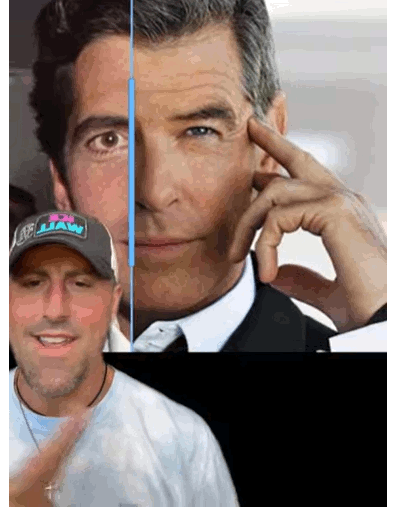
JFK Jr. as Pierce
Brosnan
with
another masonic hand
sign of course |
- Is
'John John' Bond Bond? - Fittest Flat Earther on youtube.
- Playing the part of Pierce Brosnan of James Bond fame.
-
Well in fact, Ian Fleming, author of the James Bond series,
was head of the British Counter Intelligence Service, MI5.
- Some in the intelligence community believe that he wrote
much of his fiction as a warning, as many authors of fiction
do.
- Watch out Q.
|
Goldfinger, he's the man
The man with the midas touch
A spider's touch
Such a cold finger
Beckons you to enter his web of sin
But don't go in.
(Sung by Shirley Bassey in 1965)
|
Protecting gold |
- If the removal of all the good delivery gold from Fort
Knox can be viewed as a deliberate raid on the U.S. Treasury,
then such an operation might well have been years in the
making, namely 40 years.
- Certainly enough time for Ian
Fleming to get wind of it and try to prevent it!!!
- So
just how did the story of the Fort Knox gold robbery get out?
- It all started with an article in a New York periodical in
1974.
- The article charged that the Rockefeller family was
manipulating the Federal Reserve to sell off Fort Knox gold at
bargain basement prices to anonymous European speculators.
|
Golden words he will pour in your ear
But his lies can't disguise what you fear
For a golden girl knows when he's kissed her
It's the kiss of death from Mister Goldfinger
Pretty girl, beware of his heart of gold
This heart is cold.
(Sung by Shirley Bassey in 1965)
|
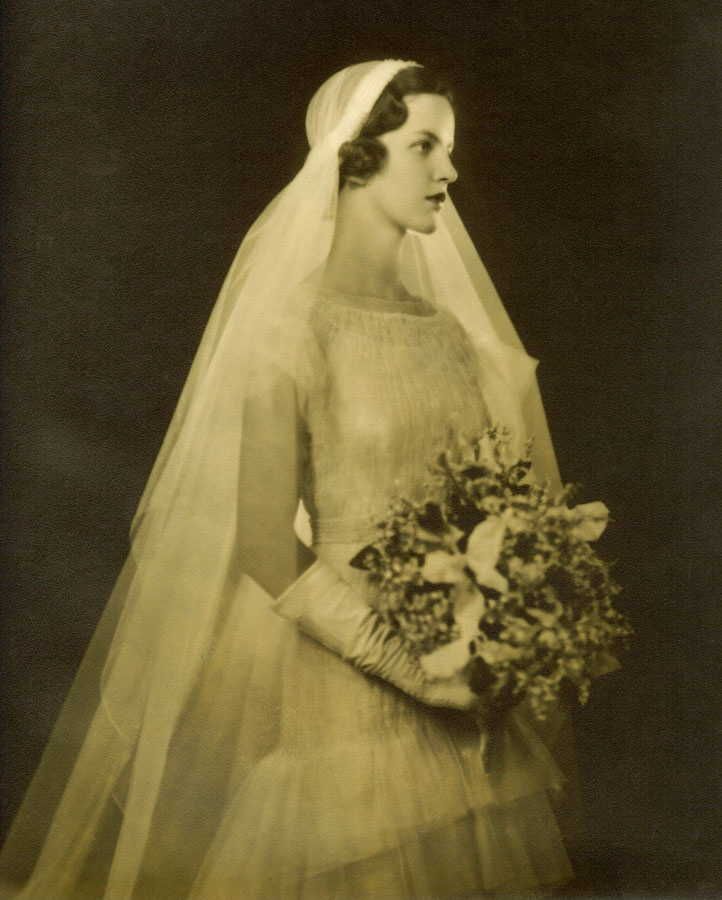
Louise Auchincloss
Boyer |
- Some 3 days later, the anonymous source of the story, Louise
Auchincloss Boyer, mysteriously fell to her death from the
10th-floor apartment in New York.
- How would Mrs. Boyer
have known of the Rockefeller connection to the Fort Knox gold
heist?
- She, unfortunately, was the long time secretary of
Nelson Rockefeller.
- For the next 14 years, Edward Durell, a
wealthy Ohio industrialist, devoted himself to the truth
concerning the Fort Knox gold.
- He wrote thousands of
letters to over 1,000 government and banking officials, trying
to find out how much was left, and where the rest of it had
gone.
|
Louise Auchincloss Boyer (1914-1974) was known as an executive assistant to Nelson Rockefeller who died tragically in a fall from a building, linked to conspiracy theories surrounding the Fort Knox gold scandal. She was a prominent figure in New York society, daughter of Gordon Auchincloss, and married to Allston Boyer, involved with Colonial Williamsburg. Her unusual death fueled speculation, though details suggest a personal tragedy following public attention. (Assistant)
|
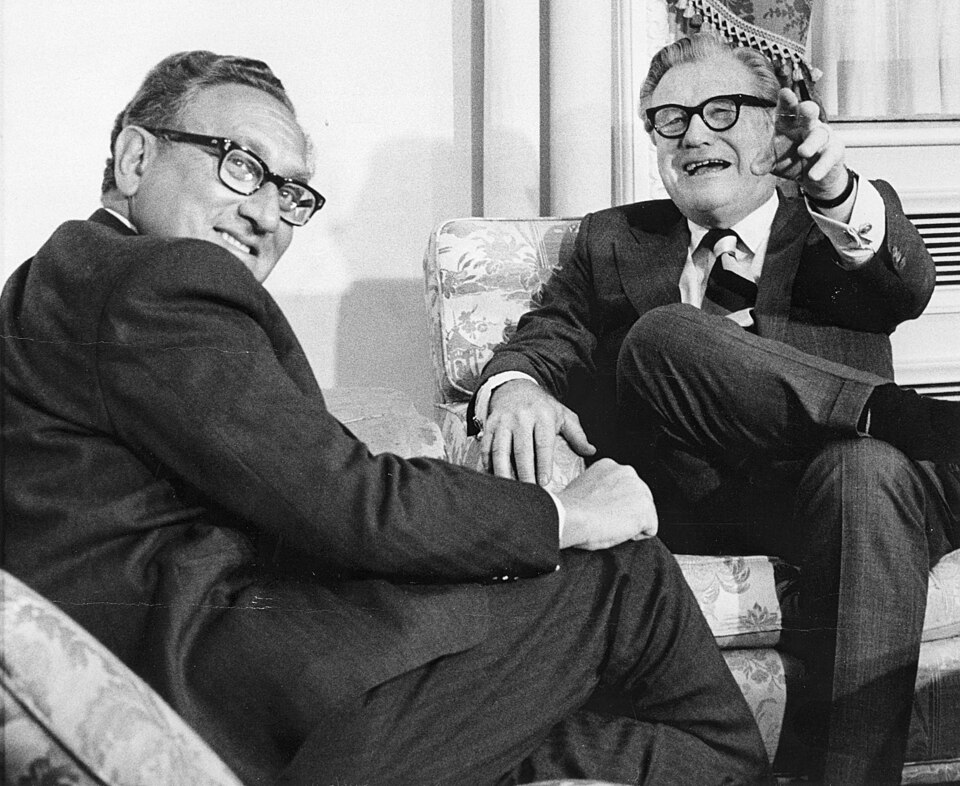
Public domain, via Wikimedia Commons
Vice President Rockefeller (right) with Secretary of State Henry Kissinger on January 3, 1975
- (Big shots right?)
They're MOCKING you |
- Edith Roosevelt, the daughter of FDR, questioned the
actions of the government.
- Unfortunately, Ed Durell never
did accomplish his primary goal, a full audit of the gold
reserves in Fort Knox.
- It's incredible that the world's
greatest treasure has had so little accounting and auditing.
- This gold belonged to the American people, not the Federal
Reserve and their foreign owners.
|
Accusations of missing gold from our Fort Knox
vaults are being widely discussed in European
financial circles. But what is puzzling is that the
Administration is not hastening to demonstrate
conclusively that there is no cause for concern over
our gold treasure, if it is in a position to do so.
(Edith Roosevelt)
|
Where's the gold? |
- One thing is certain, the government could quell
all this speculation under a well publicized audit under the
searing lights of the media cameras.
- It has chosen not to do so, and one must
conclude that they are afraid of the truth that an audit would
reveal, or they don't want us to know, period.
|
In a London Sunday Express article, which appeared on December 13, 1981, the writer quoted Dr. Peter Beter who believes the theft occurred in the late 1960s when the United States, a leading member of the London Gold Pool agreement, transferred 233.4 million ounces from Fort Knox to the Federal Reserve Bank in New York and London’s Bank of England. According to the article, 23.1 million ounces were accounted for at the Federal Reserve Bank while another 45.2 million ounces arrived safely in England. The destination of the remaining 165.1 million ounces is unknown and Dr. Beter states that attempts to learn what happened have been “stonewalled” by treasury officials.
(projectcensored.org)
|
Public Domain via
Wikimedia Commons
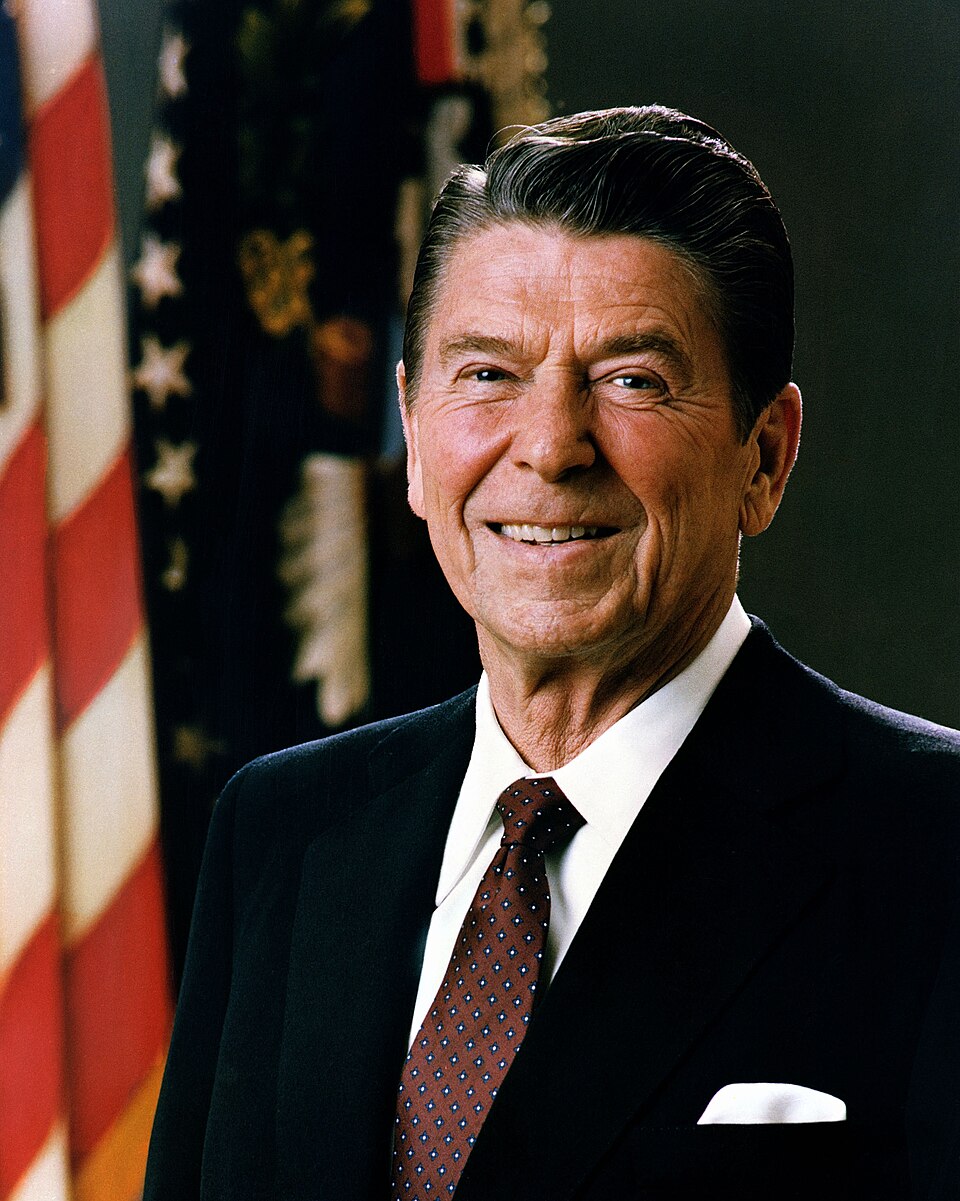
Ronald Reagan |
- Edward Durell, identified as an Ohio industrialist,
sheep farmer, and active Republican, supported Dr. Beter’s
claims, saying he believes the gold was shipped abroad,
probably 'to the Bank of England, and from there to an unknown
destination.'
- Jerry Nisenson, Deputy Director of Gold Market Activities at the Treasury Department, said:
'We have investigated the claims of Dr. Beter and his supporters and we contend that the gold was not stolen,
there is no cover-up, they have misinterpreted our books. The gold was being refined into better quality gold and those ounces just went up the chimney.'
- Here's the answer, when Ronald Reagan took office in 1981,
his conservative friends urged him to study the feasibility of
returning to a gold standard as the only way to curb
government spending.
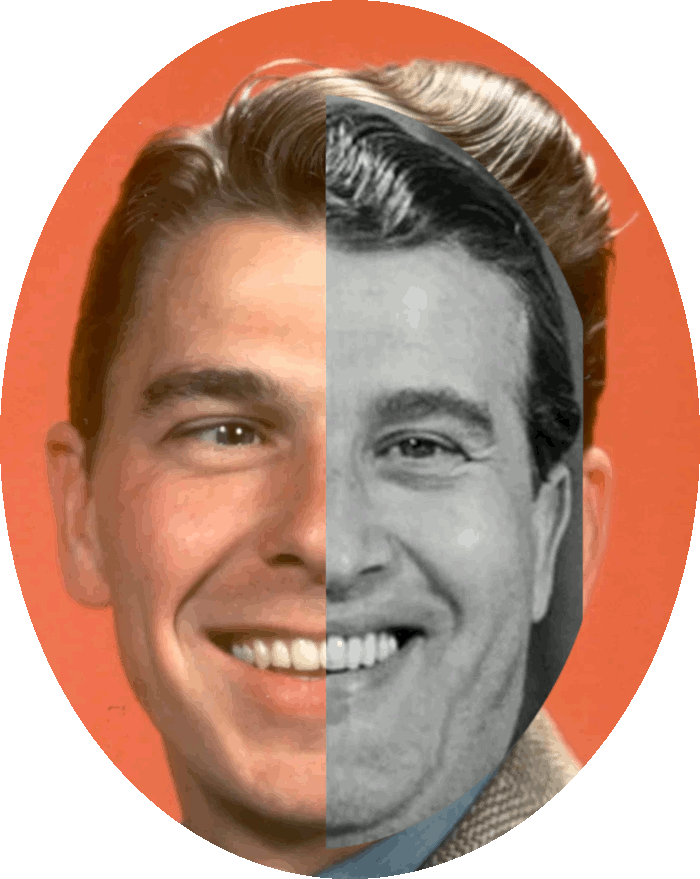
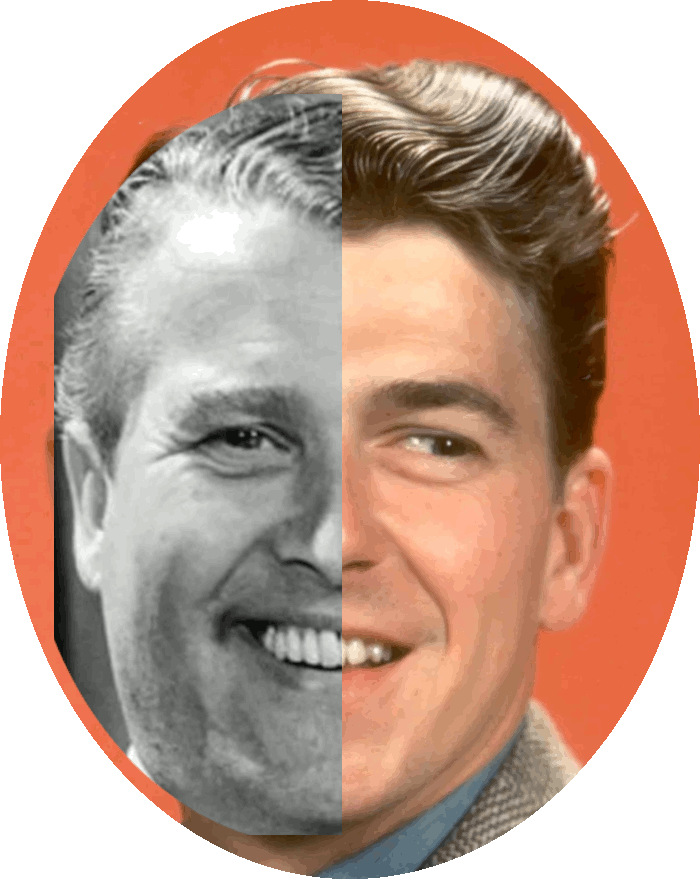
|
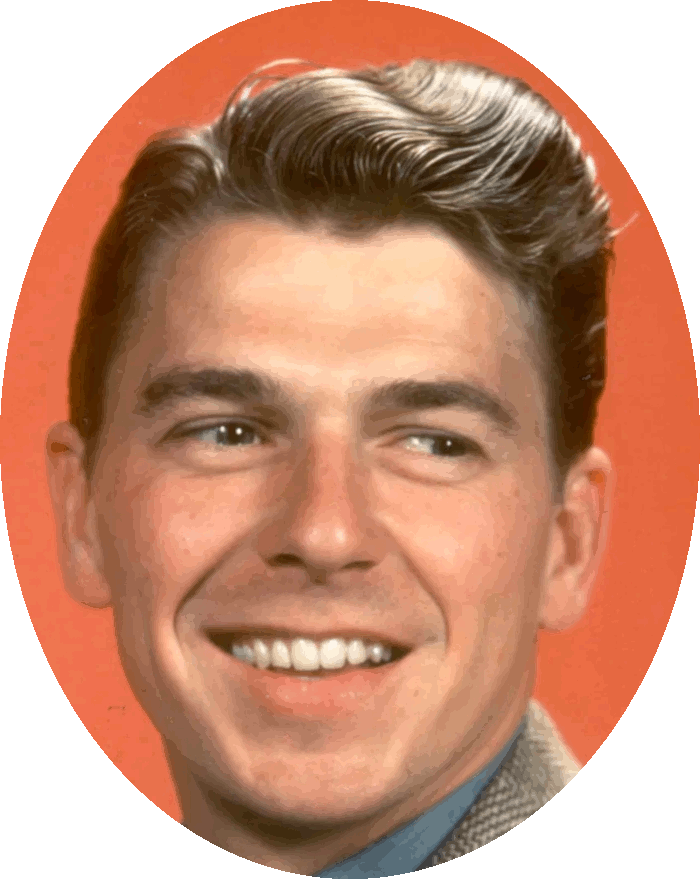
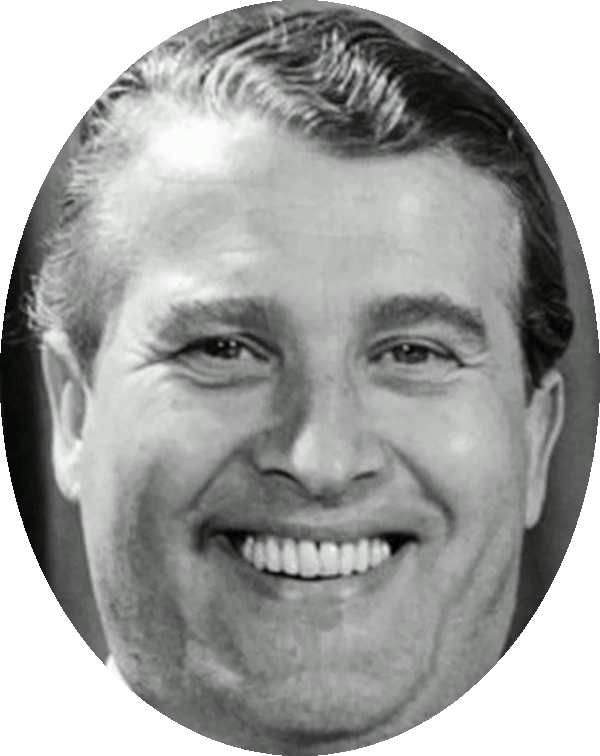
Ronald
Reagan as Wernher
Von Braun |
 |
 |
Ronald Wilson Reagan
1911-2004
2/6
6/5
|
Wernher Magnus Maximilian Freiherr von Braun
1912-1977
3/23
6/16 |
 |
 |
|
40th president |
- Youtube - The Simpsons -
Rappin Ronnie Reagan.
- His head was seen on a pike in the Chamber of Horrors at the Springfield Wax Museum.
- Wernher Von Braun played by Elon Reeve Musk of course!
|
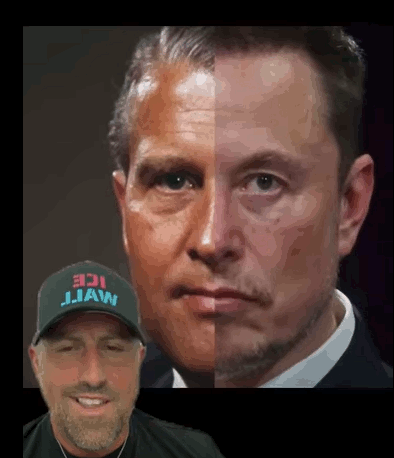
Wernher von Braun as Elon Musk |
|
 |
Wernher von Braun
1912-1977
3/23
6/16 |
Elon Reeve Musk
1971
6/28 |
-
EL-on is Von Braun
- Fittest Flat Earther on youtube.
- It's the Epstein
(ROCK) played by George Jr. and the Elvis/Trump (KING) because
he's not a trumpet he's a drum(ph) (ROLL) and that's called
the PH beat.
|
|
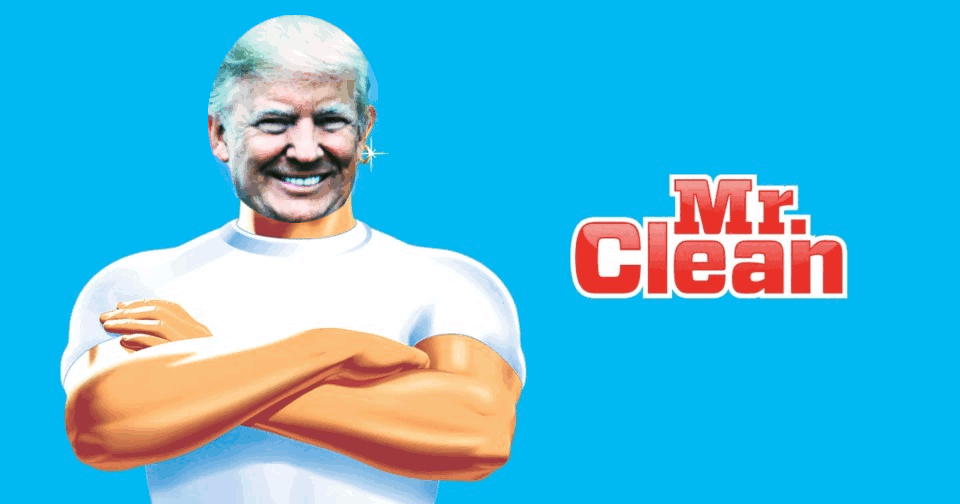
Mr. Brown Bull(crap) |
- Brawny in German is bullig.
- Braun in
German is brown.
- Clean in German is sauber.
-
Teetotal Trump and the drinking presidents.
|
As Donald Trump becomes US president on Friday many will reach for a drink. Washington DC will be whirl of parties, galas and balls.
The celebrities may be skipping it this year but the US capital will still swing to the sound of clinking glasses and popping corks. Across the country, celebrating Trump supporters will toast his swearing-in with a drink while others will numb their nerves with booze.
Around the world, alcohol will help with this historic transition. In north London, for instance, the Old Queens Head pub is throwing an Armageddon-themed party to mark the start of Donald Trump's presidency. (Ben
Wright)
|
|
|

Man eater |
- Now we know where the brawny 'Giant' came
from.
- We might need a whole page (sheet) just for the
brawny guy.
- Demon boy trumpie showing off his 'man'
power, he's thinks he's tricky and cute but he's a flaming
IDIOT.
-
Just Like Your Toddler, Ancient Jewish Texts Are Obsessed With Poop,
why do you think Trump has a gold toilet? He's a pervert
filled with it.
- Well now it's just all coming together,
George Jr. playing the part of Epstein (ROCK) and Jay Sebring
(SCISSORS) and Elon Braun playing the part of the (PAPER) and
trump is the 'model.'
|
|
Trump as the Brawny (Wernher Von Brauny) guy |
 |
 |
|
Braun guy |
Terry Day Melcher Trump
TP flushing |
|
Shape shifting racist demon who thinks REALLY
highly of himself obviously |
- See the bubbles, that is how he creates all his alter
entities because he plays billions of roles over hundreds of
thousands of years of shape-shitting.
- It's like
a virus, that's why everyone in Hollywood looks like a mass
manufactured BARBIE or KEN doll.
|
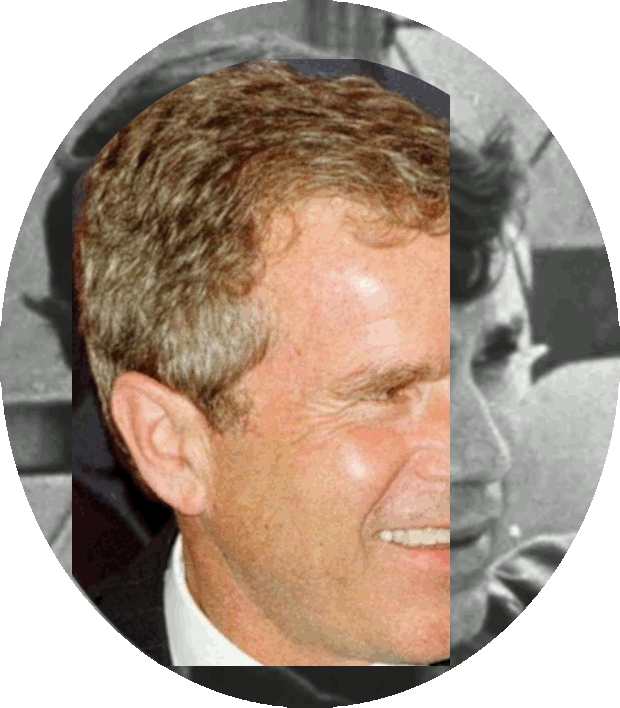
George Bush
Jr. as Jay Sebring |
George 'Skin' Walker
Bush
1946
7/6 |
Jay Sebring
Thomas John Kummer
1933-1969
10/10 8/9 |
 |
 |
|
Murdered in cold blood? |
- Because it's the Epstein
(ROCK) and the Braun(y) man (PAPER) and the Jay Sebring
(SCISSORS) played by George Jr. of course.
- BTW, they
brawny boy takes turns and is now a brunette like Elon.
- They think they're so cute, start deciphering all their
'tricky' clues, they're very shallow.
- With the
BYRDs Turn
Turn Turning point curse and Mr. Tambourine Man (pied piper
with a small drum).
- And Elon playing Admiral Byrd of
course, and Wernher Von Braun, and Ronald Reagan and now Mr.
SPACEX.
- So what is going on with that Tesla (Atlas/Atles)
alien craft about to hit earth? It crashed.
Empty bag |
- Returning to the gold standard sounded like a
reasonable alternative (it's not just more thievery), so President Reagan appointed a group
of men called the Gold Commission to study the situation and
report back to Congress.
-
The truth is, never before has so much money been stolen from
the hands of the general public and put into the hands of a
small group of private investors, the money changers
(thieves).
- Stop blaming the Boomers or each other,
you've all been screwed over.
- What Reagan's gold commission
reported in 1982, was the following shocking revelation.
|
The U.S. Treasury owned no gold at all. All the gold
that was left in Fort Knox was now owned by the
Federal Reserve, a group of private bankers as
collateral against the national debt.
(Gold Commission)
|
|