|
EDOUARD MANET - THE LUNCHEON ON THE GRASS
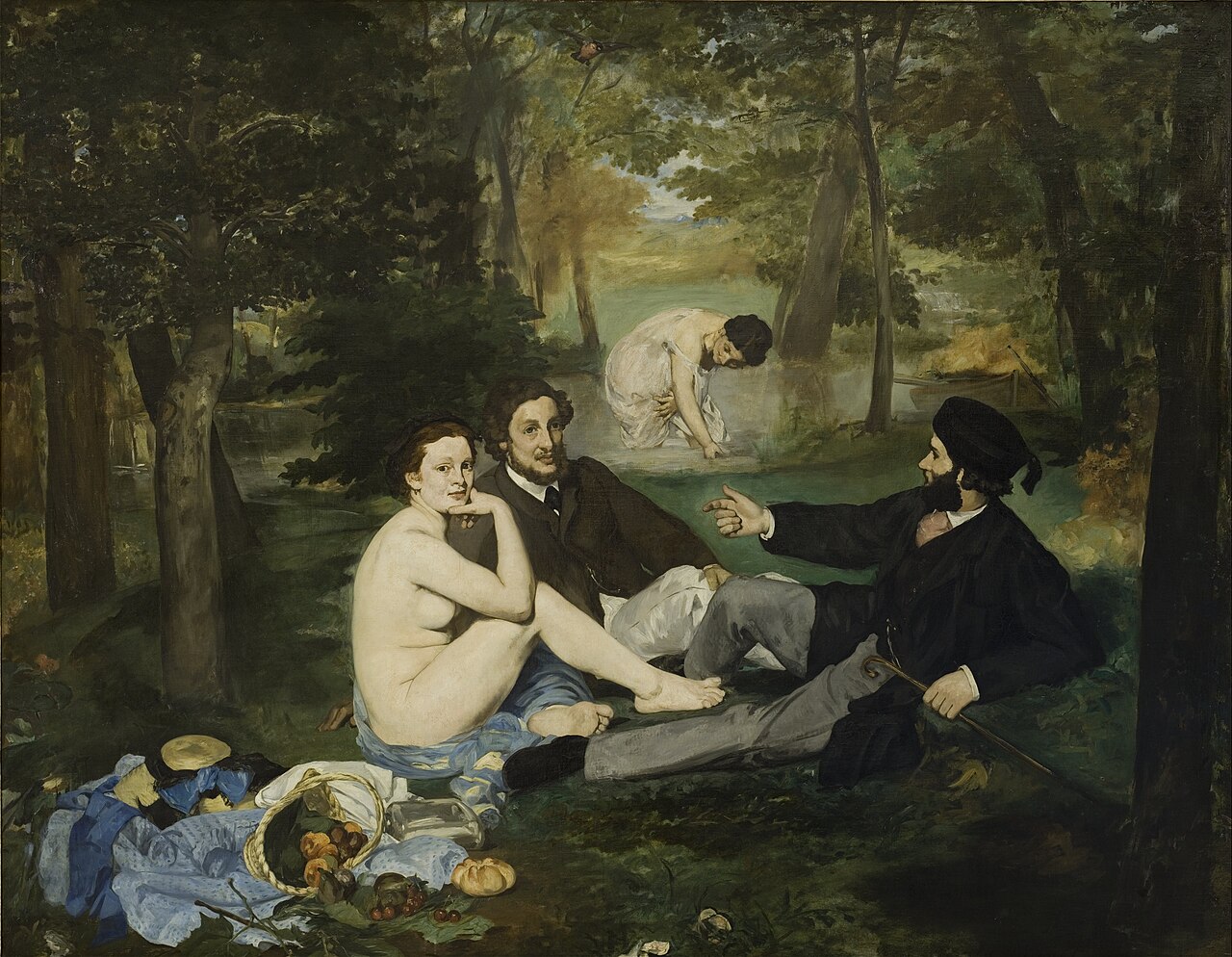
Manet,
Public Domain, via
Wikimedia Commons
1863 |
- A major early work is The Luncheon on the Grass (French: Le Déjeuner sur l'herbe; The Luncheon for short), originally
Le Bain.
- The Paris Salon rejected it for
exhibition in 1863, but Manet agreed to exhibit it at the
Salon des Refusés ('Salon of the Rejected').
- This parallel salon was initiated by Emperor Napoleon III as a solution to the public outcry after the official salon's Selection Committee only accepted 2,217 paintings out of more than 5,000 submissions.
- It allowed rejected artists to display their paintings if
they chose.
-
The painting's juxtaposition of fully dressed men and a nude woman was controversial, as was its abbreviated, sketch-like handling, an innovation that distinguished Manet from Courbet.
|
One critic stated that the brushwork
appeared to have been done with a "floor mop". However, others such as his friend Antonin Proust celebrated the painting, and novelist Émile Zola was so affected by the experience of viewing it that he later based the title painting in his novel L'Œuvre ('The Work of Art') on Le Déjeuner sur l'herbe.
(Wikipedia)
|
|
|













