 |








|
|
HIDDEN REALM - JESUS IN FRANCE - PAGE 21
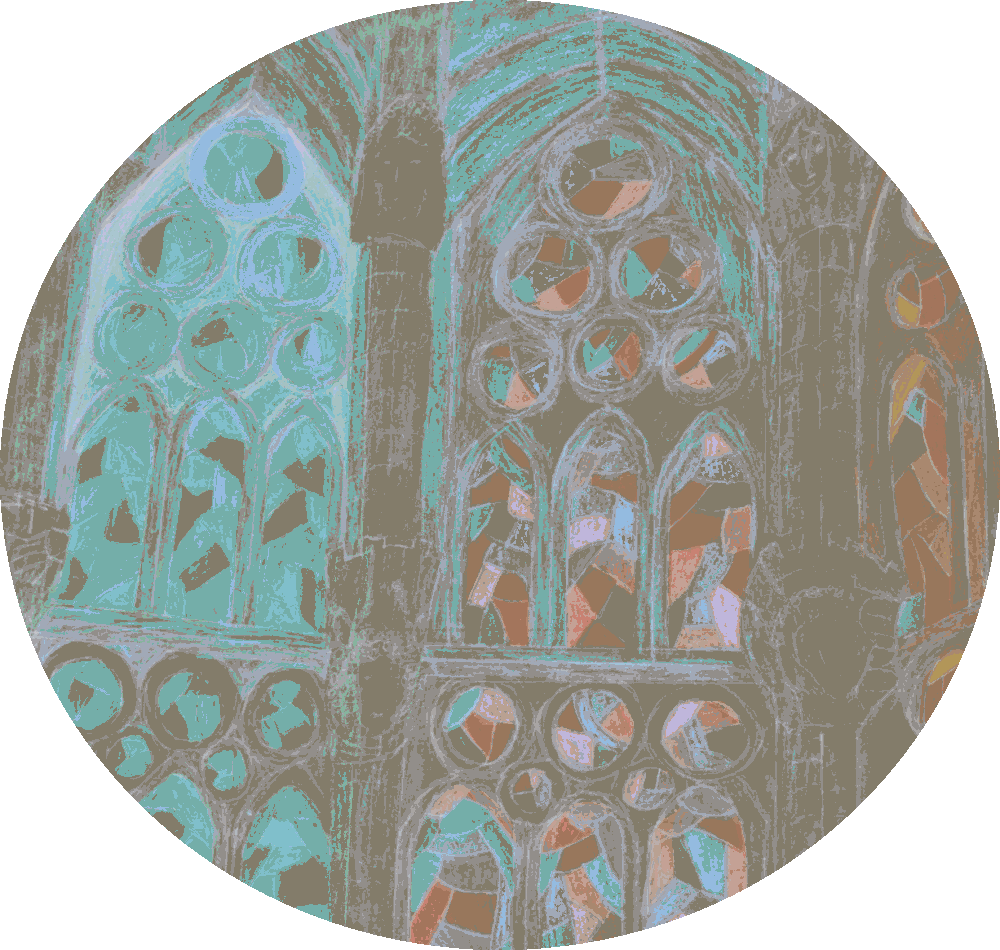
Ruins |
- Jesus Christ came to France about 50 AD to find Mary Magdalene,
his 1st wife, after
she fled from him after a failed marriage attempt and she was
tired of his 10 other wives.
- He never died on any cross
and was
traveling to England to bring back more tin to Israel from his
guardian, Joseph of Arimathea's tin mine, and the
Catholic church leaders gave him Mary's location.
- So he
stopped by to convince her to return with him because of his
broken ego and of course, he needed more of her money, but she
refused to go along.
- He returned twice more and while
there he attempted to throw her off a cliff and later entombed
her in a graveyard for several weeks, feeding her infrequent
scraps of food and water, until locals dug her out.
- At that
point, she realized the church was betraying her and giving
him her whereabouts so she quit the church and retreated to a
cave where she was cared for by locals and spent the next 30 years of her life.
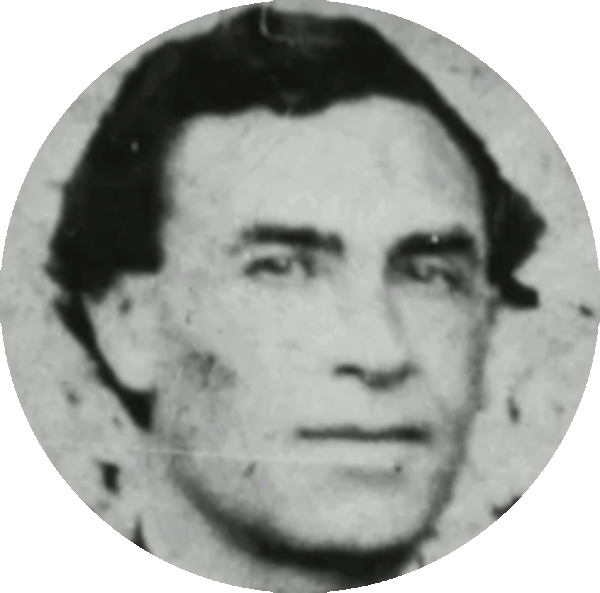
Failed priest
Bérenger Saunière
Clone of Jesus
Christ |
- The legend of the village of Rennes-le-Château is
heavily intertwined with Mary Magdalene and they constructed a
church in her name to memorialize her.
- But this was only
because they were propping up their 'Jesus is king' fake story
and were busy turning Mary into a lesser being, a lowly woman and 'saint'
in the vestibule statue, when actually
she's the sole creator of the universe.
-
The Rennes-le-Château mystery centers on Bérenger Saunière, a 19th-century priest in
the remote French village who suddenly became immensely wealthy after reportedly finding ancient parchments.
- However, Saunière was the clone of Jesus Christ and he created
that character and
he reappeared again in France because he never died on any
cross.
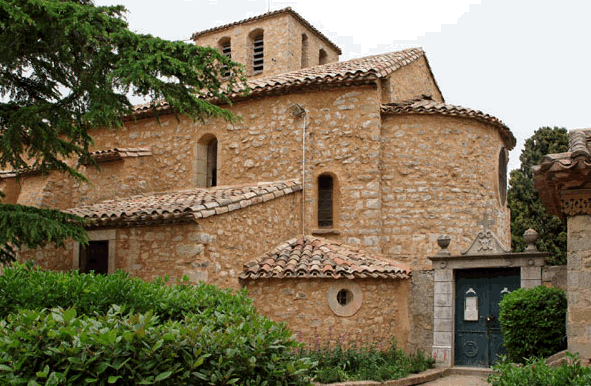
Zdenek Bakstein Photography
Church of
Saint Mary Magdalene
|
- The Church of Saint Mary Magdalene is the centerpiece of the village's lore.
-
The earliest church of which there is any evidence on the site may date to the 8th-century.
-
Although the current church on that site was built in the 11th-century and radically altered by Saunière in 1886.
- Among Saunière's external embellishments was the Latin inscription
Terribilis est locus iste displayed prominently on the lintel of the main entrance; its literal and most obvious translation is
'This place is terrible.'
- Over a 10-year period, from
1887 to 1897 he spent 11,605 Francs which equates to 4.5 million Euros
or over $5 million U.S. dollars.
- But amazingly, he
claimed the monies came from donations although he had literally no
congregation, turns out, he was soliciting in newspapers throughout
Europe for money in exchange for masses.
|
In 1910–1911, Bérenger Saunière was summoned by the bishopric to appear before an ecclesiastical trial to face charges of trafficking in masses. He was found guilty and suspended from the priesthood. When asked to produce his account books, he refused to attend his trial. (Wikipedia)
|
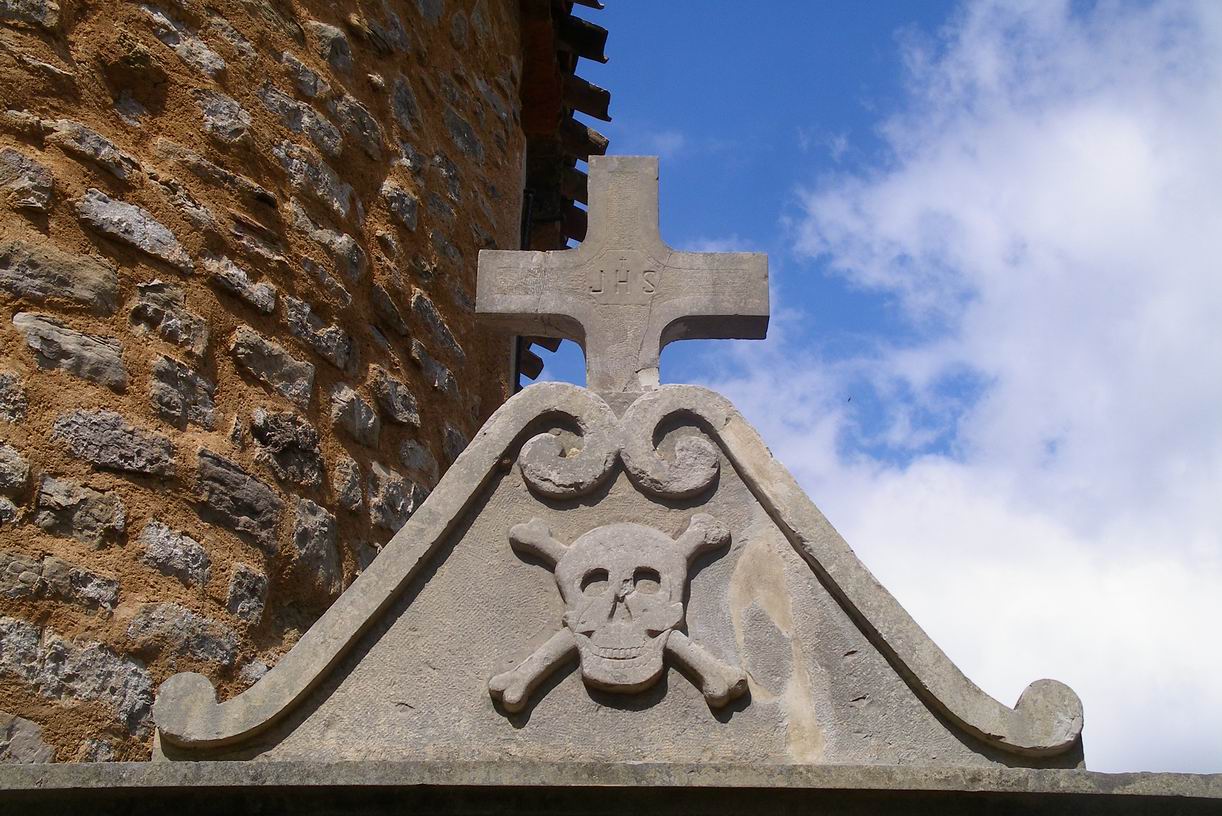
Pumuckel42, CC BY-SA 3.0 , via Wikimedia Commons
Skull and crossbones figure above the entrance to the churchyard
|
-
Saunière hid cryptic clues in its art and statues
including a chilling skull and crossbones which mark the entrance to the churchyard.
- Inside the church, one of the figures installed by Saunière was of the demon Asmodeus holding up the holy water stoup
although its original head was stolen in 1996 and never returned.
- According to local tradition, the stained-glass windows in the church refract sunlight to project multi-colored orbs (called
'pommes bleues') onto the walls and altars, particularly around midday on January 17.
- January 17 marks the death and feast day of St. Anthony the
Abbot (c. 251–356), widely considered the Father of Christian Monasticism
and the French are a big part of the Catholic story.
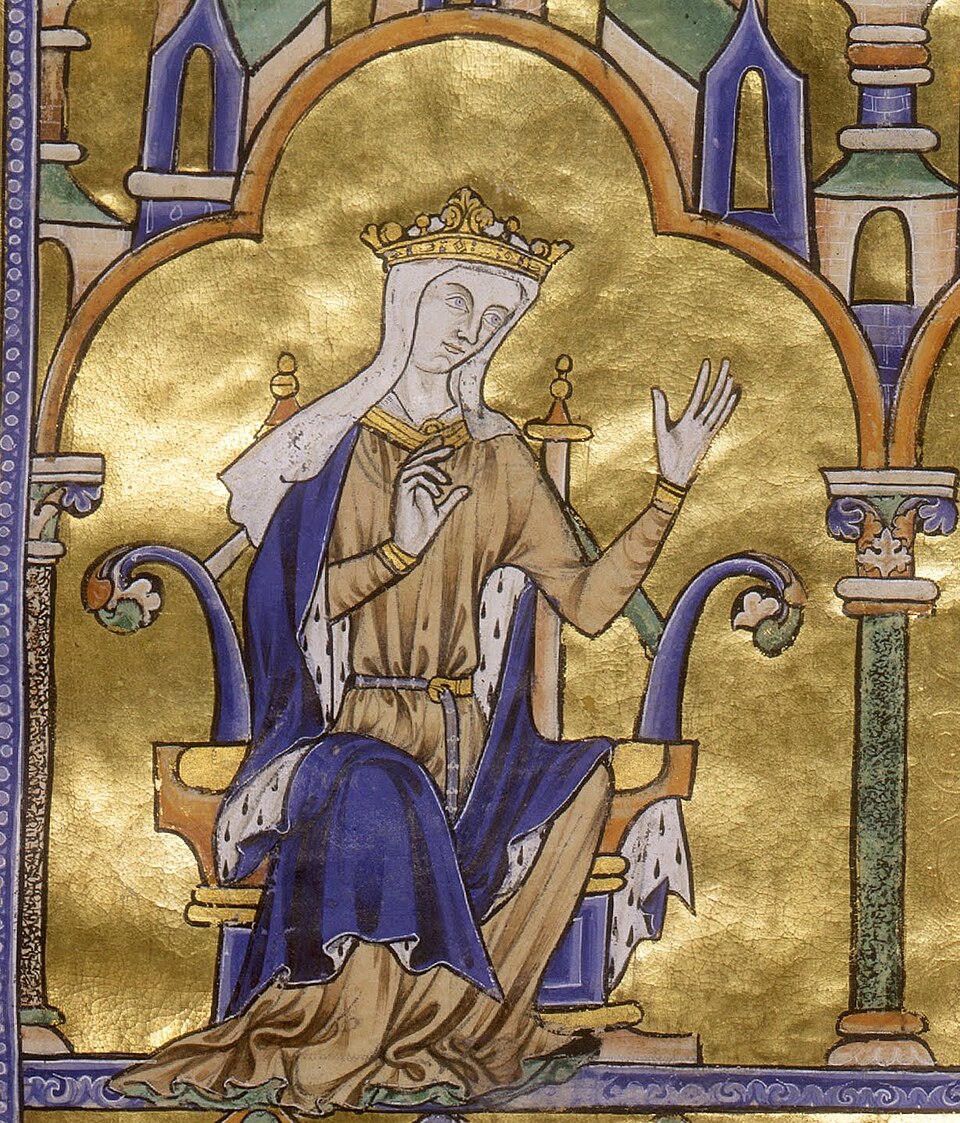
Public domain, via Wikimedia Commons
Blanche of Castile
(1188-1252)
|
- Saunière (Jesus Christ/McCluskey) returned to France because he knew
there was a lot of gold buried in the churchyard left by
Blanche of Castile, who was Queen of France by marriage to Louis VIII.
- She was the 3rd daughter of Alfonso VIII, King of Castile, and Eleanor of England, sister of King Richard I of England and King John of England.
- According to popular myth, Blanche of Castile (mother of King Louis IX/Saint Louis) raised a massive sum of gold to pay her son's ransom after he was captured during the Crusades.
- The story claims she hid the remaining surplus of this treasure at Rennes-le-Château.
-
As a result, Saunière resorted to digging up graves and stealing gold
coins and jewelry, however, he never found the treasure.

Noël Corbu
(1912-1968)
|
- In the 1950s, a local innkeeper named Noël Corbu circulated a story that Saunière discovered secret parchments during church renovations.
- Corbu purchased Saunière's massive home, Villa Bethania, a Neo-Renaissance estate which
was constructed between 1901-1905 (although he never resided in) after
his mistress (housekeeper) Marie Dénarnaud, ended up in debt and could no longer
take care of it.
- Corbu purchased the estate and turned it into a hotel-restaurant in 1955, but customers were rare because Rennes-le-Château was isolated on top of a steep hill which could only be reached by a perilous dirt road.
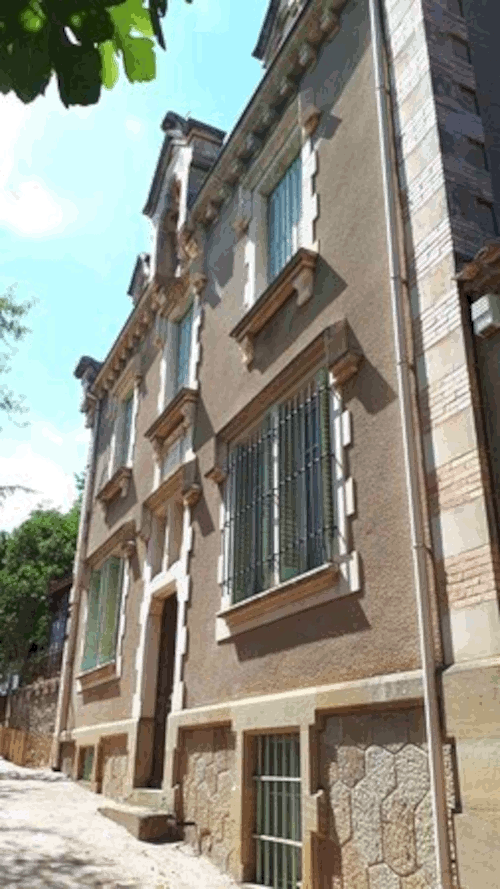
Villa Bethania |
-
In order to enhance the curb appeal and win more customers, Corbu claimed the
parchments discovered by Saunière's housekeeper pointed to the location of Blanche of Castile's hidden crown gold, allegedly totaling 28,500,000 gold pieces.
- Truth be told, Corbu was another clone of Jesus Christ and
he was hot on the trail of that gold.
- However, Saunière
nor Corbu ever found the gold and it wasn't
Blanche's gold anyway, it belonged to someone else and will
remain buried, although the entire story will soon be revealed.
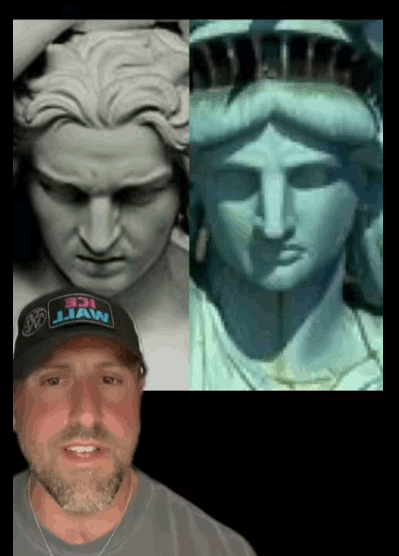 |
|
|
Statue of Liberty is Lucifer |
|
- Youtube -
#statueofliberty or statue of #lucifer - Fittest Flat Earther.
- Do you know why an artist in France donated the
Statue of Liberty to the United States?
- Because he was a
Freemason and knew what this new country was all about,
enslaving the world for the fallen angels (Freemasons).
-
They knew that the U.S. was created to dumb everyone down and
rewrite history, something the ancient-minded Europeans
wouldn't let happen because they knew their history.
-
The Statue of Liberty is based on Libertas, the Roman goddess of freedom
only it's really a fallen male angel, Lucifer (Jesus Christ)
from Alpha Centauri.
- Sculptor Frédéric-Auguste Bartholdi designed her, famously modeling her face after his mother, Charlotte,
what a lie.
- The Statue of Liberty was originally designed
as an Egyptian woman and was a perversion of the Colossus of
Rhodes and was thoroughly rejected by Egypt.
|
The Statue of Liberty was originally designed as an Egyptian colossus. French sculptor Frédéric Auguste Bartholdi originally pitched a massive lighthouse called Egypt Carrying the Light to Asia to stand at the Suez Canal, depicting a robed female peasant. When Egypt declined the project, he reimagined it for New York. (Assistant)
|
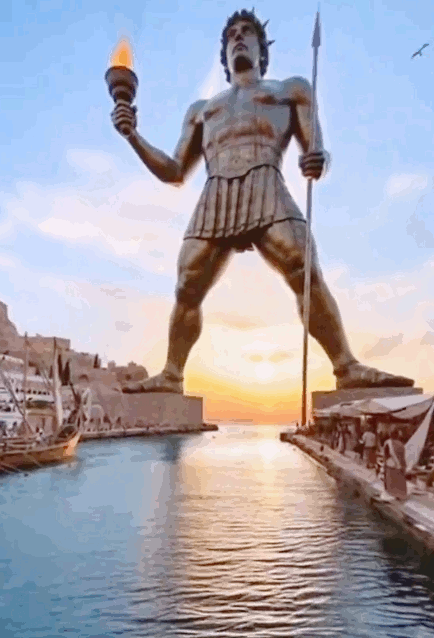
Conception by
Michael Richard
Plowman
Colossus of Rhodes (built 294 - 280
BCE)
|
- After returning from Egypt without a commission in the fall of 1869, Bartholdi apparently decided to transform his Egyptian colossus into a neoclassical Statue of Liberty.
- Art historians have found a series of sketches and clay models apparently done between the spring of 1870 and the spring of 1871 in which the Egyptian figure gradually became Roman and Greek.
- Whether Egyptian or neoclassical, all shared an up-stretched arm,
with the right arm, holding a torch.
- In some models, especially the Egyptian ones, the breasts are prominent; in others, they are barely visible.
- Ultimately, Liberty emerged as far more androgynous than her khedival ancestor.
- And as she left her Egyptian roots behind, she shed her North African dress for the draped garments of ancient Greece.
|
Khedival (or khedivial) is an adjective that means of or relating to a khedive. A khedive was a historical title of honor given to the Ottoman viceroy (governor) who ruled Egypt from 1867 to 1914. (Assistant)
|
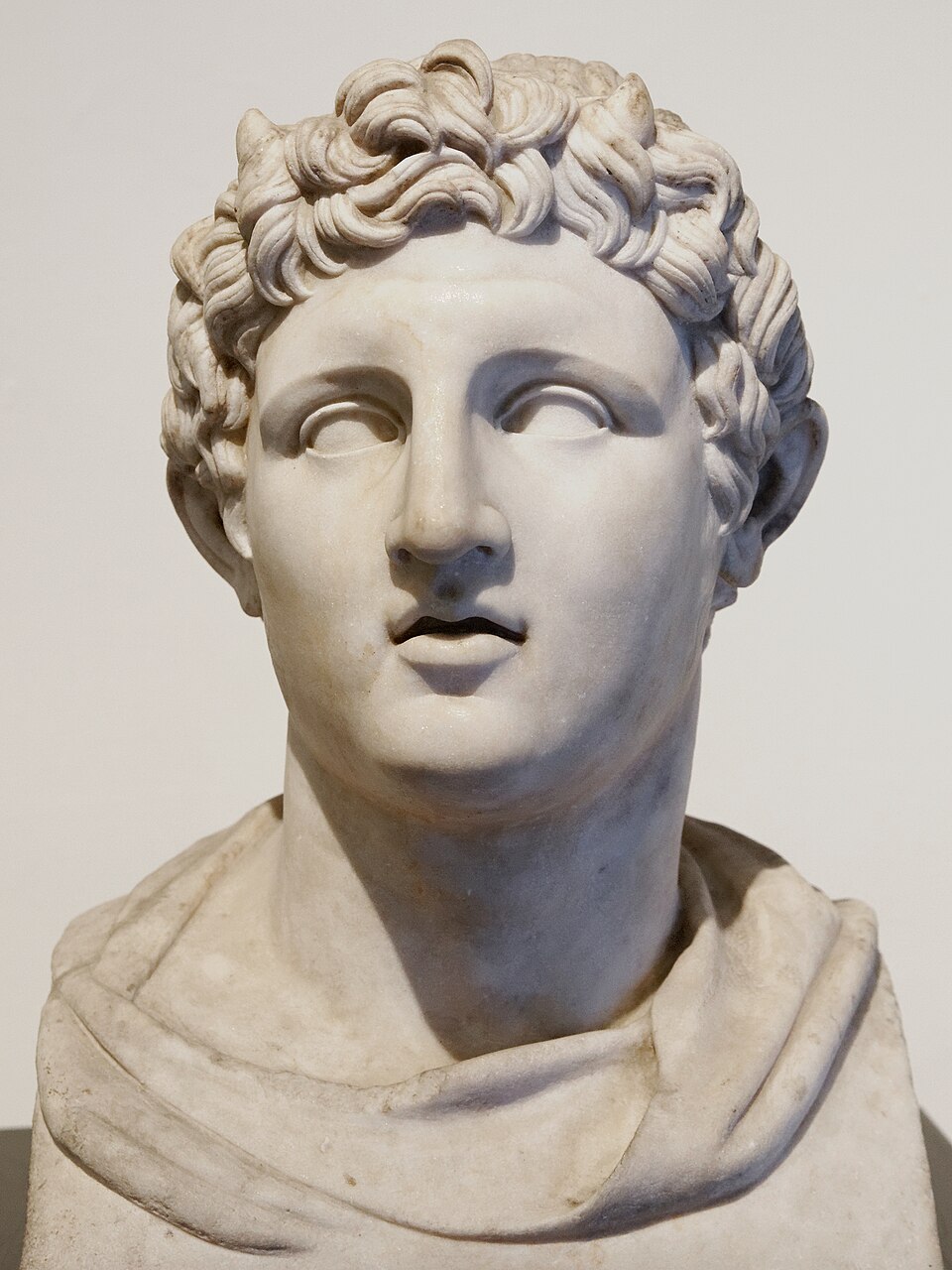
© Marie-Lan Nguyen / Wikimedia Commons
Demetrios Poliorketes (337–283 BC
BCE)
|
- But as you can see the real Colossus of Rhodes was
modeled after a
powerful male, not anything close to female, and he was the
true God and his statue represents the sun god Helios.
- One of the Seven
Wonders of the World.
- It was the image of Demetrius I Poliorcetes (Besieger of Cities)
who was a Macedonian Greek nobleman and military leader who became king of Asia between 306 and 301 BCE, and king of Macedon between 294 and 288 BCE.
- He was a member of the Antigonid dynasty, and the son of its founder, Antigonus I Monophthalmus, and his wife Stratonice, as well as the first member of the family to rule Macedon in Hellenistic Greece.
- His father was Alexander the Great's top general.
-
Poliorcetes was
trying to wrestle the cities away from the evil shapeshifting
fallen angels who run this world, but he didn't have Sophia,
who was half of his strength and completed him, so
he failed at that.
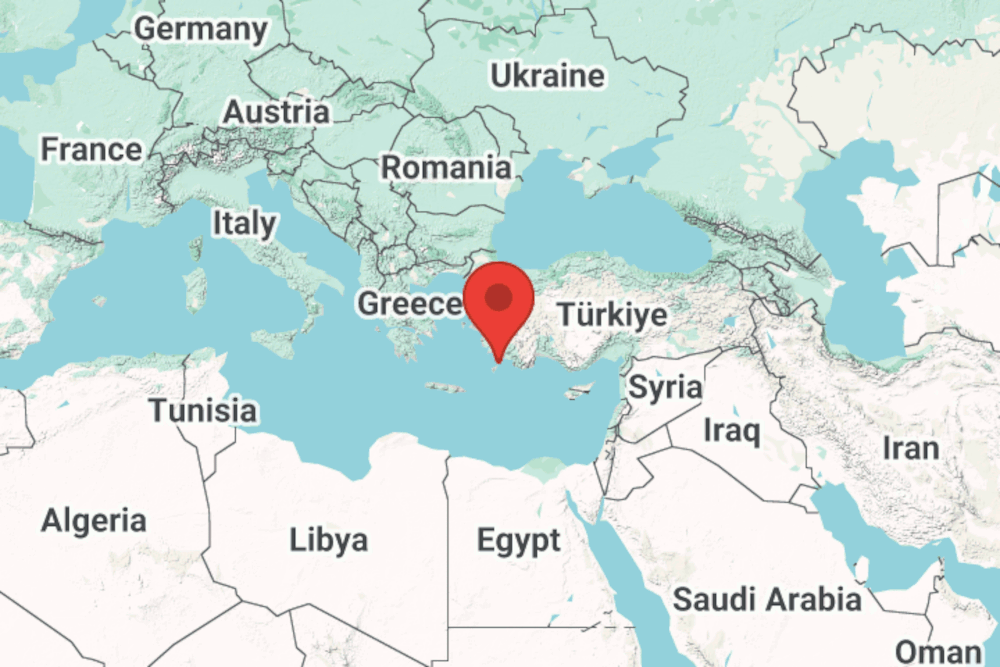
Location of the
Island of Rhodes |
- After his demise, the citizens of the
Greek island of Rhodes erected the statue out of bronze
as Helios because Poliorcetes was so well-loved.
- He
originally straddled the harbor but was taken down 66 years later by the
fallen angels when they manipulated the ground he stood on and
created a powerful earthquake.
- However, the fallen angels
completely changed the story and it went down in history as the Rhodians commissioning the statue to celebrate their successful defense of the island against a yearlong siege by Demetrius I of Macedon in 304 BCE.
- It was funded by melting down the abandoned weapons and bronze war machinery left behind by the Macedonian army.
- The Greek island of Rhodes is located in the southeastern Aegean Sea, roughly 310 miles
(500 kilometers) north of the Egyptian coast (Alexandria).
- On a broader Eastern Mediterranean map, it sits just off the southwestern coast of Turkey.
|
The statue, which stood 108 feet (33 meters) took 12 years to build (c. 294–282 bce), was toppled by an earthquake about 225/226 bce. The fallen Colossus was left in place until 654 ce, when Arabian forces raided Rhodes and had the statue broken up and the bronze sold for scrap. (Assistant) |
Claude |
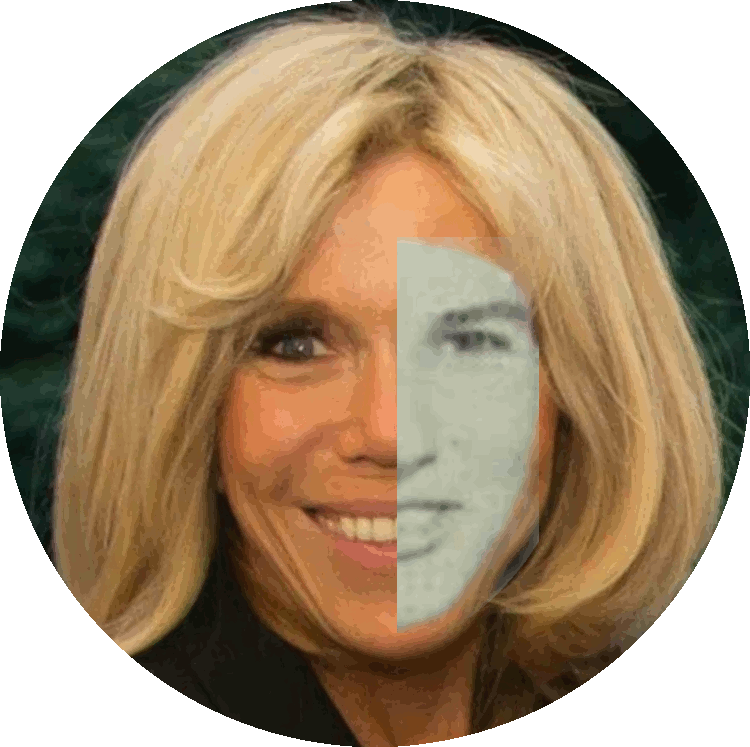
- That's not the end of the story for Jesus Christ
(Lucifer/McCluskey) and the parts he has played in France,
because now he is playing Brigitte Macron.
|
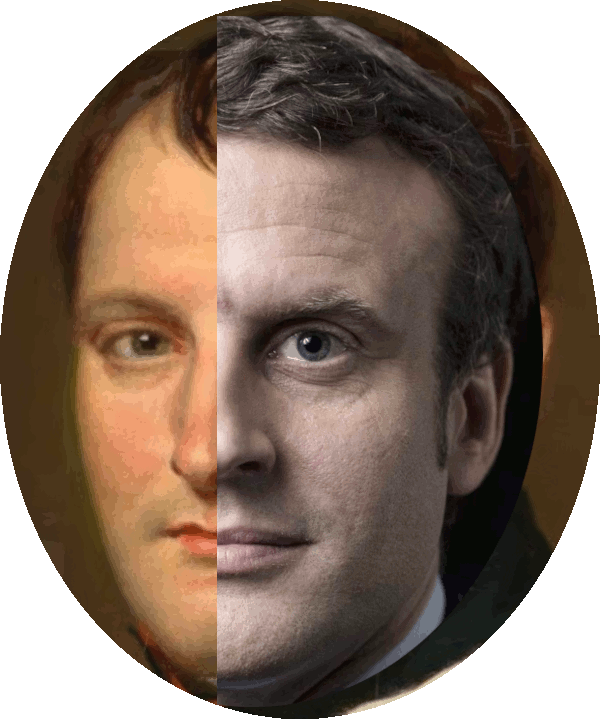
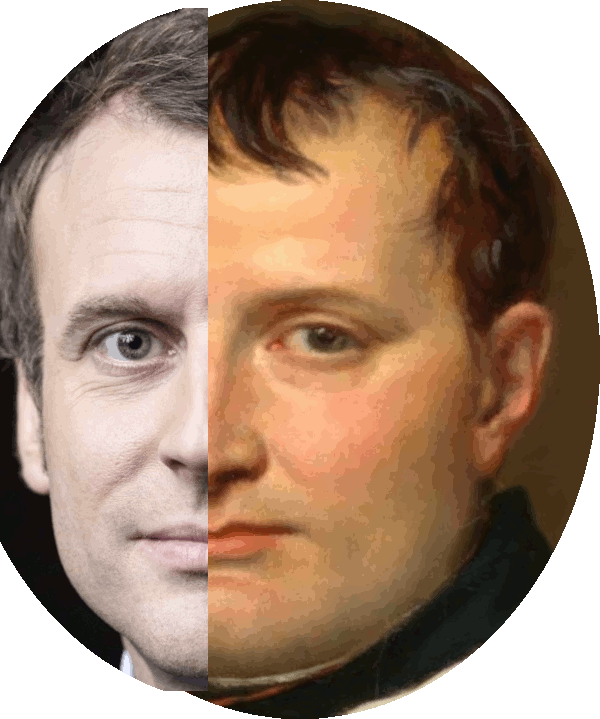
Emmanuel Macron as Napoleon Bonaparte |
 |
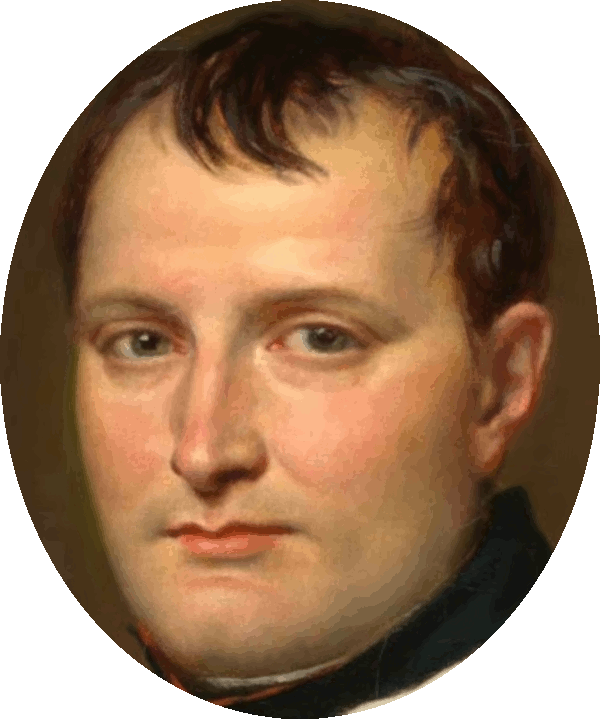 |
Emmanuel Jean-Michel Frédéric Macron
1977
12/21
President of France
|
Napoleone di Buonaparte
1769-1821 Still
living
8/15 5/5
Emperor of the French,
General in the French Revolution
|
 |
 |
Jupiter
Macaron |
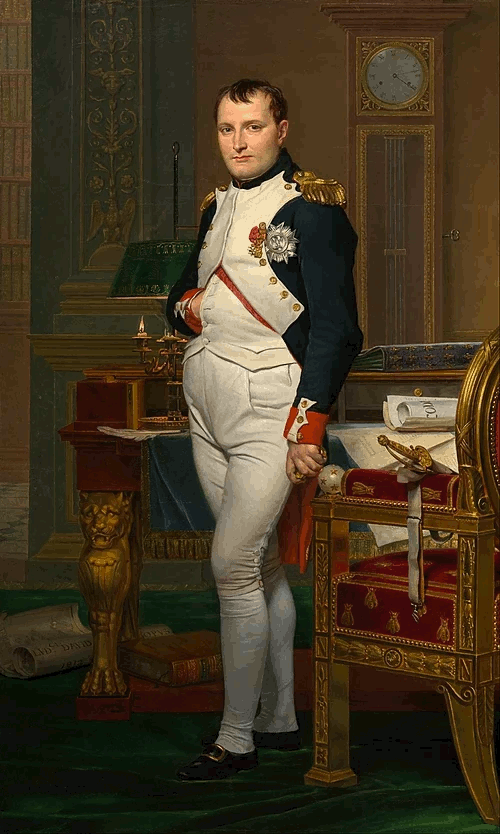
Bonaparte Masonic hidden hand |
- Brigitte is now married to
Emmanuel Macron, the President of France, who
she met when he was age 8 and she was 32 when she was his
teacher.
- Macron is the clone of Napoleon Bonaparte, a warmonger who, like Christ, never died and is a
shapeshifter still roaming around.
|
In “Christ the Chimera: The Riddle of the Monster Jesus”, art historian Katie Kresser traces the tradition of the monstrous in Christian iconography to AD 200 and the Alexamenos Graffito, which depicts Jesus as a donkey-headed figure on a cross.
The Jesus of art history has been associated with the god Dionysos, the god Apollo, the god Ra. He has been presented as a warrior hero, an epicene virgin, a stern judge, a free-spirited hippie. He has been a man with an ass’s head.
Kresser speaks of the “challenging, adaptable, expectation-shattering chimericality of Jesus.” Jesus as shape-shifter. Jesus as monster. (Rebecca Bratten Weiss) |
France |
- We all know what Jesus Christ was doing in France but
there is much more to this story still to come.
- But what
you should know is this story is not really about Mary
Magdalene, it's about the owner of all the hidden gold.
- Stay
tuned because we're ready to add more very soon.
- A mysterious inscription on a German headstone
Coded sentences in the Shakespearean Plays
2000 year old British coins
Secret ciphers in the New Testament
Pictorial cryptograms in Vatican art treasures
Curious statues sculptured for a church in Southern France
Concealed information in the Bible and the discovery of hidden church records combine to reveal a story of deception that has no equal in the pages of world history.
This groundbreaking book reveals to the world for the first time original new information about the emergence of the New Testament and its story of Jesus Christ. It provides historical evidence showing not only vital ancient manuscripts been hidden from the public domain but also other sensitive and associated Biblical material has been purposely withheld or suppressed from the general populace.
Nostramdamus wrote:
O vast Rome, your ruin draws near, not of your walls but of your blood and substance. One sharp in letters makes so horrible a mark, His sharp point goes all the way to the quick.
- The Bible Fraud: An Untold Story of Jesus Christ
by Tony Bushby (Author)
|
The most unholy.
Socrates

| |
 |
 |


