|
HIDDEN REALM - AUTONOMOUS - PAGE 9

Winding road |
- An autonomous vehicle is a vehicle that employs driver assistance technologies to remove the need for a human operator.
- There are six stages of automation in in these vehicles, ranging from fully unassisted manual driving at stage 0 to fully automated self-driving cars at stage 5.
-
Though the terms self-driving or automated are commonly used interchangeably with autonomous, cars currently on the market are not capable of acting fully autonomously and cannot be operated without the intervention of a human driver.
- This is the story about why self-driving vehicles are
almost impossible, particularly in city driving scenarios.
|
Waymo, Tesla and others are racing to build a
potentially trillion-dollar robotaxi business. But
after riding in both cars, visiting Waymo's San
Francisco depot, interviewing safety engineers, and
activists — we discovered that nothing on the road
today is truly autonomous. (Dailymotion)
|
City streets |
- We've all been hearing a lot of news recently about how
Tesla and Waymo have been driving through our cities without
any driver assistance and that this technology is fully
capable and the wave of the future.
- The authors of all
this flurry of news suggest that something cutting-edge, promising, and destined to replace current methods
of driving are already on the horizon and that our manually driven vehicles are on the way out.
- Except the
real story is that none of these vehicles are fully
autonomous, no matter how good they seem at navigating the
roads.
- For a large part, this promise of such futuristic
technology is largely a scam.

Terms |
- AV stands for Autonomous Vehicle, referring to a car, truck, or transport vehicle capable of sensing its environment and operating without human involvement.
- FSD is Tesla's Full Self-Driving (Supervised) is an advanced driver-assistance system enabling cars to steer, brake, change lanes, and navigate traffic, though it requires constant human supervision
and as a Level 2 autonomous system, it is designed for navigating urban streets and highways but is not a truly autonomous, driverless system.
- AI cars, or Artificial Intelligence-powered vehicles, use algorithms, sensors, and neural networks to perceive their surroundings, make driving decisions, and navigate without, or with limited, human intervention.
- ADAS are advanced driver-assistance systems which are
classified as AVs.
- LiDAR cars are vehicles equipped with Light Detection and Ranging (LiDAR) sensors that use laser pulses to create, real-time, precise 3D maps of their surroundings, enabling navigation and obstacle detection
and are found in Waymo's and Volvo's.
- EV (Electric Vehicle) is a car powered entirely or primarily by electric motors using energy stored in rechargeable batteries
and unlike conventional cars, EVs produce no tailpipe emissions and are charged via an external power source.
w:Waymo, Public domain, via Wikimedia Commons |
- Waymo LLC describe themselves as an American autonomous driving technology company headquartered in Mountain View, California.
- They are a subsidiary of Alphabet Inc., Google's parent company.
- As of March 2026, Waymo claims that they operate public commercial robotaxi services in 10 U.S. metropolitan areas, have 3,000 robotaxis in service,
and provide 500,000 paid rides per week and have logged 200 million fully autonomous miles.
- Except that is not really the whole story because Waymo's
only operate in specific geofence locations which are
designated zones that employ GPS, cellular data and Wi-Fi to
determine location.
- Meaning these zones are tech enabled and unless you live or work inside
one of these zones, Waymo's not going to take you anywhere.
|
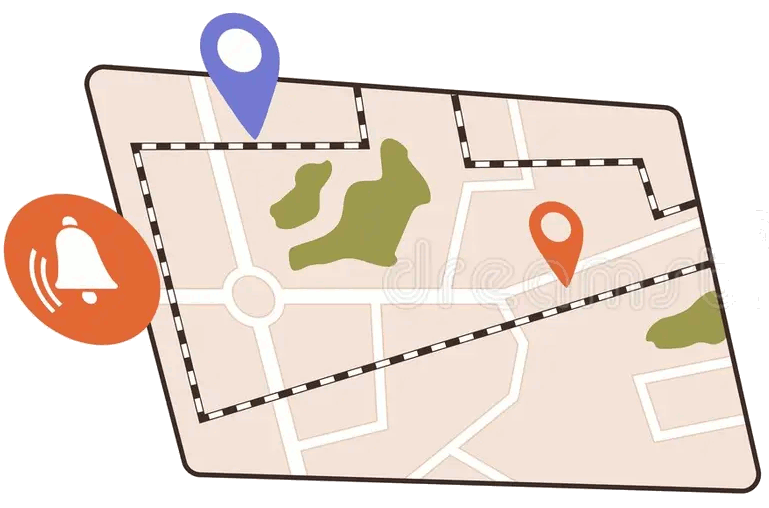
A geofence is a virtual boundary created around a specific geographic location using GPS, cellular, or Wi-Fi data. It triggers actions—like alerts, notifications, or marketing messages—when a device enters or exits the predefined area. These boundaries are drawn on map interfaces in applications for fleet management, marketing, or security. (Assistant)
|

Geofence location |
- While Waymo is expanding, service is restricted to specific, high-density, geofenced areas in select cities, including Phoenix, Los Angeles, San Francisco, and parts of Texas.
-
In cities like Austin and Atlanta, Waymo partners with Uber, but service is still limited to specific, high-demand, high-frequency zones rather than city-wide access.
- Without being in these designated zones, you cannot currently hail a ride.
- The service is moving from limited,, specialized areas to more comprehensive coverage within these cities, including freeway driving
which is currently prohibited.
- To use the service, you must check the official Waymo App or Waymo website to confirm if your specific location is within the active coverage, often referred to as their operating domain.
|
A geofence is a virtual "perimeter" or "fence" around a given geographic feature. A geofence can be dynamically generated (as in a radius around a point location) or match a predefined set of boundaries (such as school zones or neighborhood boundaries). (Wikipedia)
|
Geofences applications |
- Some of the common uses of geofence technology include the following.
- Retail
and marketing where stores, malls, and competitor locations
use it for targeted ads, such as sending a coupon as a customer
who enters a shopping center.
- Security and safety in residential areas, school zones, or fenced work sites to track individuals or prevent unauthorized access.
-
Logistics and asset management in airports, parking lots, warehouses, and construction sites to monitor vehicle or equipment movement.
- Service and productivity monitoring in specific work sites to automate time tracking or notify managers of arrivals/departures.
-
Personal user-defined 'places' such as, 'home' or 'school' to receive alerts when family members enter or leave
or for smart home automation.
|
Geofencing was invented in the early 1990s and patented in 1995 by American inventor Michael Dimino, using the first-of-its-kind GPS and GSM technology for a tracking system to locate objects anywhere on the globe from a remote location. Cellular geofencing for global tracking is cited in the United States Patent Office over 240 times by major companies such as IBM and Microsoft since 1995. (Wikipedia)
|

Geofence public use |
-
Geofence technology is also used for public transport information systems.
- In legal work it is used by law enforcement for 'geofence warrants' to identify all mobile devices present within a specific, restricted area during a set timeframe.
- However, the technology has also raised significant privacy concerns, particularly regarding its use by law enforcement to issue geofence warrants to collect data on all individuals within a specific area.
- Suspicious activity could trigger an alert to the device's user as well as messaging to the geofence operator
and this information, could contain vehicle location data that could be sent to a mobile telephone or an email account.
|
Target Corporation settled for $5 million with the
San Diego City Attorney in April 2022, promising to
audit and improve pricing procedures, after a San
Diego complaint that the company used geofencing to
raise prices when a customer entered a store. (Wikipedia)
|
SpyToMobile (SpyToMobile.com)., CC BY-SA 4.0 , via Wikimedia Commons
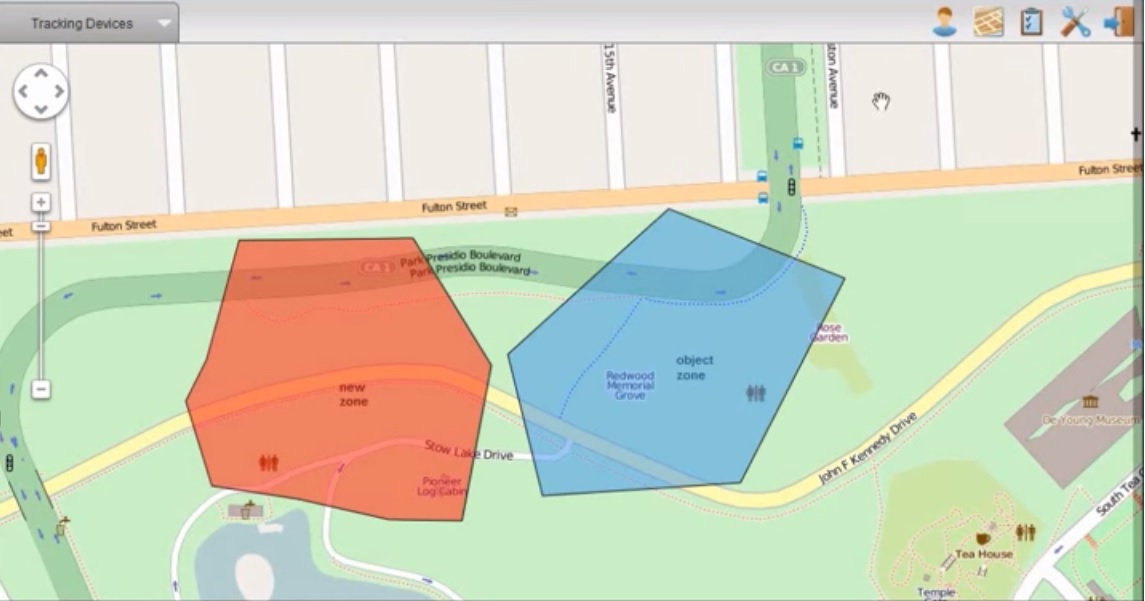
Two geofences defined in a GPS application |
|
- There is a very specific technical application
setup which is defined by latitude and longitude coordinates with a set radius to create a circle or polygon.
- It includes technologies such as GPS, Wi-Fi, or cellular data to trigger notifications.
- Geofence types can be static (fixed around a location) or dynamic (moves with a user or vehicle).
-
The technology uses different types of targeting to identify zip codes, street addresses, GPS coordinates using latitude and longitude, as well as IP targeting.
|
It is possible to monitor several geofences at once
(multiple active geofences). The number of active
geofences on Android devices is limited to 100 per app
and per user. It is possible to monitor different type of triggering activity for each geofence separately—entrance, exit, or dwell in the monitored area. (Wikipedia)
|

Location tracking |
- Before it is possible to start using the geofencing method,
it is necessary for a user to allow location tracking if
you're wondering why your browser and phone are always asking
for your permission now.
- There are two types of geofencing
active, foreground real-time, and passive, background
inactive state, and choice of type depends on the purpose of using geofencing in a given situation
- It is not necessary to implement any additional hardware to function
and this service is available for both Android and iOS operating systems.
|
During the use of Starlink satellites in the Russo-Ukrainian War, SpaceX used geofencing to limit the use of Starlink Internet services outside the borders of Ukraine such as in Russian-occupied territories in Ukraine. (Wikipedia)
|
Tesla, Public
domain, via
Wikimedia Commons |
- Another company promoting this hype about autonomous
vehicles is Tesla,
who describes their product as 'full self-driving' except they
require eyes on the road and hands by the wheel.
- Tesla
doesn't use geofencing technology.
- Currently, Tesla is running limited, often supervised,
rideshare trials in cities like Austin and San Francisco using
Model Y vehicles, featuring lower costs but higher wait times
compared to competitors like Waymo.
- Tesla is developing a dedicated, steering-wheel-less autonomous
'Cybercab' for its robotaxi network, with production aimed for
2026 but they have a long way to go before they could ever
truthfully claim that their vehicles are autonomous.
Homing pigeon |
- The thing no one is hearing much about, is that when any
of these vehicles have problems, they require the intervention
of a human to tell them what to do.
- While aimed at reducing accidents, AVs struggle with complex, non-standardized scenarios, causing failures in recognizing obstacles or reacting to erratic human driving.
- AVs often fail to handle unexpected, rare situations ("edge cases") such as unpredictable pedestrian behavior or unusual construction zones, which requires the AI to have human-like judgment.
- Plus, like we already
pointed out, the Waymo's only operate in carefully controlled geofence zones.
- Self-driving cars are coming
soon, to a city near you, but yet no one really knows how many
humans it takes to operate them.
- Yet both of these
companies are touting their robotaxis, but why are they having
so many problems getting it right?
- Which company could be
the first to obtain a trillion dollar market with their
product?

Two very different
solutions |
- There are two main players already vying to bring
robotaxis to American roads.
- Although, Waymo and Tesla
have two very different approaches to autonomy.
- When you
see both vehicles side by side, this becomes very apparent.
- It comes down to one company using LiDAR, and the other
using cameras only.
|
LiDAR (Light Detection and Ranging) is a remote sensing technology that uses pulsed laser light to measure distances, creating high-resolution 3D point clouds of environments. It works by measuring the time a laser pulse takes to return to a sensor, often deployed via aircraft or vehicles. Common types include topographic (terrain) and bathymetric (water)
LiDAR. (Assistant)
|
Dllu, CC BY 4.0 , via Wikimedia Commons
Waymo
LiDAR |
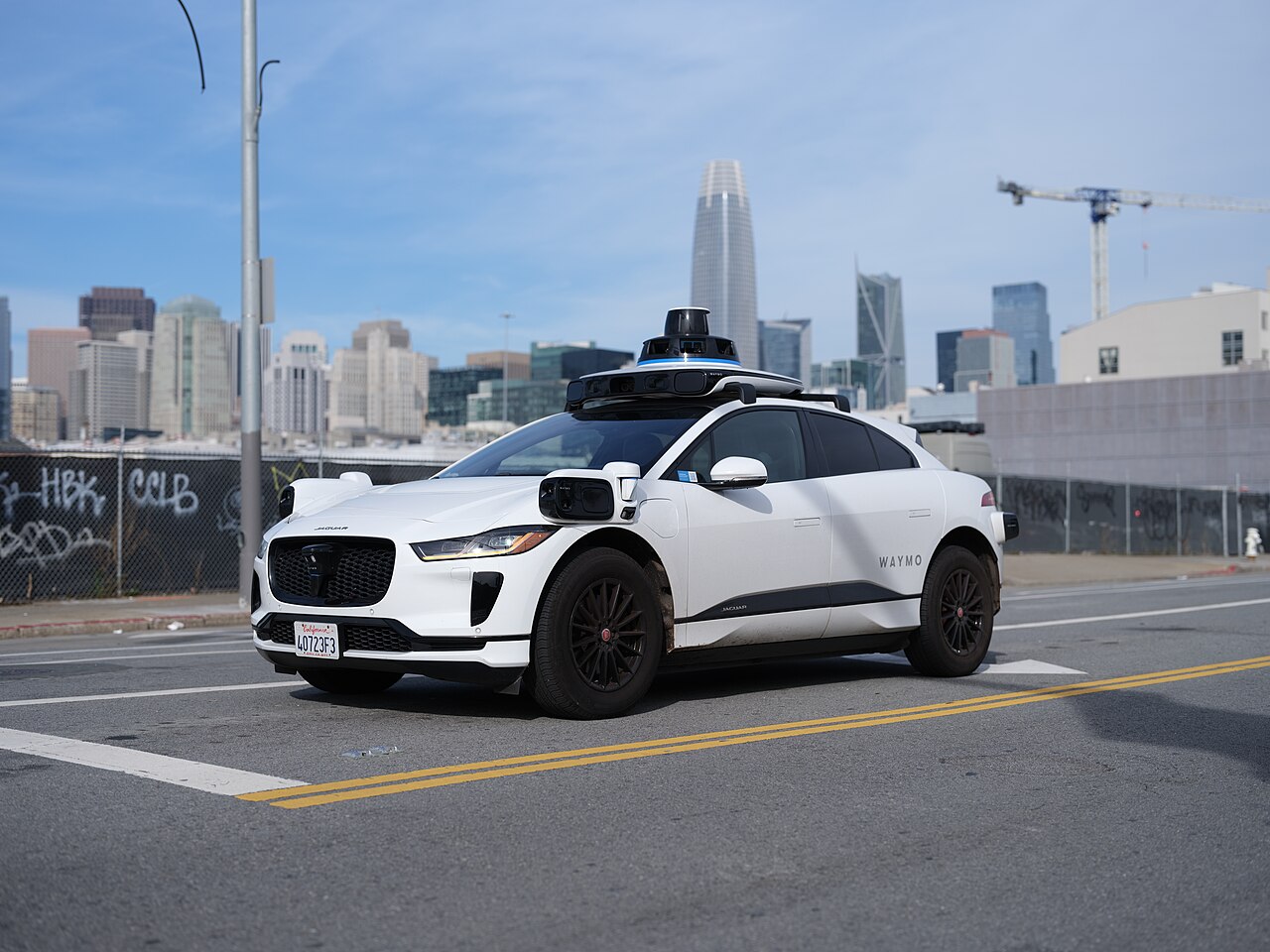
- The Waymo has LiDAR, radar, 29 cameras all around the
vehicle which gives it the appearance of a high-tech space
ship.
- LiDAR technology spins out laser pulses to build
a high-resolution map of nearby cars, cyclists, and
pedestrians.
- Radar makes use of radio waves to track how
fast objects are moving and how far away they are, even
through elements like snow, rain, fog and dust.
- The
multiple cameras are used to read colors, signs, and signals.
|
In October 2018, the California Department of Motor Vehicles issued a permit for Waymo to operate cars without safety drivers. Waymo was the first company to receive a permit for day and night testing on public roads and highways.. (Assistant)
|
_MYLE_Festival_2025_DSC_9565.jpg)
Alexander Migl, CC BY-SA 4.0 , via Wikimedia Commons
Tesla Model Y |
- Tesla has just eight cameras, barely visible at all, in
fact, Elon Musk has called LiDAR a fool's errand and something
that is expensive and unnecessary.
- The camera-only
approach has an advantage, cost, because it's way cheaper to
have a self-driving car navigate with cameras and AI than to
have all the additional sensors that a Waymo does.
- But
there's a downside and most experts say if you're serious
about self-driving, a camera-only
approach will never truly be safe.
- Some feel using
camera-only is like tying one hand behind your back and it
also makes perfecting the technology a lot harder to
accomplish.
|
As of late 2025, there have been hundreds of reported accidents and at least 65 fatalities involving Tesla's Autopilot/FSD systems, with 54 verified by U.S. regulators. Data suggests over 1,000+ total crashes reported since 2021, including dozens of recent incidents where FSD violated traffic laws, leading to a 2025 federal probe. (Assistant)
|

Full Self-Driving |
- Major problems with Tesla’s Full Self-Driving (FSD) include dangerous phantom braking, unexpected disengagements, poor handling of complex urban intersections, and erratic behavior in low-visibility, notes.
- Despite improvements, the system still struggles with 'edge cases,' requiring constant human supervision to prevent accidents due to sudden, unanticipated movements.
- While some vehicles are operating truly driverless, many initial tests have relied on safety monitors in the passenger seat to comply with regulations and ensure safety.
- However, if Musk could ever prove that the camera-only
approach is safe, he's already promised that every Tesla on the road could be modified
and become self-driving.
|
While designed for full autonomy, reports suggest that in some scenarios, Tesla’s remote assistance workers can take temporary control of the vehicle to resolve situations. (Assistant)
|

FSD engaged |
- FSD is a level 2 system which will never require Tesla to accept liability for anything, especially when they have now updated the marketing to say exactly that.
-
NHTSA said it has six reports in which a Tesla vehicle, operating with FSD engaged, approached an intersection with a red traffic signal, continued to travel into the intersection against the red light and was subsequently involved in a crash with other motor vehicles in the intersection.
- A driver in Houston in 2024 told NHTSA that FSD is not recognizing traffic signals
and this results in the vehicle proceeding through red lights, and stopping at green lights.
- The complaint added: "Tesla doesn't want to fix it, or even acknowledge the problem, even though they've done a test drive with me and seen the issue with their own eyes."

FSD behavior |
- NHTSA also said it will review FSD behavior when approaching railroad crossings
and they opened an investigation into 2.6 million Tesla
vehicles over reports of crashes involving a feature that lets
users move their cars remotely.
- Tesla's FSD, which is more advanced than its Autopilot system, has been under investigation by NHTSA for a year.
- The agency said it has reports of Tesla vehicles using FSD driving through red traffic lights and driving against the proper direction of travel during a lane change.
- The auto safety agency said FSD, an assistance system that requires drivers to pay attention and intervene if needed, has
induced vehicle behavior that violated traffic safety laws.
|
Major problems facing autonomous vehicles (AVs) include safety critical sensor failures in poor weather, complex liability, high costs, and software brittleness in unpredictable scenarios. Key challenges involve erratic driving behaviors, cybersecurity risks, pedestrian detection failures, and regulatory gaps.
(Assistant)
|
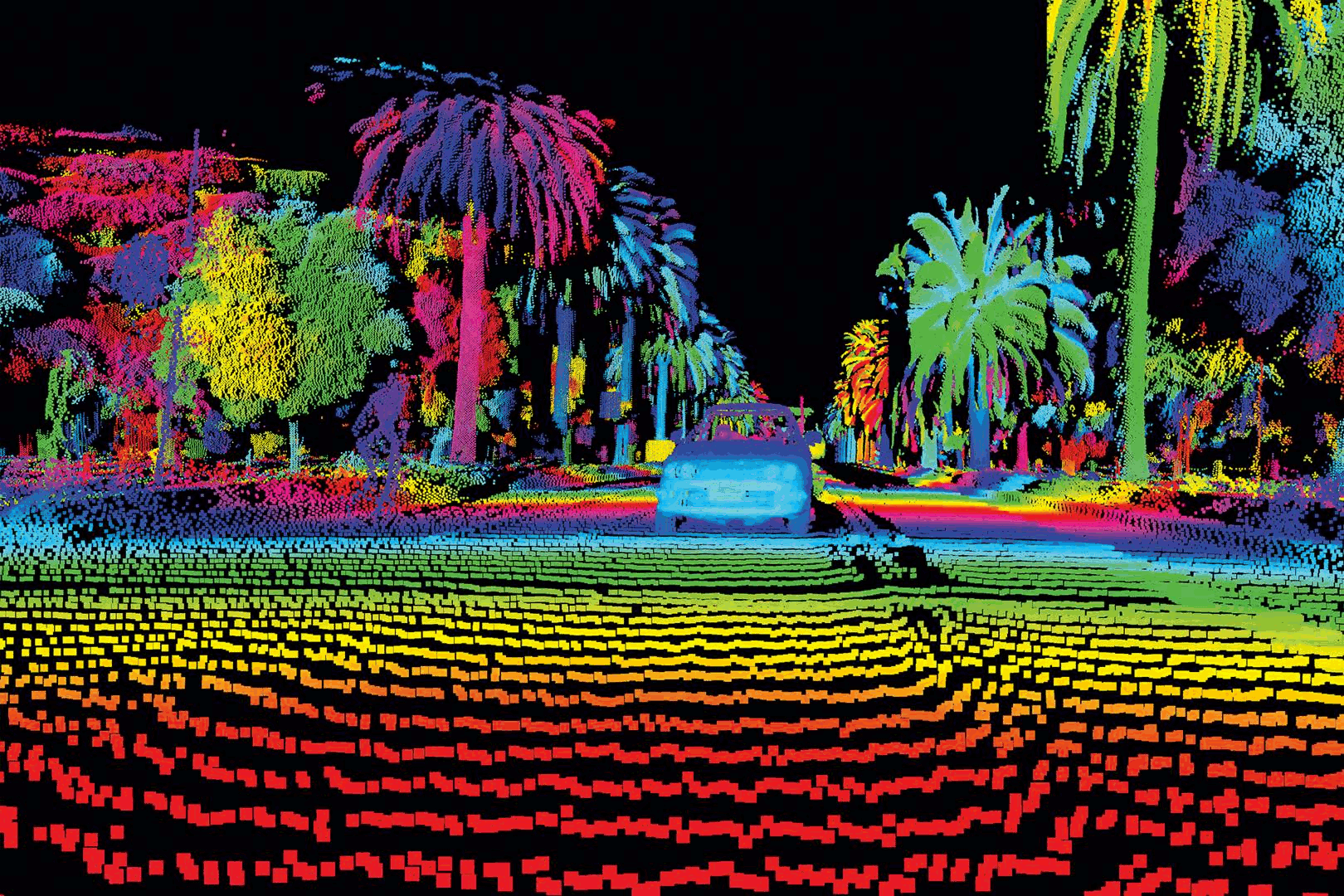
Image Courtesy: Wired.co.uk
LiDAR radar |
- There are several things that make autonomous vehicles different from
human drivers.
- Because there's a very long list of fairly
normal driving scenarios that robotaxis struggle with that
aren't an issue for any normally skilled human driver.
-
One big problem self-driving vehicles have is they have
trouble stopping for school buses and that includes both Tesla
and Waymo.
- Experts
in Austin, Texas, home of Tesla, proved that this was 100% of the time
when they first began testing and Waymo is having the same
issues.
- They can not only see the signs but also can't
see the flashing red lights.
|
The National Transportation Safety Board announced it would fold the latest incident into an ongoing safety investigation that began last year, when Austin ISD announced over 20 school bus safety violations involving Waymo's self-driving cars.
(cbsaustin.com)
|

Coming to your
neighborhood |
- Federal investigators
complained that a Tesla autonomous vehicle passed a stopped
school bus as it was loading and unloading students, the latest in a string of incidents that has drawn scrutiny from officials and
the community.
- The violations continued even after Tesla filed a software recall
recently with the National Highway Traffic Safety Administration
(NHTSA),
after which, during further testing, additional infractions were recorded.
- Additionally, the vehicles were ignoring the school
speed limit zones.
|
Elon talks about how FSD is x times safer than a human driver. Even if you take away all of the controversy surrounding the context of what constitutes those miles, that fundamentally doesn’t matter at the end. What matters is “will Tesla feel confident enough to take responsibility?” When you drive a car and get into a crash, whether you’re distracted or drunk or something, that’s your fault. If you die because of something wrong with a driverless car, that’s the car’s fault. It takes control and culpability away from the customer, which brings a whole different level of scrutiny. (teslamotorsclub.com)
|
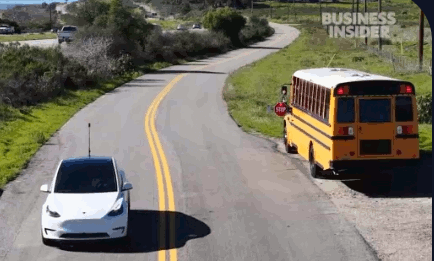
Tesla passing a
school bus with stop
sign out |
-
Consumers are complaining and 90% agree that Tesla vehicles
should be banned immediately and question why NHTSA allow the
company full self-driving.
- However, upon hearing this
news, Tesla didn't do a thing, although they did send the Dawn
Project who was monitoring them a cease and desist notice.
- Many feel that consumers should boycott Tesla until the
company proves that their full self-driving software (FSD) is
safe.
- The company has made improvements, but 1 out of 5
times the vehicle still will not stop.
- But it's not just
Tesla, Waymo is under investigation in Austin for passing
school buses, and in Santa Monica, a Waymo hit a 9-year-old
outside a school.
|
The Dawn Project’s mission is to identify and call out the software that puts humanity at risk and to demand that defective and insecure software be replaced with software that never fails and can’t be hacked.
(dawnproject.com)
|

Keep out |
- Both Waymo and Tesla's full self-driving software has major design
flaws, like driving on the wrong side of the road.
- They
also can't see 'one-way' or 'do-not-enter' sign on both sides of
the street and will invariably end up driving the wrong way.
- Traveling the wrong way on a one-way street could land any
driver in hot water, especially in a school zone but what happens when there is no driver to blame?
- That’s the question police officers found themselves asking after an autonomous Waymo drove the opposite way on a one-way street outside
an elementary school.
- There are video's all over the news
with autonomous vehicles that were filmed trying to go the wrong
way onto HOV lanes during rush hour traffic, or driving on the
wrong side of the road.

Public domain, via Wikimedia Commons
Safety
guidelines |
- The SAE has defined 6 levels of automation for
autonomous vehicles.
- Level Zero is a car that has no
automation and that's the majority of cars on the road today
although driver assistance is provided in the form of
warnings, for example, blind spot or lane departure warnings.
- Level One automation is when the car can steer and brake on
its own, but not both at the same time, and that's similar to
the lane assist currently available in vehicles like the Honda
CR-V, however, the driver is fully in command with assistance
from the automated feature.
- This may be in the form of automated acceleration and braking, as in the case of adaptive cruise control, in which the speed of the car adjusts automatically to keep up with the speed of traffic at a safe distance; or automated steering, in which the driver is assisted by features such as lane centering.
- Level Two is somewhat more complicated and it's
where most of today's self-driving hype resides, meaning the
vehicle can steer, accelerate and brake on its own, but it requires a
human to still be fully operating the vehicle and paying attention to the road.
|
SAE International: A global professional association and standards organization, formerly known as the Society of Automotive Engineers, focusing on automotive and aerospace engineering.
(Assistant)
|
Street regulations |
- Even though it seems way more capable, Tesla FSD is
still only a level two driver assist program.
- In fact,
Tesla will even give the driver a warning if they take their
eyes off the road too long and that allows them to evade all
the robotaxi regulations because they only apply when the
company claims their vehicles are level three or above.
-
Another thing about level three is that it comes with what
engineers call the handoff problem, meaning that it's
automated until suddenly it calls for human assistance and
then a real driver needs to step in right away.

Stuck |
- Level Four is where things start to look and feel more
autonomous because there"s nobody in the driver's seat.
- At this level, a vehicle is fully self-operational within set boundaries, requiring no attention or assistance from a human driver, and indeed may not include features such as pedals or a steering wheel.
- Examples of stage 4 self-driving vehicles include local driverless taxis operating within
'geofenced' boundaries.
- Waymo is level four most of the time, but sometimes they get
stuck and when that happens they must phone in for help and
that human intervention assists the robotaxi to complete the
driving task.
-
That interaction classes the vehicle as partially human driven
proving that they're not really even attaining a full level
four classification.
- Level Five means that the vehicle
can drive itself anywhere at any time, and under any
circumstances, it's the goal of full autonomy, but it doesn't
exist yet.
- Fully self-driving vehicles that require no driver assistance or monitoring and operate without boundaries or conditions.
- While there is work being done on this technology, experts’ predictions of the timing of its implementation and availability vary widely.

Weather conditions |
- There's another thing that's keeping robotaxis from
being fully autonomous and that's Mother Nature.
- Autonomous vehicles face significant challenges in bad
weather, as rain, snow, and fog impair sensors that Waymo
employs such as the LiDAR, cameras, and radar, reducing visibility and detection capabilities.
- LiDAR creates a 3-D map of the environment which
typically includes street infrastructure, other vehicles,
pedestrians, traffic lights, and road signs.
-
Powerful computer systems process the gathered data and make decisions about vehicle operations, continually adjusting steering, cruising speed, acceleration, and braking, as sensors communicate constant changes about the vehicles’ surroundings.
- While designed for ideal conditions, companies are mitigating this using sensor fusion, cleaning systems, and advanced AI training to handle adverse conditions.
- Water droplets distort camera images and block sensor emitters
and heavy rain can completely disrupt radar functionality.
|
Machine learning and artificial intelligence are foundational elements of automated vehicle systems. Through machine learning, vehicles are trained to learn from the complex data that they receive to improve the algorithms that they operate under and to expand their ability to navigate the road. Artificial intelligence enables vehicles’ systems to make decisions about how to operate without needing specific instructions for each potential situation encountered while driving.
(Britannica)
|

Snow fall |
|
- For cameras and sensors, snow is especially problematic
because it can erase lines on the road and make everything
look like a blank white sheet.
- Plus, those snowflakes can
create noise inside the LiDAR sensors and even block the
cameras.
- Snow obscures lane markings and road signs, while snow accumulation blocks sensors
and snow scattering can cause false readings of obstacles.
- Waymo says their vehicles are already driving year round in
10 states, including New York, Michigan, Colorado and
Minnesota and they performed tests in California.
- The
Jaquar I-Pace Waymo's already have sensor cleaning technology
and the upcoming Ojai model will have more improved cleaning
for more severe weather conditions.

Snowy |
|
- Although there are Tesla videos with vehicles driving in
snow in FSD mode and the owners say they can handle it pretty
well, Waymo admits that winter weather driving conditions are
underrepresented in their training models.
- In order to
make up for that training when they don't have cars in winter
scenarios, they've added to their simulated models to help
train them to improve dealing with winter weather.
- But
there are other problems too, strong, direct sunlight or glare
can blind camera sensors, similar to what human drivers also
encounter.
- Those
simulations can also be used to deal with what engineers call
long tail problem.
- Things like encountering wet cement or a car
hauling something that is hanging out the back because these
can all constitute rare safety cases.
|
Waymo's world model is an AI-generated video game
with a virtual Waymo car driving in a virtual world
that is so realistic that the car behaves exactly like
it would on a real road. Waymo can now simulate any
scenario they want safely to greatly expand on rare
scenarios, such as people in costumes on Halloween.
(Vincent Vanhoucke)
|

Dry condition |
|
- Waymo recently
unveiled 'World Model' which can help mitigate some of these
rare safety issues because they can transform models from a
dry condition to a snowy one.
-
This allows the driver to multiply the data the vehicle is
familiar with and while Waymo admits that there is a long list
of these long tail situations, the simulations have allowed
them to reach levels of performance that are showing results.
- It's hard to wrap your head around how simulations of a road
with wet conditions and the same road shown in dry conditions
can help the Waymo vehicle navigate better but this is all
part of AI in use.
- This is because the Waymo World Model
can help vehicles learn from situations that they may never
actually encounter in real life.
|
Waymo uses a centralized, fleet-learning approach where the "Waymo Driver"—the AI software—is trained, and that knowledge is shared across all vehicles in the fleet. (Assistant)
|

Long tail 'edge' case |
|
- Some of
the demonstrations they have on their website include things
like driving into a tornado and a charging elephant.
- But the
biggest problem with the simulation is that if it doesn't have
something in it that you actually encounter, like a cow in the
middle of a street, then you'll never train against it.
-
So simulations can help but if the particular scenario is not
included, Waymo engineers have not really solved the problem.
- Which makes you wonder why they don't use all their camera's
to simply get out of the way of anything obstructing the road
instead of having to program each unique case.
- Before
they can truly say their vehicles are safer than human
drivers, robotaxis will need to clock literally billions of
miles, maybe trillions of miles so they can program for as
many of these 'edge' cases as possible.
|
Waymo vehicles are extensively trained using a combination of real-world driving data, closed-course testing, and complex simulations to learn from millions of miles of experience. This machine learning approach allows the AI to handle complex scenarios, such as navigating city streets or freeways, rather than being programmed for every specific situation. (Assistant)
|

Public outcry |
|
- The engineers from Dawn Project claim that humans are
not nearly as dangerous as the self-driving vehicle industry
would like us to believe.
- Humans actually have a pretty
good track record but we have a lot of fatalities because
there are trillions of miles driven, it's just a numbers game.
- But there's no amount of computing power that can predict
how the public will react when something goes wrong.
- For
example, there was a cat who darted under a car and a
bystander tried to coax the cat out, but the Waymo drove away
and killed the cat.
- In this case, a human driver might
have seen the individual searching under the car and
investigated before pulling away.

Step up |
- This led to a huge
public outcry in the neighborhood, there were protesters and a
media conference with some elected officials.
- But it's
not that animals aren't killed every day by all kinds of
vehicles, however, it brings negative attention to every
robotaxi driving through the neighborhood, especially when it
is some new tech that consumers are watching closely.
-
Many feel that companies like Tesla and Waymo have a long way
to go before they earn the trust of the people and they
haven't necessarily been good about stepping up and showing
concern.
- A single incident can bring down down a
multi-billion dollar fleet and in San Francisco, that already
happened.
- Cruz, which was operated by GM, suspended
operations in 2023 after one of its cars dragged a woman
underneath and she was seriously injured and that was the
death knell for that service in the city.
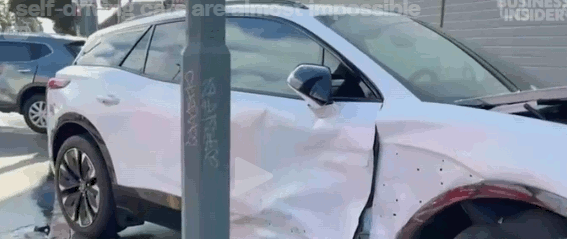
Robotaxi graveyard |
|
- There are also robotaxi graveyards starting to appear
with many seriously damaged cabs.
- It's clear that
self-driving cabs pose a risk to both pedestrians and their
pets and they are leaving a huge amount of damaged vehicles in
some cities just laying around collecting dust.
- Yet, even
if that safety record improves, none of these companies can
answer the trillion dollar question, how many people does it
take to drive a robotaxi?
- Congress grilled Waymo on where
its remote assistance workers are located and Waymo said they
had already revealed this to regulators in the media.

Philippines
|
- But Congress asked them in what countries are these
employees located and this was the first time many were aware
of it.
- They admitted they are in the Philippines and
Congress let company officials know that this is completely
unacceptable.
- Waymo revealed they have around 70 remote
assistance agents on duty and around half of them are
overseas.
- The main problem is that if some of their
employees aren't even in the U.S., you have some issues of
jurisdiction and accountability.
- On top of that, there
are some issues that these remote employees were not able to
resolve,

Media
|
- Some areas around the country still have terrible cell
phone service so there is no way to communicate with the
remote staff, even if they're in the U.S.
- The customer
is left stranded in the cab with no phone service and the
application doesn't work.
- This turned into a half hour
ordeal for one customer who had phone access to the remote
employees, however, the application didn't work and gave him a
blank screen.
- As a result, they were unable to get the
trip started again and had to send a second cab to take him
the rest of the way.
- One member of the media who reports
on robotaxis reported that the number of employees who support
Waymo is hazy because there are some in call centers, the
remote support agents, but also people at their depots who
charge and maintain the robotaxis.
- But also their are
engineers who are supporting the entire operation.

Call center |
- The number of employees who interact shows the maturity
of the technology, or how autonomous are the cars if you
constantly need a human holding its hand.
- This was made
brutally clear in 2025 when a major blackout in San Francisco
showed how fragile current AV systems are.
- More than 800
Waymo vehicles were in the outage area and experienced over
1,500 stoppages.
- Waymo admitted that 96% of those
stoppages resolved autonomously, but the remaining vehicles
blocked intersections and created problems for first
responders and other drivers.
- Something as common as a
blackout should have been part of the simulation, and even if
it was, Waymo appeared very unprepared.

Autonomous EV |
- All of Waymo's driverless taxis are electric vehicles, as are self-driving cars from competitors like Amazon's Zoox and Tesla.
- These autonomous EV rides have the potential to replace trips in gas-powered vehicles
but there are problems that can occur.
- Extreme cold can reduce electric vehicle (EV) driving range by over 40% and impact battery performance.
- Although this occurs in vehicles that are not autonomous
as well.
- The lithium-ion batteries used in self-driving vehicles pose a fire hazard if they overheat
and lithium-ion batteries may explode if they catch fire, and the fire can spread to other vehicle systems.
- You can’t put out a lithium-ion battery fire with water or a fire extinguisher, which makes it challenging to contain these fires.

Maintenance depots |
-
A visit to the San Francisco depot showed there had to be
anywhere from 70 to 100 people working there at that time.
- There were several different work functions servicing the
Waymo's as they came in.
- Some workers took care of
vehicles in charging stations, some were vacuuming and
cleaning.
- There were many different lights they placed
atop each vehicle that indicated what kind of service the taxi
required at that time.
- Of course, this is standard
service that every taxi service would have to carry out.
-
There are also Waymo drivers who get paid to sit in the
drivers seat of the car and either drive manually and his
moves, everything he does are recorded and sent back to add to
the programming.

Public roads |
- Or he could be driving in autonomous mode and performing
what he calls triage and using buttons on the steering wheel
to send data back to the developers.
- From time to time he
drifts off and the seat notices and buzzes and shakes him
awake.
- So while the operation of these robotaxis might
look sleek from the outside, there's humans interacting at
every step of the way, driving them to program the simulation
or train them, tagging data on the backend, cleaning,
servicing them, handling remote operator calls.
- An
expert claimed that people like to think that we're 99% there
because there are hundreds, and in one case, even a couple
thousand of these robotaxis out there on public roads driving
around and it feels like we're almost there, that it's just
about solved and almost done.

Cost reduction |
- But it's really quite a different story, the difference
between having a couple hundred robotaxis versus a couple
million is dramatic.
- There are still many, many issues
with safety and deployment and scalability so there is still a
long way to go.
- It's clear that owning and operating a
fleet of vehicles is an astronomical cost so that's why
anybody who's trying to make a robotaxi business work is
attempting to reduce those costs as quickly as possible.
-
The newest generation of cars won't be the Jaquar I-Pace which
cost an estimated $150,000, but rather, they'll be based on
the Hyundai Ioniq which is estimated to be about half the
cost.
- What remains unclear is how much that cost
reduction will help Waymo close the gap in pricing with other
rideshare services like Uber and Lyft.
- Current pricing
shows that Lyft is now the winner at $12 and Uber is about $22
on average.

Pricey |
- Some financial expert contend that Waymo needs to be
targeting more expensive rides, like $30, to make the numbers
work on their current $126 billion valuation.
- Waymo is
still struggling to find the right vehicle models, service
options and niche and right now they don't have the exact
formula to 'know how to do it.'
- They're trying to keep
all the doors open because they're still learning a lot and
they've teamed up in various cities with companies like Uber,
Lfyt and Avis to manage their fleets.
- Right now it's a
real hodgepodge because every city is different, for instance,
in one city Waymo rides are booked through the Uber app and they manage
the fleet and they have different models in all their
locations.
- Recently they've joined with Doordash doing
deliveries and they've been paying Doordashers to show up at
stranded Waymo's just to close the doors.
Radically different |
- Tesla's model is radically different and they're selling
cars to consumers today with the promise that in the future
they'll become self-driving cabs that can earn money for the
owners when they're not using them.
- Musk claims it will
be like an Air-Bnb, you can add or subtract your car to the
fleet whenever you want and when it's added to the fleet it
makes money for you while you're gone.
- Morgan Stanley
analysts expect one million Tesla cyber cabs on the rod by
2035.
- They're projecting that robotaxis will take over a
third of all rideshare miles in the years to come.
- But
overall, self-driving car use will remain pretty flat.
-
However, if robotaxis remain a novelty, how will these
companies deliver on their biggest promise, that their cars
are safer than human drivers?

Accident rate |
- Every year there are over 40,000 deaths on American
roads, that makes the country the most dangerous developed
nation to drive in.
- That's a death rate of about 12
people per 100,000 population.
- It's possible this is
because drivers are driving more miles than ever before and
they're more distracted.
- The argument goes that robotaxi
never drives drunk or get tired, and that they're already
safer than human drivers.
- As we see more of them on the
road, that they could reduce traffic fatalities to near zero
but there's not really enough data to prove any of these
claims.
- Waymo does have a pretty good track record so
far, however on par with Uber and Lyft drivers they have
accidents about 4 to 6 times more often than your average
driver.
- So really, all this says is that Waymo is on par
with a more high accident population.

Radically different |
- However some experts have already seen enough to say
that robotaxis will make streets even more dangerous.
- In
2023, as robotaxis started to take over the streets of San
Francisco, a group of activists calling themselves 'Safe
Street Rebels' started staging protests.
- Basically, they
figured out that if you take an orange traffic cone and put it
on the hood of a Waymo, it can stop it dead in its tracks.
- The group was proving that through a very passive and
peaceful placing of a cone, that this technology is not as
good as it seems.
- They seemed to discover this by
accident so what other things could go wrong that haven't been
anticipated?
- The group never once destroyed or damaged
any cars, and they weren't vandals but they were also showing
that the technology just in its inherent form didn't work very
well.
Fallen reputation |
- But also, in Los Angeles, in some of the anti-Ice
protests, people took their rage out on Waymo's so there's a
lot of hostility toward this type of technology, more than
likely because of the manner that people feel like it's being
pushed on them to replace them and their jobs.
- Plus the
fact there have been a lot of problems in the implementation
and they haven't proved they're street safe yet, but the
companies, especially Tesla seem like they want to ignore.
- Some of the problems were handled with such indifference
causing some people to make comments like every time they see
one in their neighborhood, they spit on it.
- With all of
Musk's dealing with Trump, that also left a bitter taste for
many and Tesla's have been heavily vandalized, and not just
his autonomous vehicles.
- And with fallen angels like
Musk running things, no wonder.
Downhill |
- Also, they've done things to 'beat' the regulations like
claiming they're FSD when they're not.
- They've hired
workers in foreign countries which not only cause problems
with jurisdiction, but Americans have a hard time
understanding so many of the foreign workers in call centers,
that's left a negative taste as well.
- Leading some to
acknowledge that people are really fed up with big tech right
now, they're tired of the ways that corporations have gotten
away with so much.
- To see how many times Waymo has
injured someone, or their pet, injured someone's loved one and
caused havoc.
- Seeing all the times that Waymo and Tesla
have messed up, you have to ask who's being prioritized, is it
the driverless car companies or is it the citizens?
- It
really appears to be the driverless car companies and people
are fed up.
Who's being
protected? |
- Plus, adding cars to this situation, isn't going to make
it any safer.
- Also, some are working now on building a
more driverless future and when they see the FSD vehicles
speeding around bicycle riders, it's very frustrating.
-
For instance, there are neighborhoods in San Francisco now
where traffic barriers have been installed to slow traffic
down, except FSD vehicles don't really understand the
barriers.
- Many of these streets are not set up for cars
to travel through to other destinations, they're made to drive
a short distance up a short block, and then get out and Waymo's
don't follow these rules.
- Proving that if the goal is for
fewer people dying on our roads, autonomy isn't the only
answer, and it might not be the best one.
- For example,
last year Helsinki, Finland, announced they had achieved zero
traffic deaths and they didn't accomplish this with
self-driving cars.
- They didn't wait for AI to solve human
behavior, they did it by slowing cars down and using alternative
forms of transportation.
- They certainly didn't wait for
Musk to solve the problem, the logic was simple, slower cars
mean fewer deaths.

City design |
- On top of that, a full half of traffic fatalities are
people who don't use their seatbelts, FSD isn't going to solve
that.
- As we pour billions into teaching cars how to drive
like humans, what if we design cities that have slower and
safer streets instead.
- You have to ask what happens next,
Waymo keeps expanding yet still aren't fully self-driving and
Tesla keeps shipping new versions of FSD that still fail
tests.
- But truthfully, highway driving will be an
albatross around their neck because the faster they drive, the
more accidents and deaths.
- Yet they really haven't been
fully implemented on freeways for the most part.
- The more
that Waymo increases their fleet sizes, the more the problems
are starting to show.
|
Driverless is not here.
Self driving cars are tech-bro playthings, not a safe alternative.
Autonomous vehicles are currently not the answer to traffic fatalities. Robotaxis are being tested in cities without consent of the residents and without proper oversight. These cars regularly fail at basic driving tasks, leading to negative outcomes. (autosafety.org)
|

Scale up mode |
- Right now Tesla is not even in scale up mode, they're
still trying to get their technology reliable enough that they
can start to scale without human drivers involved.
- This
is not an overnight success story, this has always been a
multi-decade accomplishment, and there's at least another
decade or two to go and they're already two decades into it.
- So if Waymo remains a city-by-city grind, and Tesla's
remain a driver assist system, where will we see full level
five drive anywhere, and where will full autonomy first occur?
- The
answer is in places like ports where there is a constant
stream of large trucks and shipping containers getting
unloaded from ships and coming and going all day.
- It will
be much easier to succeed and we've already seen successes in
things like transportation-enclosed environments like ports
and logistics hubs.
- Those are the easy pickings, and
that's where it will be much easier to have success.
|
Self-driving vehicles are expensive. Consumers could pay hundreds of thousands more for fully automated cars when they hit the market. Consequently, self-driving vehicles will be luxury vehicles only wealthy consumers can afford. Since different laws govern self-driving vehicles in many states, introducing fully autonomous vehicles to roadways will change driving laws and could affect legal claims from self-driving vehicle accidents. (askadamskutner.com)
|

Autonomous
operations |
- A company called Kodiak runs highly autonomous
operations in shipping, the owner of the company left
self-driving tech because this offered a more realistic path
to real-world autonomy.
- Kodiak's approach reflects where
most experts think that autonomy will arrive first.
- In
closed environments like mining, level five has been a thing
for a long time because it's the perfect setting, dull, dirty
and dangerous.
- You can control the environment and the
people working in it, however they still have employees
controlling things.
- One operator can control 20 vehicles.
- Undoubtedly, autonomous driving may come one day, however
now it feels like a driver just learning how to drive, a
little too hesitant, a little too heavy on the brake and
making many bad decisions.

Are they safer? |
- Another problem is that other drivers cut the FSD
vehicles off a lot because they know it's not a person driving
and that causes them to make quick stops and herky jerky actions
which makes the riders feel like they'll get a whiplash.
- If a Uber driver drove like that they would get low ratings.
- So are they safer than humans, well it's a very weak
argument for the general public because high-level statistics
about safety are not how people judge these vehicles, they
judge them incident by incident.
- Any bad publicity is
worth more on how they judge this technology to the consumer
than statistics.
- However there has already been a high
rate of failure in the industry and the robotaxi endeavor.
|
Tesla says FSD "will drive you almost anywhere with your active supervision, requiring minimal intervention" but does not make the car self-driving. (reuters.com)
|

Not autonomous |
- Argo AI, the startups from Ford and VW, were shut down
and Apple quietly scrapped their self-driving car program
after spending billions.
- Uber and Lyft sold off their
autonomous vehicle units, however now they are reinvesting in
the technology.
- And more are entering the rideshare
space, Zoox owned by Amazon is operating in Las Vegas and San
Francisco, Nvidia wants to build the technology stack behind
all of it and Lucid is working on a robotaxi concept.
-
These robotaxis will continue to be a mix of impressive,
frustrating, and potentially dangerous, but know that whenever
you see a self-driving car on the road, someone, somewhere is
behind the wheel and this is even true in successful
industrial applications such as Kodiak who have been operating
for 15 years.
|
Oliver Carsten, a professor of transport safety at the University of Leeds, said the NHTSA investigation into Tesla "should serve as a wake-up call for Europe. We are seeing an increasing number of systems on the market that blur the line between assistance and automation." (reuters.com)
|

Long way to go |
-
If full automation were to be achieved, advocates of self-driving technology predict that it would bring about increased road safety, as human error would have been eliminated from driving.
- Though the terms self-driving or automated are commonly used interchangeably with autonomous, cars currently on the market are not capable of acting fully autonomously and cannot be operated without the intervention of a human driver.
- In fact, Tesla was forced to change the way it
advertised in China so they were not banned from the market
because they initially advertised there as FSD.
- The industry standard is to use the term automated.
|
Determining liability (manufacturer, owner, or software developer) in accidents is complex. Ethical dilemmas, such as decision-making in unavoidable accident scenarios, remain unresolved. (Assistant)
|

Robotaxi fails |
- A Waymo self driving car ignored two police officers in front of it, and ran over a fire hose.
- Despite numerous cameras and sensors, a self driving GM Cruise taxi crashed into a fire truck.
- A person got stuck underneath a GM Cruise robo-taxi and the car dragged them.
- The automated systems should provide ample warning about speed limit changes, stop signs, and other changes in road conditions.
- However, if the automated systems malfunction, they may not recognize road signs or alert you if you’re drifting from your lane
and relying on these systems can cause an accident if you don’t notice a problem until it’s too late.
- Current automated driving systems can’t anticipate what pedestrians or animals will do; therefore, drivers can’t rely on these systems to take steps to avoid hitting pedestrians or animals.
|
Videos from June 2025 showed Tesla’s driverless Robotaxis in Texas steering into oncoming lanes and speeding, prompting a federal inquiry into Elon Musk's autonomous vehicle technology. These vehicles reportedly navigated left-turn lanes improperly and veered into traffic, causing concerns over safety. (Assistant)
|

Vulnerable to
hacking |
- Self-driving cars rely on computer systems to function
and hackers can bypass firewalls and access these systems,
overriding your controls and redirecting your vehicle.
-
As connected devices, autonomous vehicles are vulnerable to hacking, which could compromise passenger safety and data privacy.
|
Criminals could use self-driving cars to cause accidents and gridlock. Hackers can also access systems to access your data, increasing the risk of identity theft. (askadamskutner.com)
|
Radiation exposure |
- Multiple systems in self-driving cars, including GPS navigation and tracking systems, Bluetooth, and radio systems release radiation.
- Even short-term exposure or exposure to small doses of radiation can cause headaches, migraines, insomnia, respiratory problems, and high blood pressure.
- Long-term radiation exposure or exposure to large amounts of radiation can cause severe health issues such as cancer.
- Long-term or large-dose exposure can also be fatal.

Modern grid systems |
- Widespread adoption requires costly updates, including
clearer road markings, smart traffic signals, and robust 5G
connectivity and this will be easier to accomplish in some
areas of the country, like Phoenix, because of more modern
roads and signage standards.
- Additionally, some city's
are set up on grid systems which make it easier for autonomous
systems to navigate.
- Critics of autonomous technology predict that full automation could lead to increased vehicle miles traveled, with a resulting increase in congestion and environmental pollution.
- The elimination of driving could enable urban sprawl by making it easier for commuters to live farther from their places of work.
- Lobbyists for autonomous vehicle companies (Waymo, GM Cruise, Amazon, Apple, etc.) are scrambling across every state in America to promote unproven benefits of AVs, and to craft state and federal laws that favor AV manufacturers, putting consumers at risk and keeping local authorities powerless.
|
By 2023 vehicles with partially automated systems, including lane-keeping assist, adaptive cruise control, and traffic jam assist, were on the market. Fully autonomous cars, however, are not available for purchase or use. Predictions for the availability of this technology vary. Stage 4 automation is predicted to be available to consumers by 2030–35. (Britannica)
|

Ox eye |
- Since we do know that we'll living in a fallen world,
run by fallen angels, we should be aware of what they're
attempting to do to us, because this huge push for
robotaxis appears to be an easy way for them to take more
of our freedoms away from us. - They've priced these
vehicles so far above the market, which is already totally
skewed, and no one will be able to own their own vehicle
and that's already in the works so then you'll be forced
into their dangerous cabs. - On top of that, knowing
what Musk (Satan) has been doing in this world, and
realizing that McCluskey (Lucifer) are up to. - Both are from Alpha Centauri and they've just about
destroyed earth already and have turned into a torture
device to keep all the angels they trapped here stuck
and knowing this should wake you up even more.
|
The phrase "You'll own nothing and be happy" is a well-known, often-cited quote that originated from a 2016 World Economic Forum (WEF) video and an essay written by Danish politician Ida Auken regarding a hypothetical future in 2030. (Assistant)
|

Henry VIII cage |
- Interesting, some 45
years ago when Musk took Sophia for a drive in the
DeLorean, in an attempt to travel back in time to change
the future, McCluskey
showed up a few weeks later and he was employed by an outfit that was
working on electric powered vehicles way back then. - A
long long time ago, and this has been going on a long
time. - Phoenix resident envisions Grand Canyon airship
and we should ask if these starships would have time
traveler Trump's name all over them, because both Trump
and McCluskey took turns playing Henry VIII in past lives
(older and younger versions).

Still falling |
- SpaceX Delays Starship Test Flight Again.
- Why Do SpaceX's Starships Keep Exploding? - His FSD doesn't work either. - But on top on all this, now Musk won't even allow
you to purchase his Tesla FSD vehicle outright, he's
demanding a $99 monthly subscription fee, guaranteed to
rise soon, to use this 'feature' that doesn't work
yet, after you pay full purchase price for the car. - "Self-Driving" Tesla Crashes Through Railroad Crossing Gates.
|
SpaceX’s Starship program has experienced multiple
failures in 2025 and 2026, including vehicles breaking
up in space, losing attitude control during re-entry,
and exploding during ground tests, with the FAA
frequently investigating these "rapid unscheduled
disassemblies". These setbacks, caused by issues like
hardware failures and structural shaking, have delayed
the program's timeline. (Assistant)
|
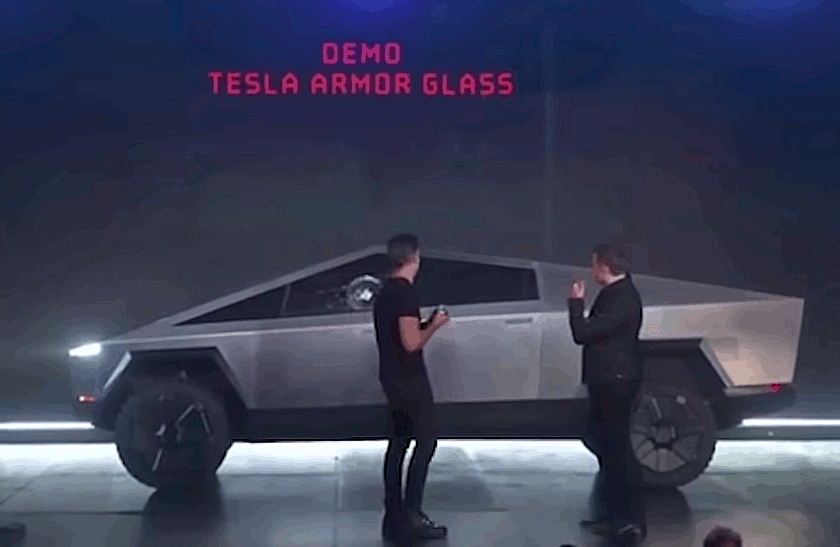
Cybertruck
'bulletproof' window
smash fail |
-
In
June 2025 in Austin, TX, a Robotaxi entered a left-turn lane, entered an opposing lane of traffic, and wiggled before correcting its course.
- The incidents led to increased scrutiny of the Full Self-Driving system, with reports of
'phantom braking' and erratic steering. - Users and social media highlighted these issues, with some reports showing the car trying to navigate into lanes reserved for opposing traffic during initial autonomous rollout tests.
- Car driving the wrong way in the Broadway Tunnel. -
Tesla Robotaxi swerved into wrong lane, topped speed limit in videos posted during ‘successful’ rollout.
- Despite the apparent hiccups, Tesla shares surged after a handpicked group of influencers who participated in the trial run uploaded positive reviews on X and other social media platforms.
|
Tesla also said Robotaxi service would be limited or unavailable in the event of bad weather.Musk and Trump had a very public falling-out earlier this month, though the two have since appeared to mend fences.(nypost.com)
|

No work, no workers |
- Meanwhile, Musk has
been running around telling us all kinds of things; we
won't need to save for retirement, we won't need money, we
won't need to work (while he rips off the taxpayers with
SpaceX).
- Elon Musk says that in 10 to 20 years, work will be optional and money will be irrelevant thanks to AI and robotics. - At Viva Technology 2024, Musk suggested “universal high income” would sustain a world without necessary work, though he did not offer details on how this system would function.
- His reasoning rhymes with that of OpenAI CEO Sam Altman, who has advocated for universal basic income, or regular payments given unconditionally to individuals, usually by the government.
|
"My prediction is that work will be optional. It’ll
be like playing sports or a video game or something
like that,” Musk said. “The future of optional work
will be the result of millions of robots in the
workforce able to usher in a wave of enhanced
productivity, according to Musk. (Assistant)
|
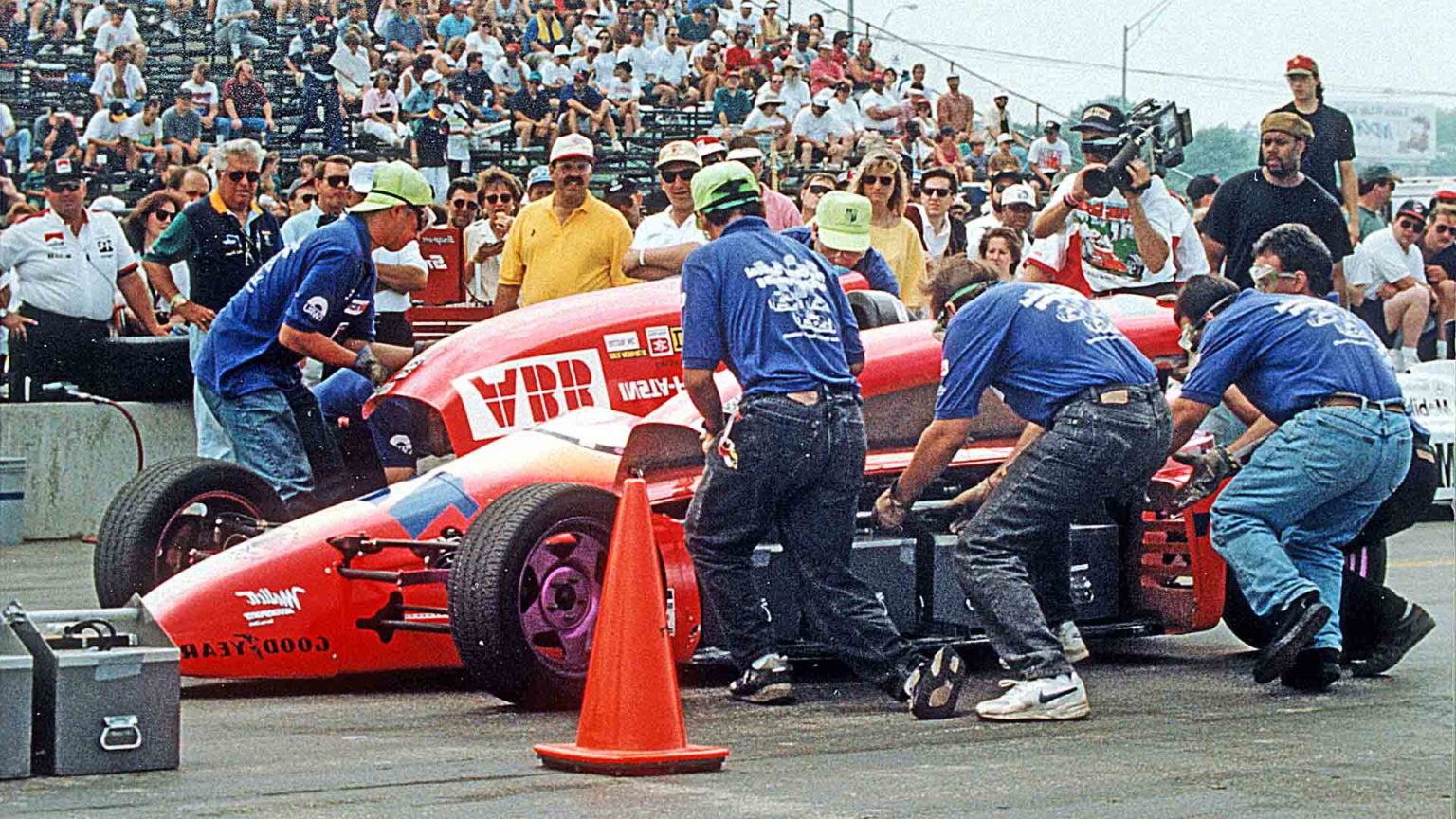
EV
Racing Quick Battery
Changeout |
-
Dan Parmley will embark next month on a coast-to-coast journey in an electric vehicle
circa 1992.
- “This trip will disprove the theory that electric cars are just for around town,” said Parmley, president of an environmental and energy systems company.
- A flatbed truck hauling a diesel-powered generator will refuel the electric vehicle along the way
and already charged battery packs will be swapped for depleted ones so the pickup won’t have to stop for long periods to recharge. -
He was well know in the alternative fuel industry as early as 1981 and held the world record for driving an electric vehicle form coast to coast.
- Daniel Parmley, president of Diversified Technical Services on 33rd Street
(of course) in Phoenix, showed off his charging station
and this was McCluskey's boss, and what brought him to the company
where Sophia worked and the demon caused so much havoc there. -
Just keep that in mind.
|
I remember the charging station he brought to Las
Vegas many years ago so we could all plug in at an
event held to promote EVs. His electric courier
service and his trip across the country swapping
battery packs in his electric truck were
accomplishments that showed his enthusiasm for
alternative energy solutions and established him as
one of our innovative pioneers. (Arisona
Republic)
|
|
|
How autonomy fails and grace prevails.
Man in the Mirror

|












