|







|
|
|
ABEL GRIMMER - SUMMER - PAGE 2
- Lyman Cornelius Smith (1850-1910) was an American innovator and industrialist.
- With his brothers, Leroy Smith, Wilbert
Smith and designer Alexander T. Brown, L.C. Smith produced popular guns, introducing the highly successful hammerless design by 1886.
- By 1890,
four of the Smith brothers were fully involved in the new
and quickly expanding typewriter industry.

The Smith brothers
in Public Domain
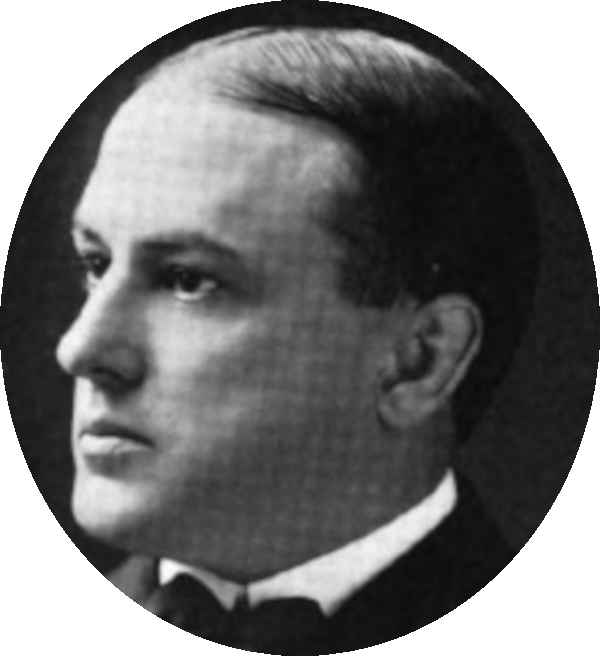
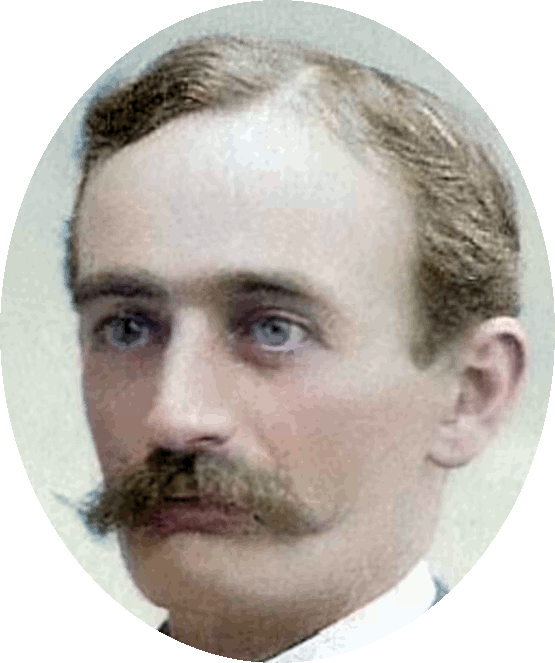
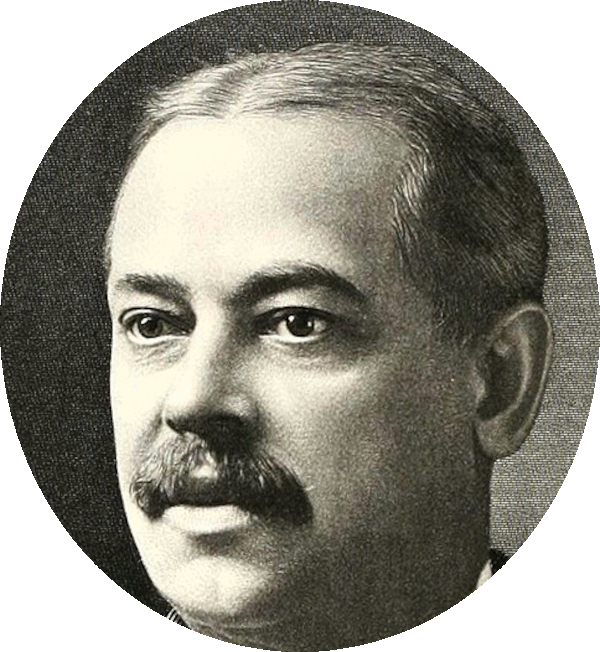
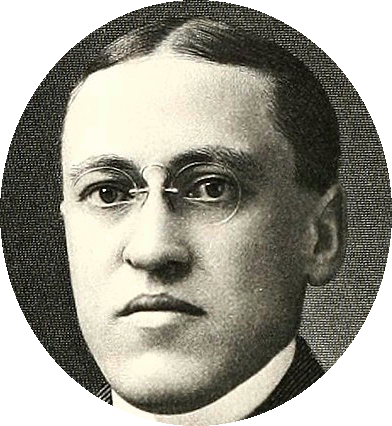
Clockwise from top left: Lyman, Wilbert, Hurlbut, and Monroe |
- Lyman Smith had 3 brothers he went into business with; Wilbert, Hurlbut and Monroe
Smith.
- Together, they pioneered the typewriter industry in
Syracuse which was nicknamed 'Typewriter City' in the late
19th-century.
- They were the sons of
Lewis Stevens Smith; and their mother was Eliza Ann Hurlbut.

Lumber business |
- Their father was a lumberman, tanner and merchant in Lisle,
in Broome County, New York, where the family moved in 1854.
- Their ancestors originally came from England.
-
Grandparents on the paternal side were William Smith and
Rebecca Bissel and on the maternal side there were several officers
who served in the Revolutionary War.
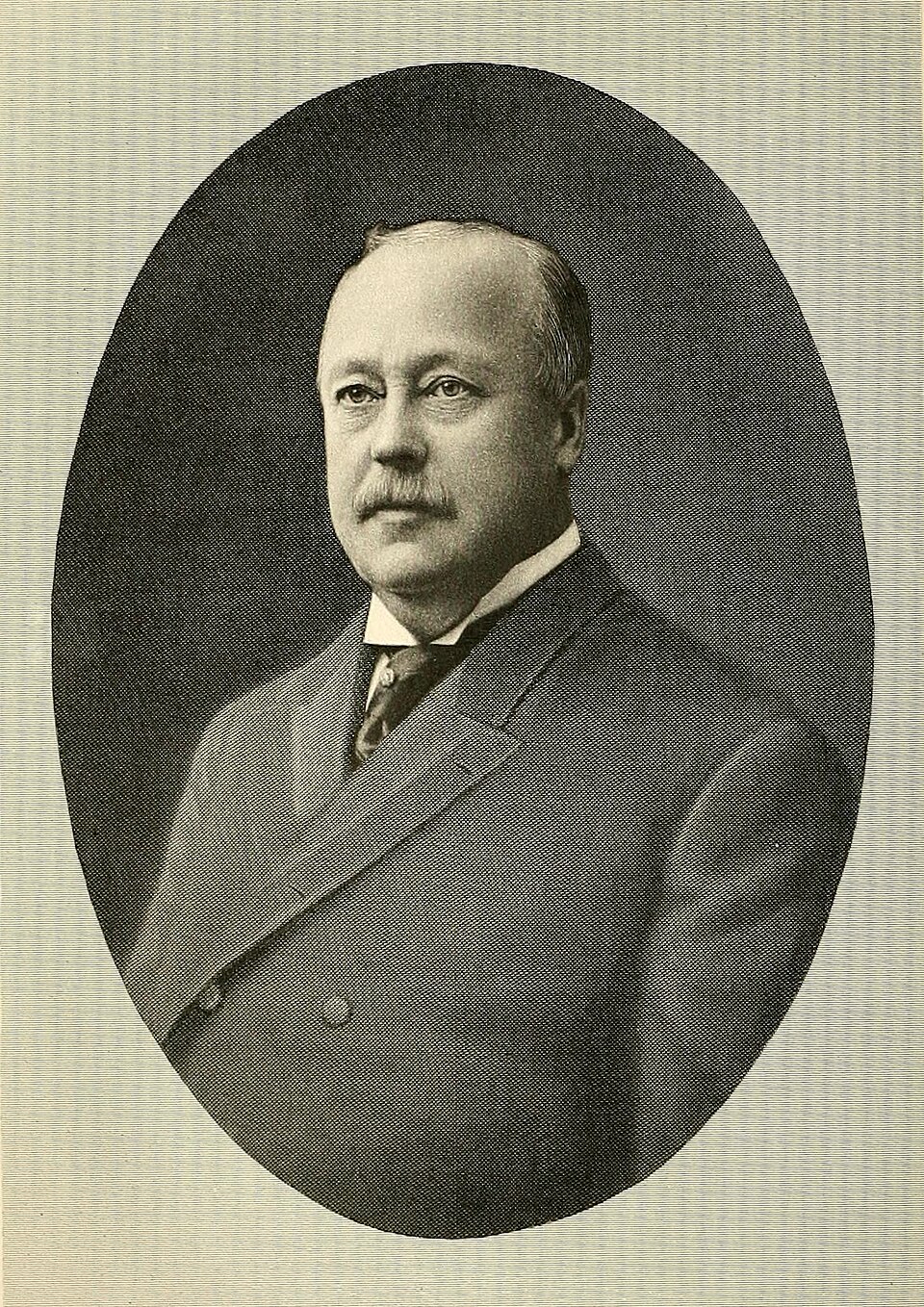
Public Domain, via Wikimedia Commons
Lyman Cornelius
Smith |
-
Lyman Smith was born on
March 31, 1850, in Torrington, Connecticut.
- He began his career as a businessman in 1873, when his father, a well-to-do sawmill operator, gave him capital to start a livestock commission business in New York City.
- That business failed dismally after only 2 years, and Lyman returned home
in Lisle with only the clothes he was wearing and a family bible given to him by his parents.
- That same year Lyman arrived in Syracuse, and worked as a clerk for a short while until his father once again financed the establishment of a lumber business.
Bankrupt father |
-
Lyman Smith's success in lumber was limited, and once again on the verge of financial failure, Smith,
along with his brothers Leroy and Wilbert, decided to enter into the lucrative business of producing firearms.
-
He allegedly borrowed so much money from his father that the elder Smith eventually went bankrupt.
Early days |
-
In February 1877, Lyman Smith married the daughter of Peter Burns, former mayor and one of Syracuse's wealthiest citizens.
- Gunmaking held a greater appeal for the young Lyman than did operating a sawmill.
- In September of that year, he and his brother Leroy
Smith joined established firearms designer William H. Baker in forming W. H. Baker & Co. at 20 Walton Street
in Syracuse.
|
According to a lecture given by Prof. Arthur J. Brewster at Syracuse University in 1941, Smith's prominent father-in-law "made it possible for Smith to acquire a small gun manufacturing plant."
(nramuseum.org)
|
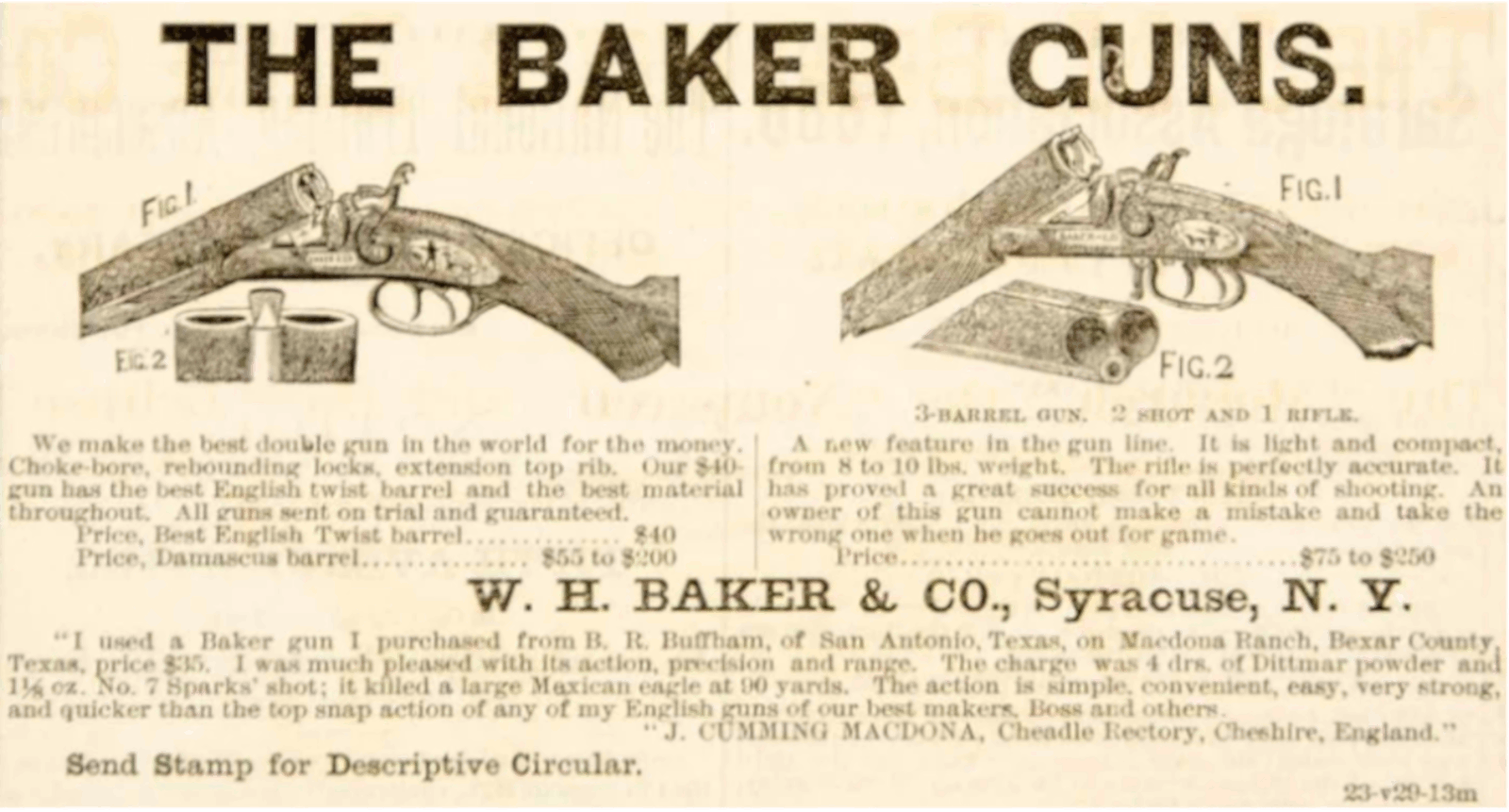
Baker Guns |
- In 1877, while in a partnership with Baker, the Smith brothers produced a
3-barrel combination gun for which Baker received U.S. Patent number 167,293 on August 31, 1875.
- The Baker combination gun was manufactured in the Smith's hometown of Lisle for approximately a year before production moved to Syracuse.
- The firm also made a Baker double-barrel shotgun, very similar to the
3-barrel gun, but without the rifle mechanism.
- They
produced the Baker designed firearm for 3 years before
switching to the L.C. Smith design.
|
Although he and members of his family manufactured guns, they are not the 'Smith' from Smith & Wesson. Instead, Lyman Smith was the namesake of the famous L.C. Smith Shotgun.
(Wikipedia)
|

Baker 3-barrel |
- W.H. Baker and Leroy Smith left the firm in about 1880, and, with several associates, established the Ithaca Gun Company.
-
Lyman Smith went into partnership with his younger brother, Wilbert, and a designer Alexander T. Brown and together they produced several popular breech-loading shotguns.
- The brothers continued manufacturing the original shotgun under
the Baker name in Syracuse.
- Brown, a gifted mechanic and designer, joined the firm as a lathe operator in 1878.
- By February, 1883, they had perfected a new gun design which was manufactured by
the company and at that time, they renamed it the L.C. Smith
Shotgun Company.
- The 'Elsie,' as the brand was commonly known, was a sidelock.
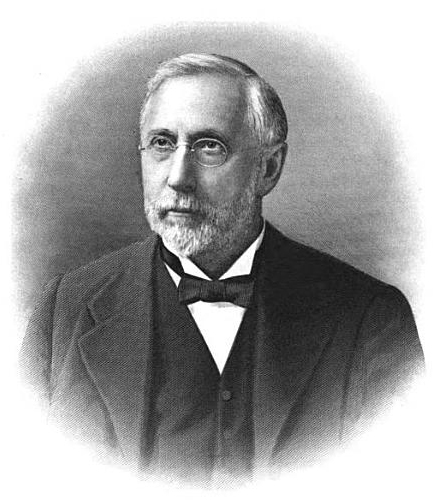
Alexander T. Brown
Genius behind
everything |
- Alexander T. Brown (1854-1929) was a successful inventor,
engineer and manufacturer.
- He was born on November 21, 1854, on a farm in Scott,
Cortland County in New York, and was the son of Stephen Smith
Brown (1827-1893) and Nancy M. Alexander (1826-1927).
-
Brown was married to Mary L. Seaman of Virgil, New York.
-
He died of bronchial pneumonia on January 31, 1929, in
Syracuse at age 74.
Re-inventing
harvest machines |
- Brown had always been intrigued by mechanical devices.
- As a boy, he had gained valuable experience while working in a neighbor's machine shop.
- His farm machinery patents developed vehicles capable of
turning square corners.
- At age 20, Brown designed a self-binding harvester, and he later worked as a salesman for the Osburn Harvester Company of Auburn, New York.
- He abandoned the sales job after one year and accepted employment as a lathe operator in Smith's well-equipped gun factory
in Syracuse.

City dwelling |
- Brown moved to Syracuse at age 23 and invented
what was later named the L.C. Smith shotgun, which was a
sporting firearm.
- Once he moved off the farm and came to Syracuse, he changed the world with his inventions and his business acumen.
- Syracuse became 'Typewriter City' making two-thirds of the
world’s typewriters thanks to Brown’s invention of the Smith
Premier Typewriter.
Mechanical engineer |
- Brown had mechanical skills and the commercial ambition
which helped make him a leader in industrial development.
-
He was a member of the American Society of Mechanical
Engineers and was also affiliated with numerous
Syracuse business associations and the New York Transportation
Club.
- Syracuse was a center of gun
manufacturing at the time.
- He maintained continuous
association with several industries throughout his
active career and was a Freemason.
Rotary Bolt
Mechanism |
- Early on, Brown
patented a breech loading shotgun that became Hunter Arms
biggest seller.
- In short time, he became L.C. Smith's most
valuable employee and they put him to work designing a new shotgun which bore Smith's name.
- Brown later received U.S. Patent No. 274,435 which covered his rotary bolt mechanism that became the
L.C. Smith's most renowned feature.
- A hardened steel cylinder, closed at the rear, was loosely fitted into a hole drilled in the frame below the tang.
- While a 'T' shaped slot was cut in the forward portion of the cylinder formed an arm.
|
This arm engaged a corresponding mortise cut into the barrel extension rib, while another part of the bolt passed over a notch in the rear of the extension rib. The bolt was operated by a top-lever which was connected to an upright rod and an arm connected this rod to the rotary bolt in such a way that the bolt rotated to the left when the top-lever was pushed. Pressing against a collar On the rod's lower end, a spring pressed against a collar to hold the bolt mechanism closed, forcing the rotary bolt to engage deeper into the barrel extension to compensate for wear.
(nramuseum.org)
|

Machine shop |
- For 30 years Brown
worked sporadically in the W.C. Lipe machine shop at 208 South
Geddes Street, which has been called the cradle of Syracuse
industry.
- This machinist shop was the foundation for
several mechanical geniuses who brought many inventions to
commercial use.
- The Brown-Lipe Gear Company and later the
Brown-Lipe Chapin Company, a subsidiary of General Motors,
came out of experiments in this small workshop.
- His
invention of the pneumatic tire is credited with the founding
of the Dunlop Tire Company.
- He was also a director of the
First Trust and Deposit Company and chairman of the Grade
Crossing Commission.

Smith Premier 1889 |
- Brown's specialty was transmissions adapted from bike chain
derailleurs, but is also known for inventing the shifting
carriage that allowed typewriters to have multiple cases or
fonts.
- He was
inventor and co-founder of Franklin Motors and the
Brown-Lipe-Chapin Company, a firm that was absorbed into
General Motors.
-
He later invented the Smith Premier full-keyboard upstrike typewriter, which premiered in 1889, that allowed the typist to see what was just typed.
- Prior to this the words were hidden from view.
|
Alexander T. Brown, developed the notable L.C. Smith breech-loading shotgun, which became a very popular firearm and made the company a great business success. While experiencing a financial windfall with his shotgun, Smith allowed Brown to experiment with a recently developed typing machine. Brown’s tinkering led to him creating the Smith Premier typewriter in 1886, the first typewriter to print both upper and lower case letters. (cnyhistory.org)
|
Early wireless |
- At the age of 48, Brown became president of the H. H. Franklin Automobile Company
and he was co-founder of Brown-Lipe-Chapin which began by inventing
2-speed 'bi-gear' for bicycles.
- Later they began making 3-speed transmissions for Yellow Cab and Henry Ford.
- In 1910 Brown-Lipe began supplying differentials to the automobile industry
which eventually became the Inland Fisher Guide unit of General Motors.
- After 1920
Brown obtained patents for the automatic telephone, which he sold to the Stromberg-Carlson company,
along with the motor-driven harvesting machines.
Doncram, CC BY-SA 4.0 via Wikimedia Commons
Syracuse
NY ~ 726 West Onondaga
Street |
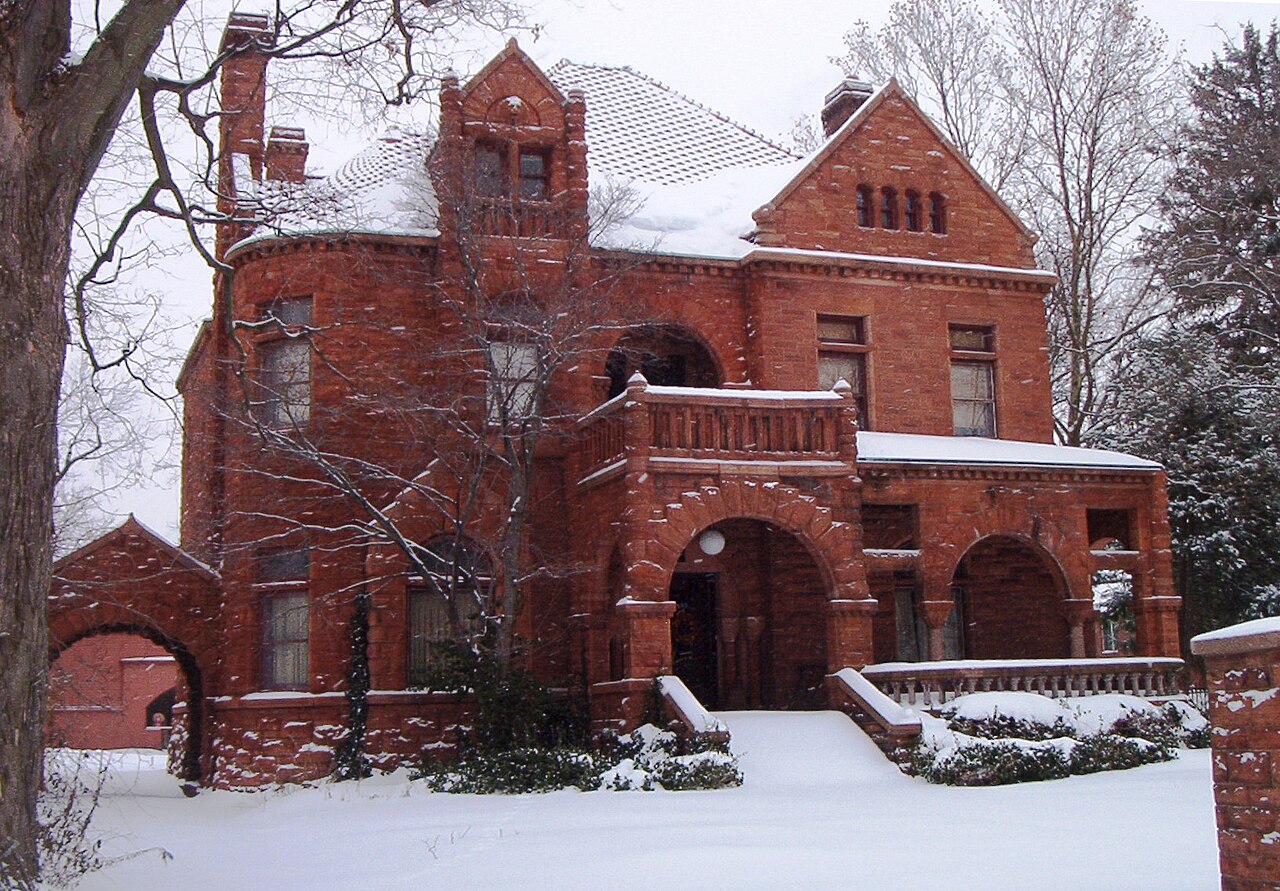
- The Alexander Brown House, at 726 West Onondaga Street
in Syracuse is a Richardsonian Romanesque mansion
in Potsdam sandstone and Spanish tile home built in 1895.
- Brown was an early tech inventor, he
added such engineering features to the house as a terracotta
shaped glass tile-covered skylight to bring natural light into
the attic, a basement to attic hydraulic elevator, and a
house-wide vacuum cleaning system.
- He held the largest collection of military weaponry in private hands during his day and was also known to have kept a live bear in what was once a stable for the horses who once pulled his carriages from the carriage house behind the main house on West Onondaga Street.
|
The 5,500 square foot carriage house held up to 10 cars and Brown had a car lift installed so that the projects he was working on could be brought up and out of the cold and into his workshop where his drivers were often known to have lived and assisted.
(nramuseum.org)
|
|
Hunter Arms Company |
- In 1886, the company produced its first hammerless
shotgun which proved to be their most successful design.
-
They began manufacturing breech-loading firearms
in 1887.
- Despite the success of the company, Smith decided to sell the manufacturing rights for the entire line of L.C. Smith Shotguns to Hunter Arms Company in 1889.
- John Hunter Sr., bought the patents and formed Hunter Arms Company
and built a family-run gun business.
|
Hunter Arms produced L.C. Smith shotguns (often with Brown's sidelock design) as premier American firearms, renowned for quality, engraving, and special grades like the Deluxe and Crown grades. (Assistant)
|
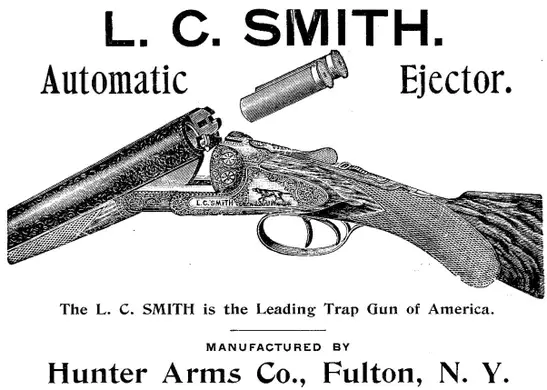
Hunter Arms Company
1889-1947
|
- Hunter continued to manufacture
the L.C. Smith model until 1945 when the business was sold to Marlin Firearms Company.
- This era saw the creation of iconic external-hammer and later hammerless models, including the renowned sidelocks.
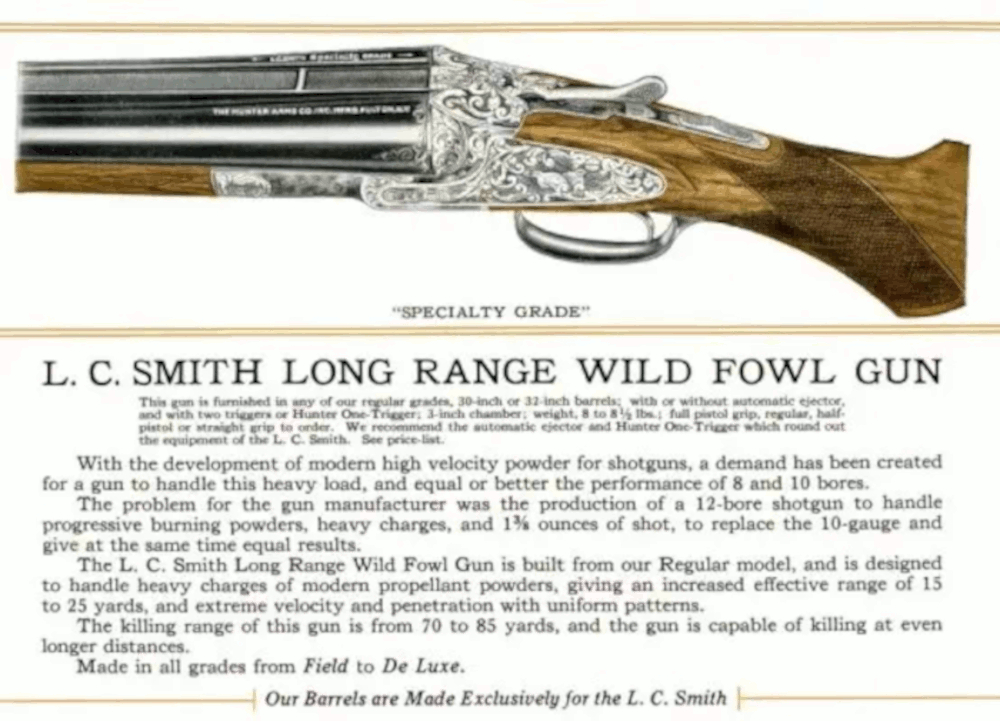
Wild fowl gun |
-
The last L.C. Smith Long Range Wild Fowl Gun was completed in 1942, and in all they
manufactured 2,631 of them.
|
Marlin produced the Baker guns under the trade name "The L. C. Smith Gun Company, Inc." until 1950, when production was stopped because of high labor costs. Marlin reintroduced the L. C. Smith line through limited production in 1967,
although it was retired in 1972. (nramuseum.org)
|

Brothers |
- Although Lyman C. Smith did not invent the typewriter, his work
(financial backing) led to the first machine on which typists could
actually see what they were typing thanks to Alexander T.
Brown who patented the feature.
-
The
Smith brothers and Brown were early industrial and civil leaders in the
city and they provided the city with a lot of jobs.
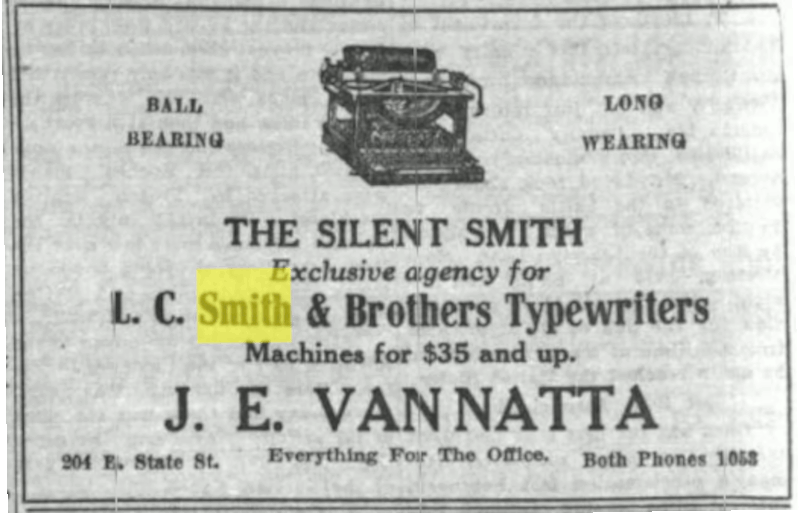
The Silent Smith |
- It was sometime around 1885 that Lyman Smith became interested in the typewriter.
and at once saw its possibilities.
- At his own expense he innovated and brought together the inventions of several mechanics
and engineers such as Alexander T. Brown in his new endeavor.
|
The era of the great American double-barreled shotgun lasted for almost 100 years, from shortly after the Civil War in the late 1860s until the middle of the 20th century. Grand old names like Parker, Fox, Ithaca, Winchester and L.C. Smith topped the list of the better double guns that were made in the United States. (Jerry
Lee)
|

Public domain, via Wikimedia Commons
Wilbert Lewis Smith |
- Younger brother, Wilbert Lewis Smith (1852-1937) was also
a pioneer in the
Syracuse typewriter industry and for many years served as president of the board of L.
C. Smith & Corona Typewriters, Inc.
- Wilbert was born on
February 29, 1852, in Torrington, Connecticut, and lived and died at age 83 at 652 West Onondaga
Street in Syracuse, New York.

Early days |
- Wilbert L. Smith received his education
in the common (public) schools, and later at the State Normal School at Cortland
which later became the State University of New York at
Cortland.
- He began his business career as a boy in the gun manufactory of his
older brother, Lyman, of Syracuse, and became the superintendent of the plant.

Small town boy |
- Wilbert Smith eventually induced his brother to abandon the gunmaking plant, and to devote
all his time and capital to the making of typewriters.
- For many years, Wilbert was an officer of the Smith Premier Company, and was in sole charge of production and was a director of the Union Typewriter Company, after they
merged with Smith Premier.
-
Wilbert built a typewriter plant at Syracuse for the Union Typewriter Company.

Business venture |
- In 1888 the brothers became involved in the typewriter
business of which he
was the first vice president.
- Lyman Smith formed the Smith Premier Typewriter Company between June 1889 and June 1890 and
they produced typewriters designed and patented by Alexander Brown.
-
Disagreement over producing visible (front-strike) typewriters, which customers wanted, led the brothers to leave the Union Typewriter Company and form their own firm in 1903.
- On a hunch, Lyman Smith moved to the new technology,
and
13 years later, about 1903, he organized the L.C. Smith & Brothers Typewriter company.
-
The L.C. Smith typewriters were renowned for their solid construction and smooth typing, using high-quality materials.
|
Their new company, L.C. Smith & Bros., introduced innovative models like the No. 1 and No. 2, designed by Carl Gabrielson, offering features like the "Magic Margin" and quiet
operation. They split from their original Smith Premier venture to develop a front-stroke typewriter, resulting in the iconic L.C. Smith models known for innovation like the quiet "Silent" and durable office machines (Assistant)
|
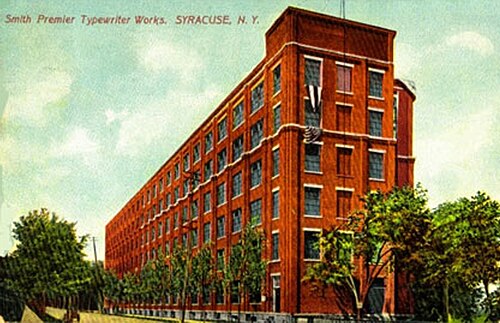
Smith Premier
Typewriter Co.,
Syracuse, New York
c.1910 |
-
In early 1903, The L.C. Smith & Brothers Typewriter Company bought a Washington and Almond Street site for their factory.
- Construction of a new building began in March 1903, and was completed in about
4 months.
- Shortly after, Timothy L. Woodruff was selected as president of the company. Woodruff had previously served as Lieutenant Governor of New York State under three different governors,
including Theodore Roosevelt.
- Woodruff was the only person in
state history to do so.
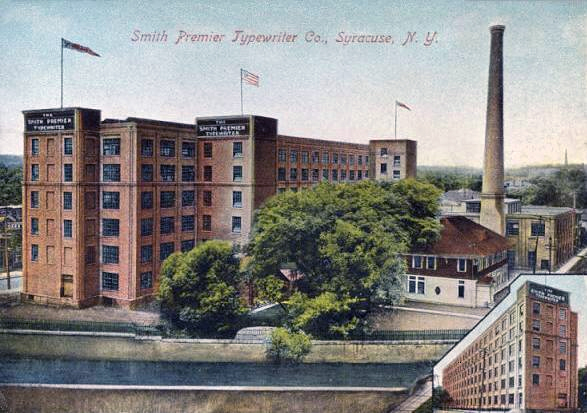
Smith Premier
Typewriter Co.,
Syracuse, New York |
- The operation shut down about 1925 when the Smith Premier
Typewriter Company was fully absorbed by Remington Typewriter
Company.
- However, the company owned the building until 1962 when it was
remodeled (painted white) and converted to an office building called Midtown Plaza.
|
Smith sold the shotgun factory in 1889 and poured additional capital into the new Smith Premier Typewriter Company. In 1903, the Smith brothers formed L.C. Smith & Bros Typewriter Company. (cnyhistory.org)
|
918 James Street
'beautiful as a rose' |
-
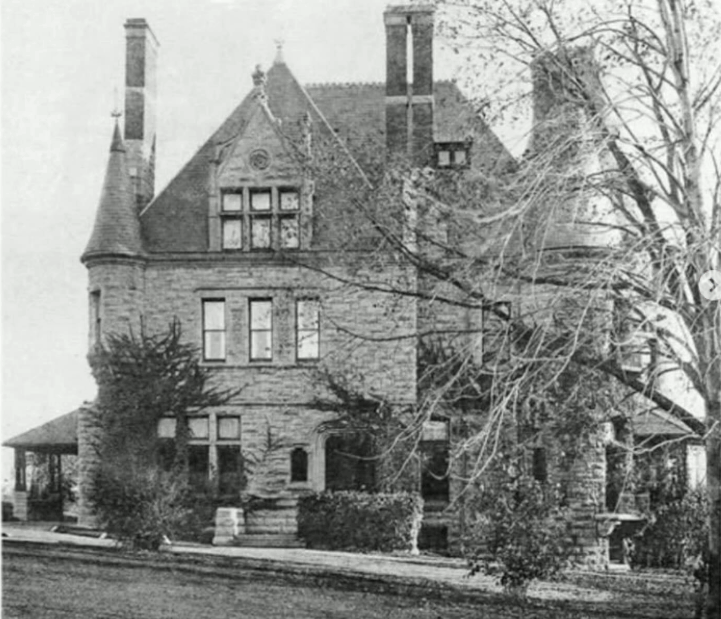
This is the former 918 James Street, the mansion known as Uarda
which was built on 4-acres in 1883 for Howard White, the owner of the Syracuse Standard newspaper.
- In 1895, the home was purchased by Lyman C. Smith.
- The house had been designed by William H. Miller, an architect from Ithaca.
- There were also several outbuildings on the property including multiple green houses.
- After the death of L.C. Smith in 1910, the house remained with the family, notably
his daughter Flora Bernice Smith who lived there most of her life until she moved to Skaneateles in 1956.
- The following year, the home was demolished.
|
The house was built of rock-face stone with a steep,
high roof of slate. Bronzed, pine, walnut, cherry, ash
and mahogany used in the interior finished formed
carved wainscoting and fluted columns with caved
capitals. Raphael-like ceilings and windows of stained
glass enriched the colors of all the rooms on the
first floor and stair landing. Gold-plated scenes,
bathrooms walled with onyx, fixtures of sterling, a
storeroom sealed with cedar, hydraulic elevator: all
the resources of foreign skill and native genius were
employed in the construction.
(syracusehistory)
|

Bill Badzo - Historic District
- Flickr
Syracuse
NY ~ 652 West Onondaga
Street |
- Wilbert Smith lived on West Onondaga Street which was once one of Syracuse’s grandest thoroughfares, lined with Italianate and Queen Anne style mansions designed by Syracuse’s most prominent architects.
-
He didn't always live this way, his parents moved to Lisle, a small farming community, soon after his birth.
-
In later life, Wilbert was a director of the Crucible Steel Company of America and a vice president and one of the founders of the Great Lakes Steamship Company.
Lyman C. Smith in
Oakwood Cemetery |
- The Lyman Cornelius Smith College of Applied Science was
established in 1901 after Lyman Smith donated $75,000 to erect a
the college and remained on the Board of Trustees until his death.
- Today Smith Hall is the headquarters of the College of Visual and Performing Arts at Syracuse University.
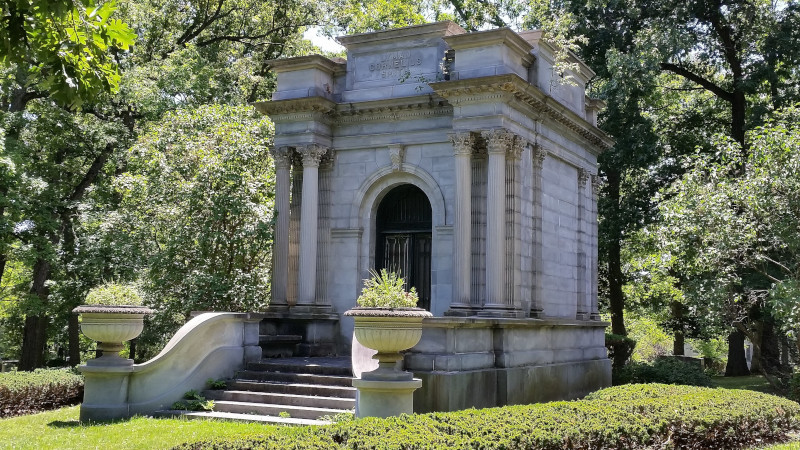
- Lyman Smith died at age 60 on November 5, 1910, in Syracuse,
New York, and was buried in Oakwood Cemetery.
|
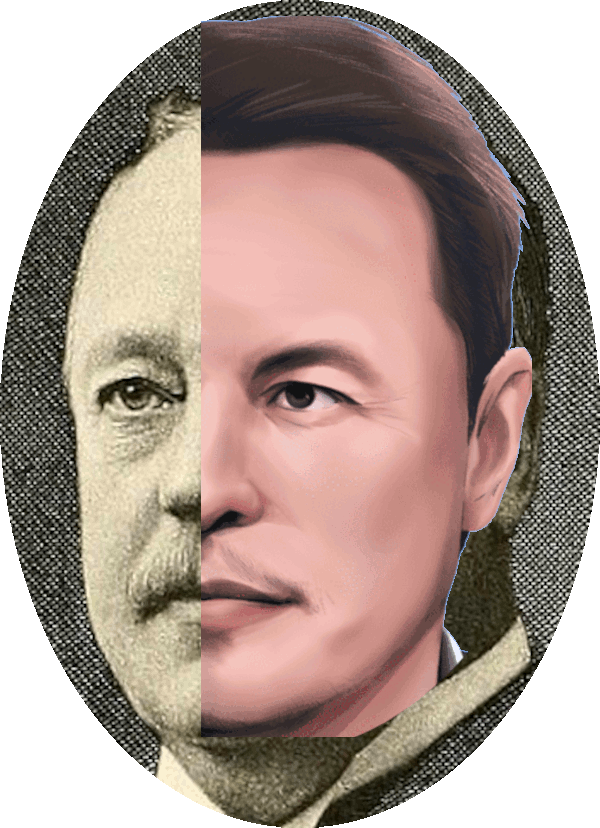
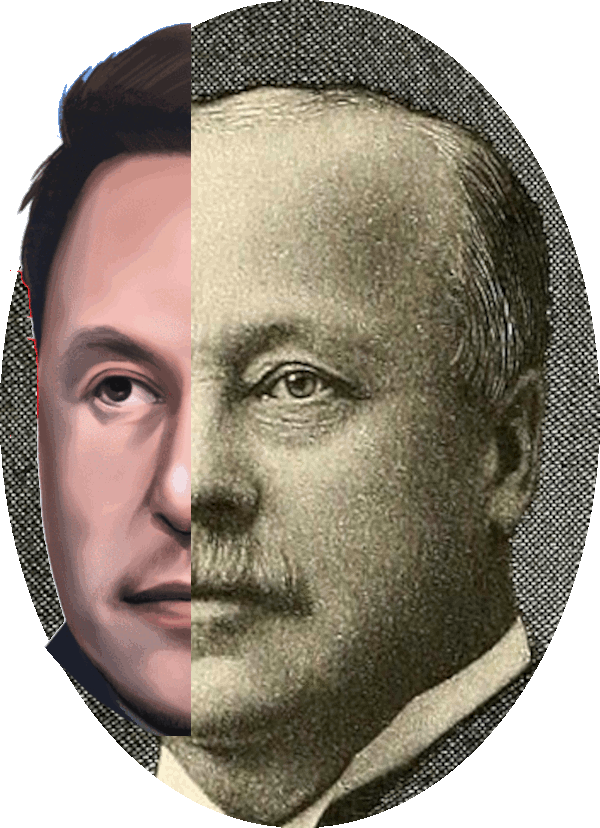
Elon Musk as
Lyman Cornelius
Smith |
Elon Reeve Musk
1971
6/28
|
Lyman Cornelius Smith
1850-1910
3/31
11/5 |
 |
 |
|
Patent and money mooch |
- Lyman C. Smith was awarded the French Legion d'Honneur a 32nd
degree in Freemasonry.
- Elon Musk says he has Covid for a second time, but he is feeling relatively well.
|
The National Order of the Legion of Honour is the highest and most prestigious French national order of merit, both military and civil. Consisting of five classes, it was originally established in 1802 by Napoleon Bonaparte and it has been retained (with occasional slight alterations) by all subsequent French governments and regimes.
(Wikipedia)
|

Public domain, via Wikimedia Commons
Monroe Clayton Smith |
- Monroe Clayton Smith (1861-1914) was born on April 28,
1861, in Lisle, New York.
- He was a member of many clubs and fraternal organizations.
- Smith was secretary and head of the selling forces and he
made many trips to all parts of the United States and made many friends.
- In 1893, when the Smith Premier Company became a part of the Union Typewriter company,
he continued to serve as secretary until 1903.
- In that year with his brothers, he resigned to become secretary of the newly organized L.C. Smith & Brothers Typewriter company.
- Upon the death of Lyman C. Smith, Wilbert C. Smith became president of the company and Monroe C. Smith vice president.
|
He was a member of the Century club, Citizens club, Anglers association of Onondaga, Syracuse Automobile club, Chamber of Commerce, S.P.C.A. and S.P.C.C., Knights of Pythias, B.P.O.E. and the Turn Verein.
(legacy.com)
|

Monroe C. Smith
home - 627 West
Onondaga Street
Current day police
state |
- Monroe Smith was vice president and secretary of the L.C. Smith & Brothers Typewriter company.
- He owned a home at 627 West Onondaga Street in Syracuse and
was married to Emma Jones.
- He was a thirty-second degree mason, a Shriner and a member of the Grotto.
|
A Turn verein (German for "gymnastics club") is a German-founded athletic and social organization promoting physical fitness (gymnastics), German culture, and liberal politics, brought to America by immigrants, evolving into the modern American Turners, focusing on sports, community, and integration while still preserving heritage.
(Assistant)
|
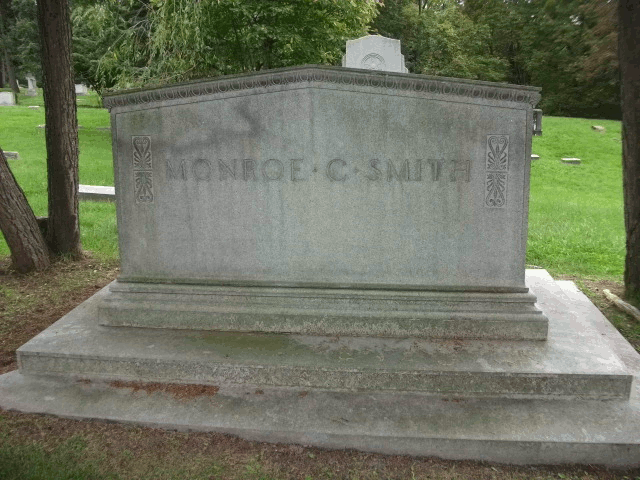
Monroe C. Smith -
Oakwood Cemetery |
- Monroe Smith died at age 53 on July 24, 1914, and was
buried in Oakwood Cemetery in Sect 66.
- Smith's death resulted from an illness of more than
2 years, following a nervous breakdown.
- He spent part of the winter away from Syracuse and returning felt improved,
however, for the last month of his life he was unable to leave the house.
- Apparently he didn't do quite as well as his
3 brothers.
|
The Syracuse Turn Verein will hold a special meeting tomorrow afternoon to act upon the death of Mr. Smith. The members will be requested to attend the funeral in a body.
(legacy.com)
|
|
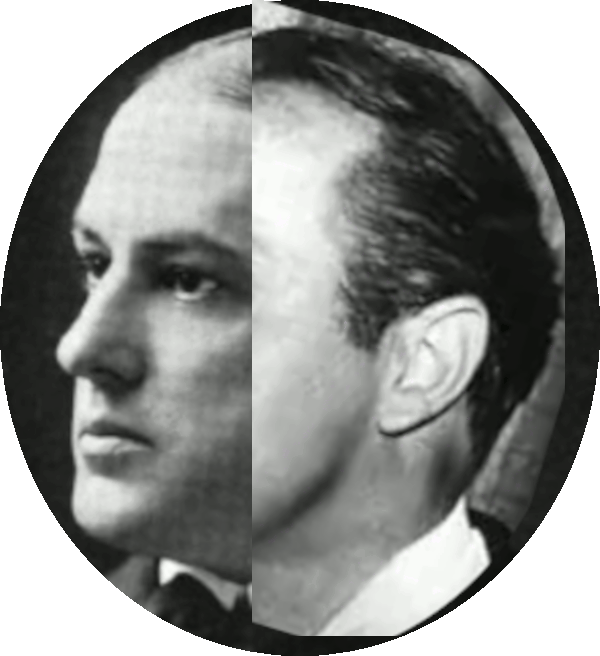
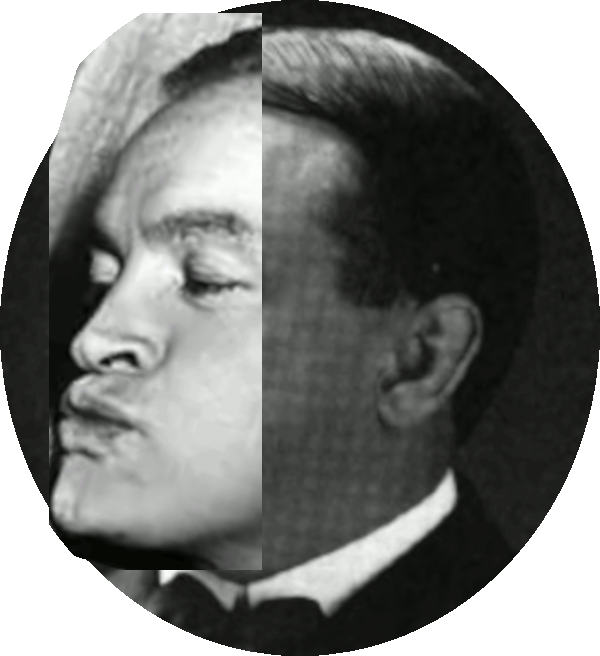
Bob Hope as
Monroe Clayton
Smith |
Leslie Townes Hope
1903-2003
5/29 6/27
|
Monroe Clayton Smith
1861-1914
4/28 7/24 |
 |
 |
|
Lost hope |
- Masonic services were conducted at Oakwood cemetery by Central City Lodge.
- Bob Hope's connection to Corona refers to the Naval Hospital in Corona, California, where he hosted a popular radio show in 1947, bringing laughter to recovering WWII sailors and Marines, a performance rediscovered and streamed years later, connecting the comedian to the city's wartime history.

Lyman Smith retires
permanently |
- The company became tremendously successful, and by 1911, the manufacturing plant, located at 701 E. Washington Street in Syracuse, doubled in size.
- Upon the death of Lyman Smith, younger brother Wilbert Smith became president of the
Smith Premier concern, and devoted his attention principally to the company's interests.
- In 1924 when he retired from Smith Premier, Wilbert took over the property, business and operations of the L.C. Smith & Bros. Typewriter Company.
- He remained however as chairman of the board of Smith
Premier and under
his direction the company moved forward to occupy an international position.
Groton farming |
- In 1926, the brothers merged with Groton-based Corona Typewriter Company to become L.C. Smith & Corona Typewriter Company,
later shortened to Smith Corona (SCM).
- The merged company made office machines in Syracuse and portable typewriters in Groton.
- By 1936, L.C. Smith & Corona employed over 4,000 people in its factories in Syracuse, Groton, Cortland, Geneva, and Aurora, Illinois.
- At that time, the company also made Corona adding machines in Groton, Vivid duplicating machines in Cortland, typewriter type in Geneva, and accessories and supplies in Illinois.

Individual efforts
|
- In 1926, Wilbert Smith became chairman of the board of the L.C. Smith & Corona Typewriters, Inc.
and he had other business interests.
- There were 36 subsidiary companies of which
he was a director.
- He was a director of the Crucible Steel Company of America, vice president of the Great Lakes Steamship Company,
and one of the organizers and later chairman of the board of the directors of the Syracuse Trust Company.
- Wilbert Smith was also chairman of the board of the National Bank of Syracuse before its merger with the Trust Company in 1918 and he was vice president of the Syracuse Trust Company before the consolidation.
- In addition, he was vice president of the Smith-Lee Company, Inc. of Oneida.

Four pillars at
gravesite
|
- Wilbert Smith had been in failing health for several years
and a physician and nurse were in attendance at the time of
death on August 28, 1937.
- Rev. Franklin P. Bennett,
rector of St. Paul's Episcopal Church of which Smith was a
communicant, officiated at his funeral service and he was buried in the family mausoleum in Oakwood Cemetery.
- He was a member of the Century Club, the Citizens and the
Onondaga Golf and Country Clubs, and the Pontiac Fish and Game
Club.
- Survived by his wife, the forrmer Louise L. Hunt,
a native of Syracuse.
|
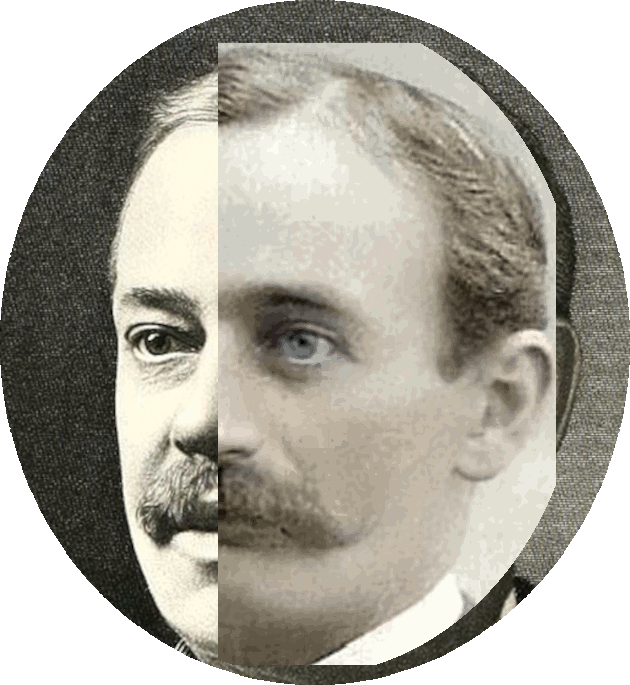
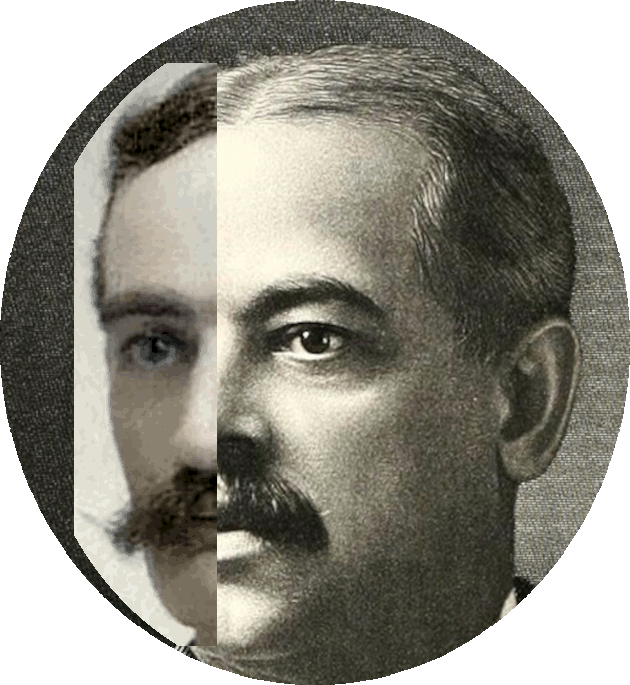
Friedrich
Trump as
Wilbert Lewis Smith |
Friedrich Trump
1869-1918
3/14 5/30
|
Wilbert Lewis Smith
1852-1932
2/29
8/28 |
 |
 |
|
Flaming demon from hell |
- Illegal alien with no VISA or green card.
|
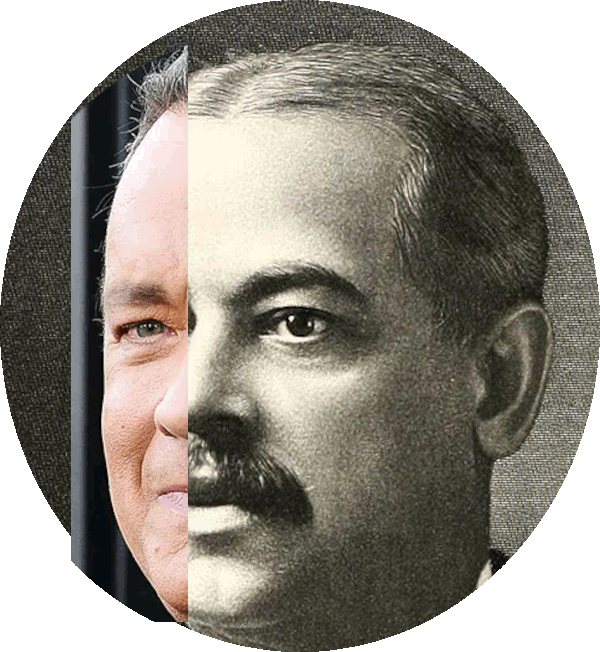
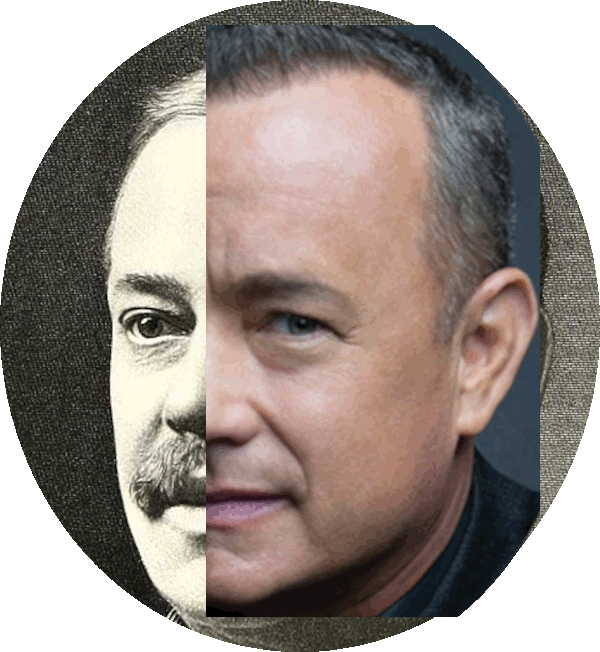
Tom Hanks as
Wilbert Lewis Smith |
Thomas Jeffrey Hanks
1956
7/9
|
Wilbert Lewis Smith
1852-1932
2/29
8/28 |
 |
 |
|
Corona |
- Before the second World War, Wilbert Smith served on a committee of seven, connected with the typewriter industry and turned his plant over to the government for war purposes.
- It seemed to be all planned in ADVANCE, he died in 1937
but was apparently already greasing his fingers over it.
- Tom Hanks and his wife, Rita Wilson, were among the first celebrities to publicly announce they had tested positive for COVID-19 in March 2020 while in Australia.
- They both recovered and donated their blood antibodies for research into the virus.
|
In December 2020, Hanks stated they would wait to get vaccinated, ensuring that people who needed it more urgently got the shot first. He also expressed his willingness to receive the vaccine publicly to demonstrate its safety.
(Assistant)
|

Mr. Rogers meet Tom
Hanks |
-
Youtube -
Tom Hanks Rogers
- Fittest Flat Earther.
|
Hanks is a distant cousin of Nancy Hanks and her son
President Abraham Lincoln and children's host Fred Rogers (who Hanks has portrayed in a film role).
(Wikipedia)
|

Tom
Hanks letter to fan |
- Tom Hanks is a famous typewriter enthusiast, especially known for his love of Smith-Corona brand machines, often gifting them and even choosing one (a Smith-Corona Silent) as his favorite in the documentary
California Typewriter, praising their durability and satisfying typing experience.
- He's famous for sending handwritten notes and typewriters to fans, and has been seen collecting more Smith-Corona models like the Clipper.
- Hanks famously gifted a Smith-Corona typewriter to an 8-year-old boy named Corona who was being bullied, sending a personal, typed letter alongside it.
- He once agreed to appear on the Nerdist podcast after the host sent him a 1934 Smith-Corona, and Hanks typed his acceptance on it.
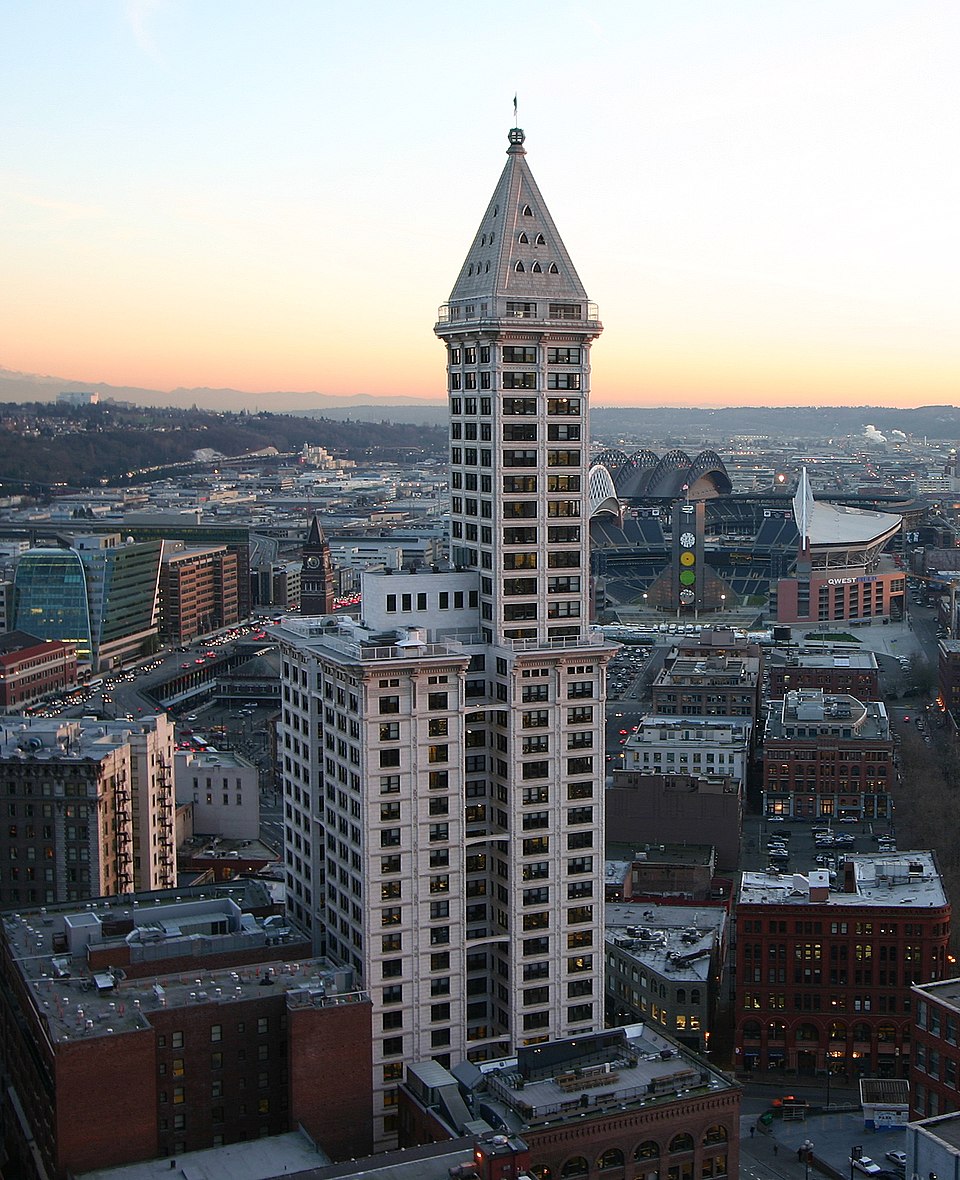
Christopher S. Maloney (NorthLights), CC BY 2.5 via Wikimedia Commons
Smith Tower in
Seattle |
- Sleepless in Seattle.
- Smith Tower is a skyscraper in the Pioneer Square neighborhood of Seattle, Washington.
-
The tower is named after its builder, the firearm and typewriter magnate Lyman Cornelius Smith.
- Its construction was largely overseen by his son Burns Lyman Smith after his father's 1910 death and would remain under the ownership of the Smith family into the 1940s.
- It was originally known as the L.C. Smith Building.
- Smith Tower is an example of neoclassical architecture
and its outer skin is granite on the 1st and 2nd floors, and
terracotta on the rest.
- Completed in 1914, the 38-story, 462' tower was among
the tallest skyscrapers outside New York City at the time of
its completion.
|
In the wake of the Klondike Gold Rush, Eastern financial interest in Seattle was at an all-time high.
Prominent local attorney James Clise, who represented
numerous capitalists in New York and Boston. was
responsible for many of the land transactions that saw
numerous new office buildings built in the city. Among
his largest clients at the turn of the century was
Syracuse, New York millionaire industrialist Lyman
Cornelius Smith and his brother Wilbert Lewis Smith
who, through Clise, purchased and developed numerous
buildings in Seattle's Pioneer Square district. L.C.
was soon the city's biggest taxpayer and the largest
individual owner of Seattle real estate in the
country.
(Wikipedia)
|
.jpeg)
Asahel Curtis, Public domain, via Wikimedia Commons
Smith Tower looking north on 2nd Avenue, 1914 |
- Lyman Smith was originally going to build a 14-story
building on the Bailey Corner, which was the site of the
Seattle Fire.
- His son convinced him to build instead a much taller skyscraper to steal the crown from rival city Tacoma's National Realty Building as the tallest west of the Mississippi River.
- It was the tallest building west of the
Mississippi River until the completion of the Kansas City
Power & Light Building in 1931.
- It remained the tallest
building on the U.S. West Coast for nearly half a century,
until the Space Needle overtook it in 1962.
- Lyman Smith
died a month before the construction company broke ground.
|
The burst of the dot-com bubble hurt Smith Tower by raising its vacancy rate to 26.1 percent, twice Seattle's commercial vacancy rate, as of December 21, 2001. The Walt Disney Internet Group, for example, at the time reduced its seven floors to four. By 2007, the occupancy rate had rebounded to about 90 percent, with new occupants such as Microsoft Live Labs.
(Wikipedia)
|

World War II |
- Soon after, L.C. Smith & Corona and several other Onondaga County businesses re-tooled to make war-time products.
- In the fall of 1941, the company received its first war contract to produce primers for bombs at the Syracuse factory.
- In February 1942, the company received a war production conversion order from the U.S. government, to begin making munitions.

War machine |
- By this time, L.C. Smith & Corona already had about
FORTY government war production contracts and was ready to further curtail typewriter production in favor of making war products.
- David Nelson, head of the War Production Board (WPB), expressed an appreciation for the speed with which the typewriter industry
'snapped into the war stride.'

War tower |
- On March 6, 1942, the WPB froze the sale and delivery of all typewriters.
- Typewriter production gradually diminished through the spring and summer, and in October 1942, the WPB discontinued all typewriter manufacturing.
- They had to get the demonic war machine pumped up so they
could make LOT's
of money.
World War bail out
|
- Hunter Arms supplied special L.C. Smith training shotguns, known as
'Rochester Ordnance' models for training aerial gunners, helping them lead targets on skeet ranges.
- Throughout
the war, L.C. Smith (Hunter Arms)
continued making its high-quality sporting shotguns, though the parent company faced financial difficulties, leading to bankruptcy and a bailout by local businessmen.
- The company also secured contracts for parts for naval weaponry, helping it stay afloat during the Depression and war years.
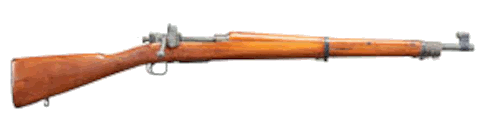
World War M1903-A3 |
- During World War II, the L.C. Smith typewriter company contributed to the war effort by manufacturing bolt actions for the M1903-A3 rifle, portable cipher machines and bomb fuses.
- Many companies halted the production of their regular products and concentrated on their war efforts but L.C. Smith was able to continue making typewriters
for a while.
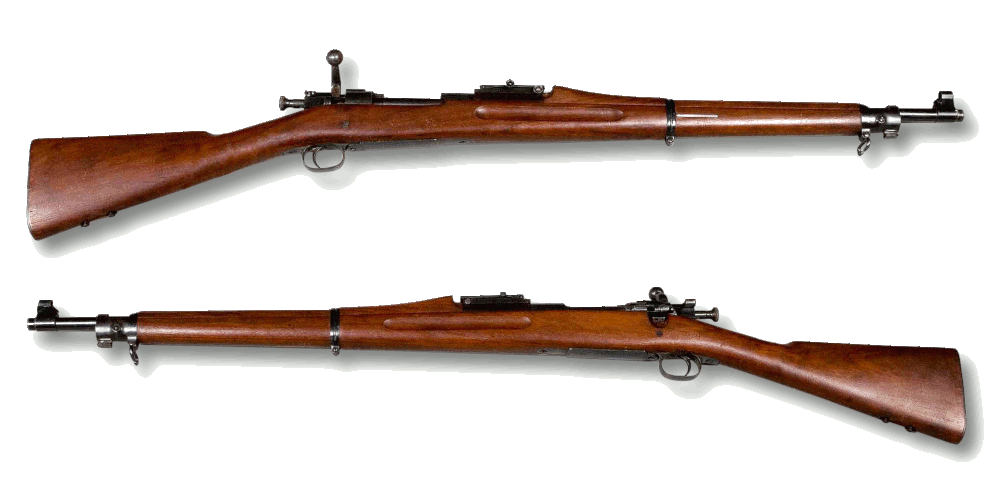
Springfield M1903A3 |
- Even before the conversion order to discontinue making typewriters, L.C. Smith & Corona became a prime contractor to make the Springfield M1903A3 bolt-action rifle, which although used mainly during the early 20th century, remained a standard issue infantry rifle during World War II.
- Private companies such as Remington Arms in Ilion, New
York, and L.C. Smith & Corona made thousands of these rifles for the military.

Covered by the U.S. fair use laws
Simpsons
Springfield Rifle |
- At peak production, the Syracuse factory made 23,000
Springfield rifles per month
(276,000 a year).
- The company not only made the rifles at the Syracuse factory but they also tested them there as well, firing the rifles deep within the innards of the factory.
- Along with making the bomb primers and rifles, employees at the Syracuse factory also made parts for pistols, machine guns, and torpedoes, amounting to over 64 million parts made during the war.
|
In The Simpsons, "Springfield rifle" refers to the real-world firearms used by Springfield's police, often AR-15s or Colt M16s, and sometimes sniper rifles, while town founder Jebediah Springfield famously used a rifle to fight a snake, symbolizing the town's frontier roots, with guns like Homer's revolver appearing in episodes about gun culture like "The Cartridge Family".
(Assistant)
|

Covered by the U.S. fair use laws
Cartridge Family |
-
A football (soccer) riot breaks out in Springfield after a boring match between Mexico and Portugal.
- Fearing for her family's safety, Marge tells Homer to buy a Home Security System, but after learning it would cost $500, he buys a handgun instead.
-
In the episode, Homer purchases a gun to protect his family, of which Marge disapproves.
- Homer begins to show extremely careless gun usage, which causes Marge to leave him when she catches
son Bart using the gun without their permission.
- Homer brings Marge to a local National Rifle Association meeting hoping to change her mind, but she remains unconvinced.
|
The end music is the theme to the 1960s British TV
series The Avengers, and the song playing when Homer
is sitting and watching things go by while he is
waiting five days for his gun is "The Waiting" by Tom
Petty and the Heartbreakers. Petty rarely let his music be used on television, but, being a fan of The Simpsons, he allowed them to use it.
(Wikipedia)
|

Covered by the U.S. fair use laws
Springfield Mafia |
- Youtube - Simpsons -
Paint it black.
- Youtube - Simpsons -
Homer vs. The Springfield Mafia.
|
Another interesting war product that L.C. Smith & Corona made was the M209 Hagelin cipher machine. Developed by Boris Hagelin of Sweden in 1940 for the U.S. Army, the M209 Hagelin was a portable, hand-cranked encoder that created coded messages. While not as robust as other encoding machines, the signal corps used the M209 Hagelin to create time-sensitive messages that were no longer necessary after a couple of hours. L.C. Smith & Corona made approximately 140,000 encoding machines under a license provided by the Hagelin Company before it was discontinued in 1962.
(cnyhistory.org)
|

War effort target
|
- While L.C. Smith (under Hunter Arms) produced sporting arms and specialized training guns for WWII, its associated Marlin business was heavily involved in war production
- Marlin turned into Marlin-Rockwell Corp and the company
boomed, becoming a huge producer of M1895 Colt-Browning machine guns for the U.S. and Allies.

Explosive |
- Although the federal government had ceased production of typewriters in late 1942, it subsequently realized that there was a shortage of 600,000 typewriters needed for military use.
- At first, the remedy for obtaining additional typewriters was to redirect machines already in the military’s possession, then to purchase used typewriters owned by private companies.
- The government also asked civilians to give up one in four typewriters to add to the inventory!
- Although the military obtained several thousand typewriters this way, it fell far short of its goal.
- Pressure mounted to manufacture new typewriters once again and L.C. Smith & Corona officials made plans to convert their Syracuse factory back to making typewriters.
|
The M1 Garand is an American .30-caliber semi-automatic rifle that was the standard-issue service rifle for the U.S. military during World War II, the Korean War, and into the Vietnam War. Created by designer John Garand, it is known for its reliability, distinctive "ping" sound when its internal eight-round clip empties, and for giving U.S. troops a significant advantage in firepower.
(cnyhistory.org)
|
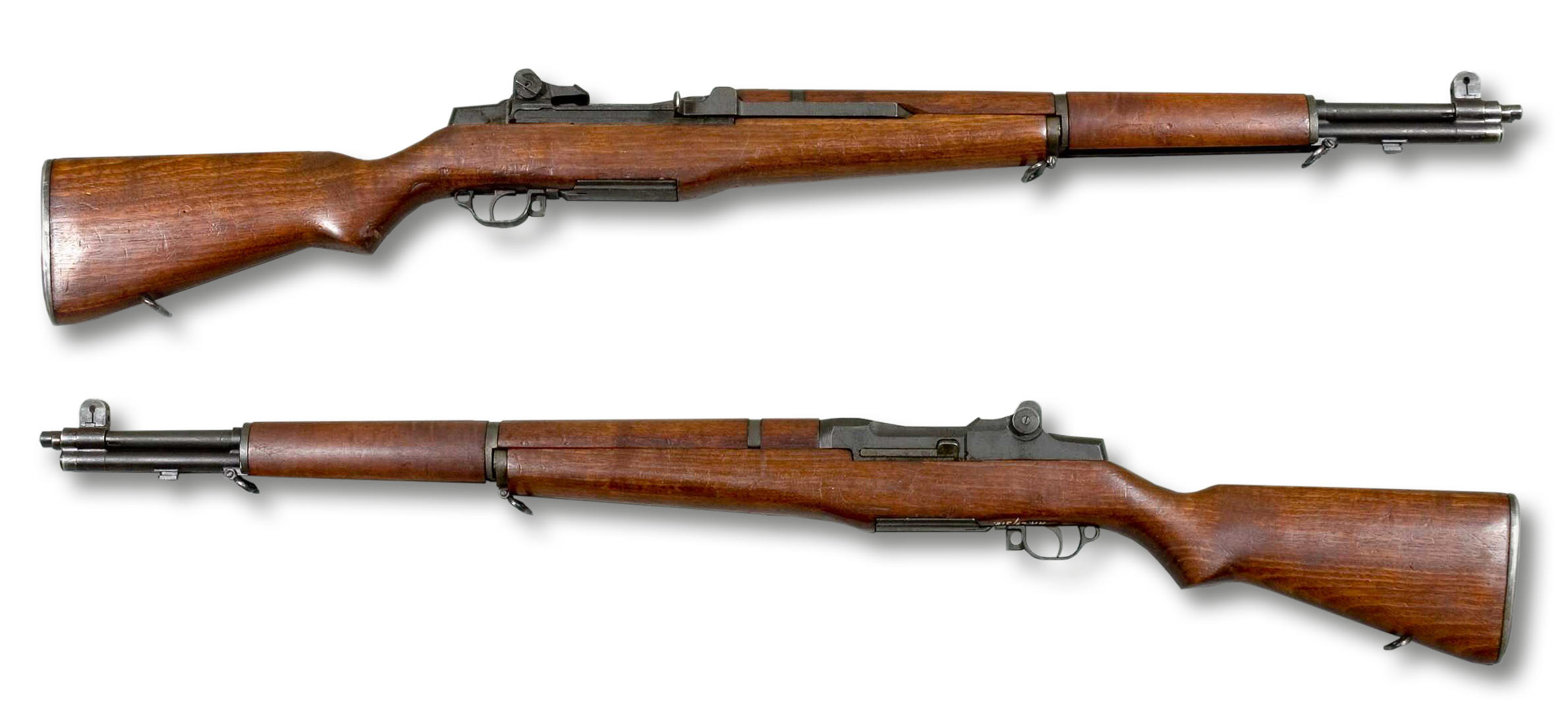
Armémuseum (The Swedish Army Museum), CC BY-SA 4.0 , via Wikimedia Commons
M-1 Garand |
- Along with needing additional typewriters, the military started issuing the M-1 Garand and carbines to the infantry.
- These semi-automatic weapons began replacing the M1903A3 bolt-action rifle made by L.C. Smith & Corona.
- By November 1943, the government terminated the rifle contract and typewriter production resumed in Syracuse.
- In December, Major General L.H. Campbell, head of the ordnance department, wrote a letter to Hurlbut W. Smith, president of L.C. Smith & Corona:
|
“The approaching termination at your plant of the manufacture of the 1903-A3 army rifle will bring to a close a most valuable war emergency contribution by every one of you at L.C. Smith & Corona Typewriter Co. In behalf of the ordnance department may I congratulate you and all your skilled people for your excellent work in tackling boldly an unfamiliar type of production, following thru and providing your troops and those of the United Nations with accurate reliable rifles.”
(cnyhistory.org)
|

War advantages |
- The company took advantage of the re-conversion to purchase more modern equipment from the government and by February 1944, the company was back to a 50% production rate.
- War production was also suspended at the Groton factory in 1943 but only for
2 months while employees at that factory made much-desired portable typewriters for the U.S. Navy.
- Once reaching the quota for portable typewriters, the company returned to making war products until the end of the war.
- After VJ Day, the Groton factory converted back to making portable typewriters and adding machines for civilian and business use.
|
Company officials expanded the Groton factory in July 1945 and, in August of that year, began constructing an eight-story, block-long addition to the Syracuse factory, adding almost another 125,000 square feet of design, manufacturing, and office space on E. Washington St. In 1946, the company changed its name to Smith-Corona and began to identify all its office and portable typewriters and adding machines as Smith-Corona. In 1953, the company modified its name to Smith-Corona, Inc.
(cnyhistory.org)
|
.jpg)
Public domain, via Wikimedia Commons
Hurlbut W. Smith |
- Hurlbut William Smith (1865-1951) was dean of Syracuse area
industrialists and was also president and chairman of the board of L.
C. Smith & Corona Typewriters, Inc.
- Smith was born
on June 24, 1865, in Lisle, New York.
-
He had a deep heart interest in the creation of a memorial to the county's war heroes that would ever be a living symbol of the country's gratitude.
- Witnessing the fruition of the effort to bring this about gave him one of the greatest thrills of his life, he declared.
-
Since 1918 he served on the Board of Trustees of Syracuse University, from which he received the masters of arts degree in June 1921 and the degree of doctor of laws in 1951.
- At a special meeting on May 4, 1946, the Syracuse Board
of Education named the city's technical-industrial high school
Hurlbut W. Smith Technical and Industrial High School.

Hurlbut W. Smith
home - 5753 sf
1111 James Street -
Syracuse NY |
- Hurlbut Smith was chairman of the
Syracuse Trust Co.'s Board of Directors and a member of the executive
committee.
- He was director and member of the executive committee of the
Crucible Steel Company of America and of the Great Lakes Steamship Co.,
Inc.
- He was also an official or director of various other corporations,
including the Smith-Lee Co., Oneida, pioneer maker of milk bottle caps, of
which he was for some time president.
- The Onondaga County War Memorial building stands as a city and county
monument to the memory of H. W. Smith's long and active
interest in civic affairs.
|
In his new book, “The Gilded Age on Syracuse’s James Street,” historian Dennis Connors takes his readers back to a time of stately mansions, gardens and carriage houses on the Salt City’s most fashionable road.
From the 1890s to 1930s, James Street was a source of Syracuse pride, a “lovely residential haven,” Connors wrote, and a respite from the “gritty businesslike neighborhood of canal-side Syracuse.”
(syracuse.com)
|
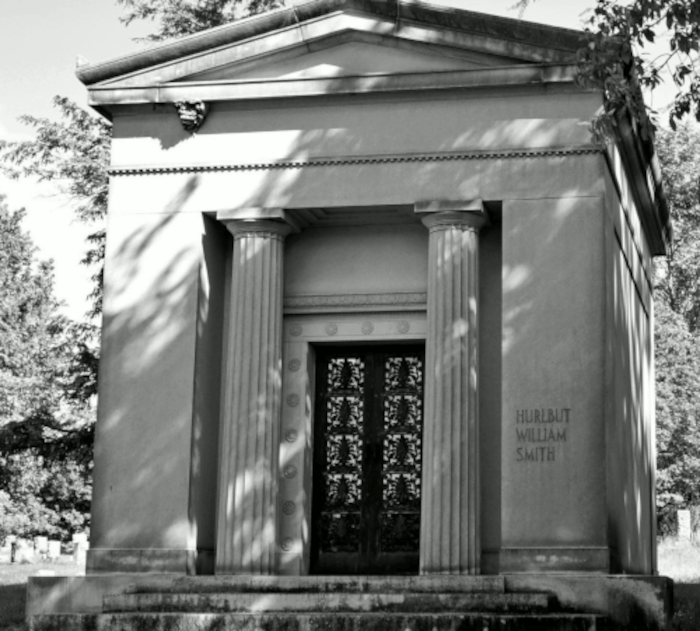
Hurlbut W. Smith -
Oakwood Cemetery |
- Hurlbut W. Smith, 86, died at
his home, 1111 James St., on December 16, 1951.
- Smith suffered a cerebral hemorrhage, which caused complete
paralysis, a week earlier.
- He had been active and he worked the preceding
Friday until the moment of his sudden illness, carrying on the duties of his
multitude of business and civic interests.
- He was a member of the
Freemasons.
|
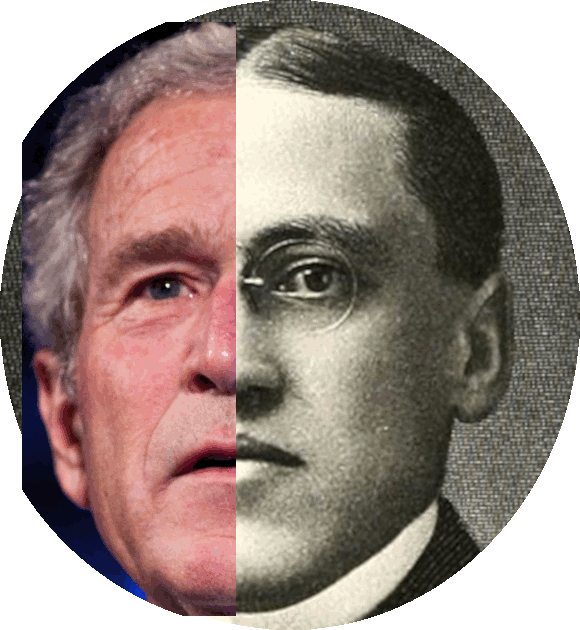
George
Bush Jr. as Hurlbut
William Smith |
George Walker
Bush
1946
7/6
|
Hurlbut William Smith
1865-1951
6/24
12/16 |
 |
 |
|
Burning Bush |
-
By May 1960, SCM began to move its typewriter production to the Groton and Cortland factories, eliminating all typewriter manufacturing in Syracuse.
- Mayor Anthony Henninger expressed shock and disappointment over Smith-Corona’s announcement it would move out of Syracuse.
- With this transfer to the other factory sites, the final vestige of the once notable typewriter industry left Onondaga County.
- President George W. Bush's Powerful Message of Hope During the Coronavirus Pandemic.
|
George H.W. Bush vomited at a 1992 state dinner in Japan due to a case of acute gastroenteritis, also known as the "stomach flu". The incident occurred while he was a guest of Japanese Prime Minister Kiichi Miyazawa and he later fainted after vomiting on the Prime Minister's lap.
(Assistant)
|

End of the line |
- Elwyn Smith, SCM president, said the company was
diligently looking for a new business to occupy the Syracuse
factory site on East Washington Street.
- The building was sold it
was remodeled and named the Midtown Plaza.
- After its initial success, Midtown Plaza was sold to a New
Jersey firm, became embroiled in back taxes owed to the city of Syracuse, and eventually became a vacant eyesore.
- The building was imploded in 1999.
|
You lack the season of all natures, sleep.
Shakespeare, Macbeth

| |
 |
 |