|
RAPHAEL - CARTOONS
Raphael, Public
Domain, via
Wikimedia Commons
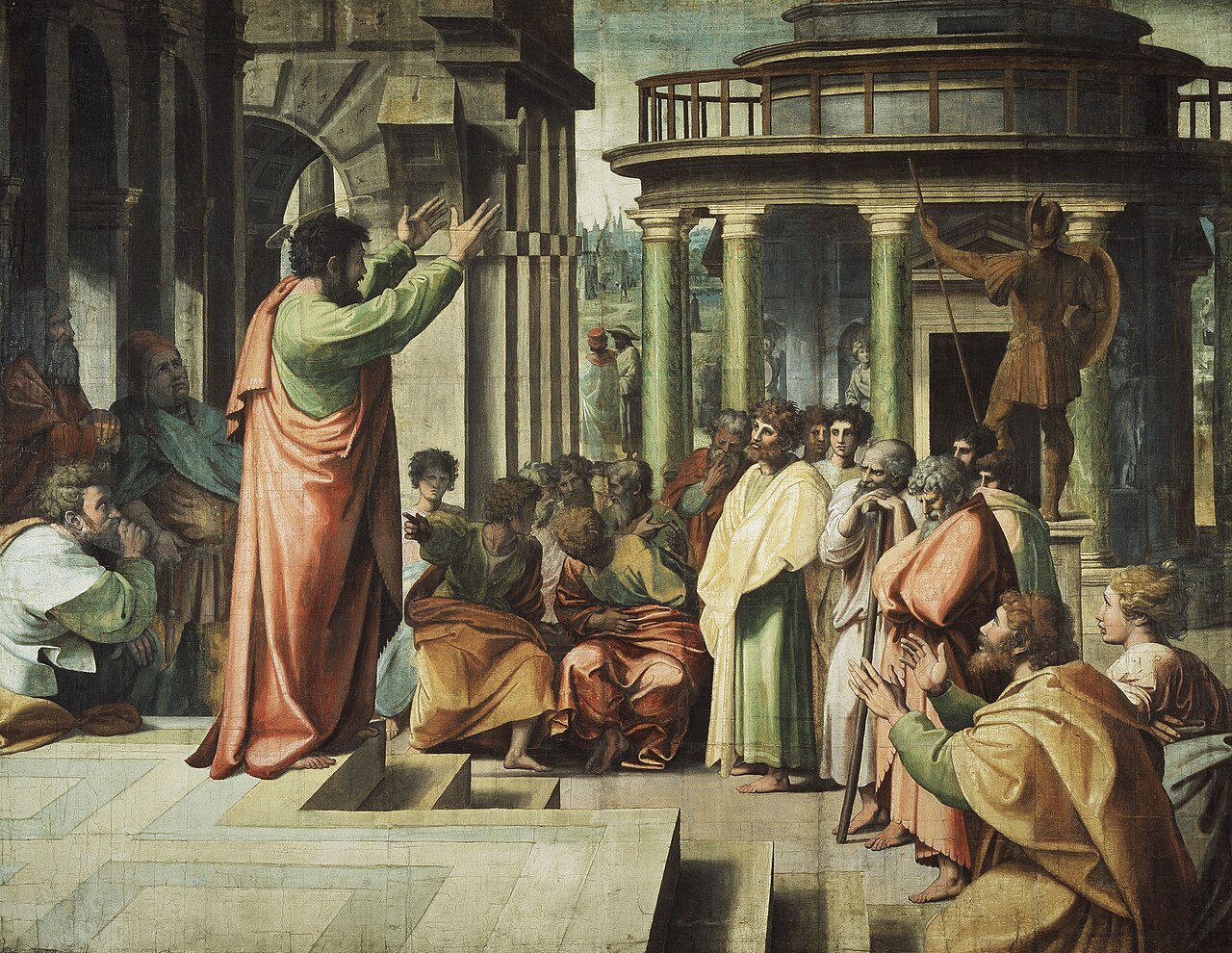
St Paul Preaching in Athens
1515–1516 |
- The Raphael Cartoons are 7 large modello paintings on paper, designs for tapestries, surviving from a set of
10 cartoons, by the High Renaissance painter Raphael in 1515–1516.
- They were sent from Rome to the weavers in Brussels, who cut them into wide strips and had them beside their looms.
- The set of tapestries was commissioned by Pope Leo X for the Sistine Chapel in the Vatican Palace in Rome, showing scenes from the Gospels and Acts of the Apostles.
- They are still hung on special occasions below the frescoes of the Life of Moses and the Life of Christ commissioned by Pope Sixtus IV.
- The cartoons belong to the British Royal Collection but have been on loan to the Victoria and Albert Museum in London since 1865.
|
Originally the set was intended to include 16
tapestries. Raphael was paid twice by Leo, in June
1515 and December 1516, the last payment apparently
being upon completion of the work. Tapestries retained
their Late Gothic prestige during the Renaissance.
Raphael was paid a total of 1,000 ducats.
(Wikipedia)
|
Raphael, Public
Domain, via
Wikimedia Commons
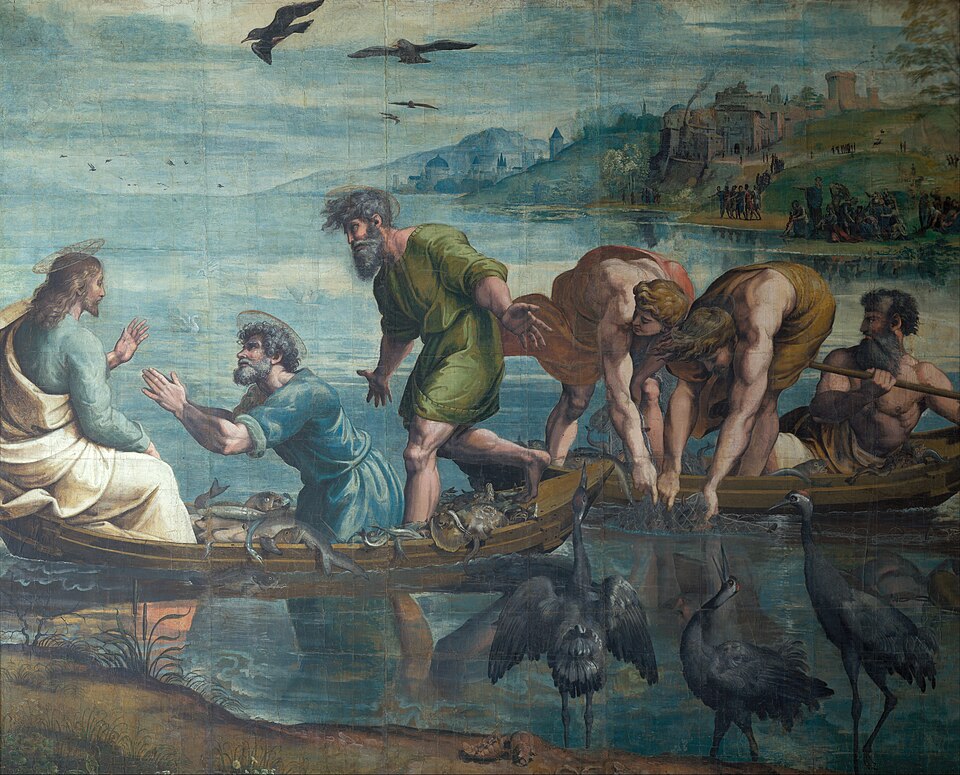
The Miraculous Draught of Fishes |
- Raphael knew that the final product of his work would be produced by craftsmen rendering his design in another medium; his efforts are therefore entirely concentrated on strong compositions and broad effects, rather than felicitous handling or detail.
- It was partly this that made the designs so effective when later reproduced in reduced print versions. The cartoons are painted in a glue distemper medium on many sheets of paper glued together.
-They are now mounted on a canvas backing and are in general in very good condition apart from some fading of the colors.
|
The cartoons are all slightly over 3 m (9 feet 10 inches) tall, and from 3 to 5 m (9 feet 10 inches to 16 feet 5 inches) wide, with the figures being over-lifesize.
(Wikipedia)
|
Raphael, Public
Domain, via
Wikimedia Commons
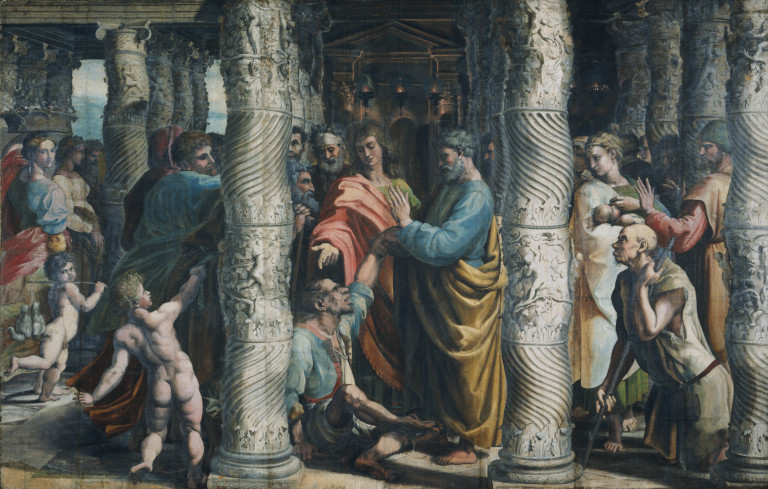
The Healing of the Lame Man |
- The cartoons are mirror-images of the finished tapestries,
which were worked from behind.
- Raphael's workshop would have assisted in the completion of the cartoons which were finished with great care.
- The cartoons show a much greater range of colors and more subtle gradation than could be reproduced in a tapestry.
|
The scenes from the Life of Peter were designed to hang below the frescoes of the Life of Christ by Perugino and others in the middle register of the chapel; opposite them, the Life of Saint Paul was to hang below the Life of Moses in fresco. An intervening small frieze showed subjects from the life of Leo, also designed to complement the other series.
(Wikipedia)
|
Raphael, Public
Domain, via
Wikimedia Commons
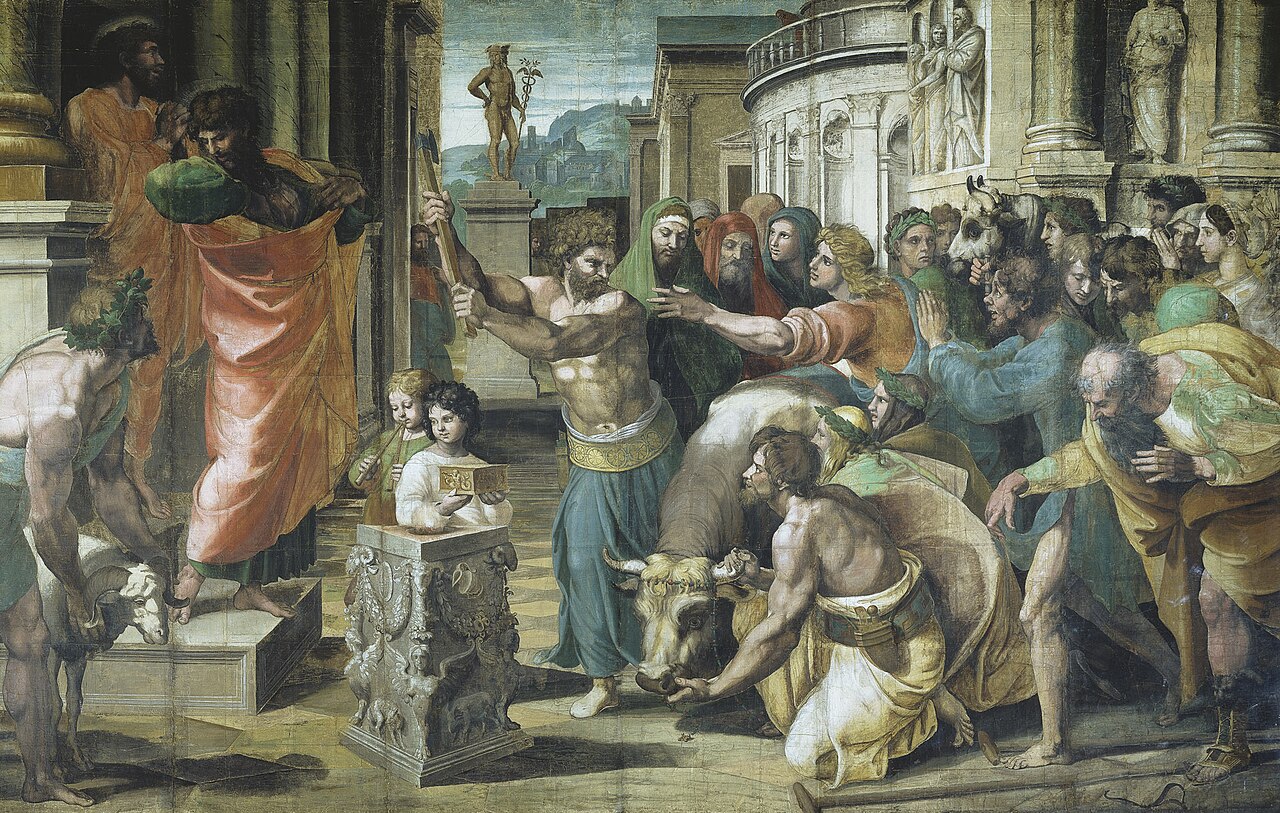
The Sacrifice at Lystra |
- The Raphael Cartoons represent scenes from the lives of
Saints Peter and Paul.
- As was usual, the completed tapestries reverse are a mirror image of the cartoon designs.
- The design emphasized a number of points relevant to contemporary controversies in the period just before the Protestant Reformation, but especially the entrusting of the Church to Saint Peter, the founder of the papacy.
- There were relatively few precedents for these subjects, so Raphael was less constrained by traditional iconographic expectations than he would have been with a series on the life of Christ or Mary.
- He no doubt received some advice or instructions in choosing the scenes to depict.
|
Each sequence begins at the altar wall, with the Life of Peter (Old Testament) on the right side of the Chapel and Life of Paul (New Testament) on the left.
This Includes the 3 subjects with no surviving cartoons.
(Wikipedia)
|
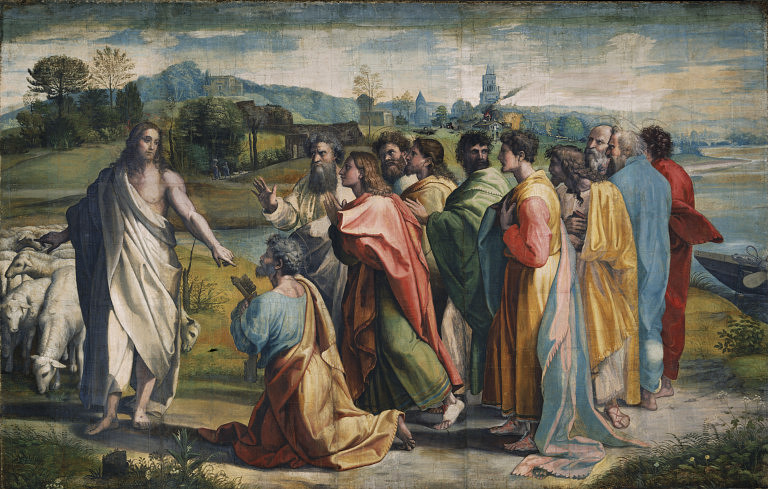
Raphael, Public
Domain, via
Wikimedia Commons
Christ's Charge to Peter |
Life of Peter:
- The Miraculous Draught of Fishes (Luke 5:1–11).
- Christ's Charge to Peter (Matthew 16:16–19).
- The Healing of the Lame Man (Acts 3:1–8).
-
The Death of Ananias (Acts 5:1–10).
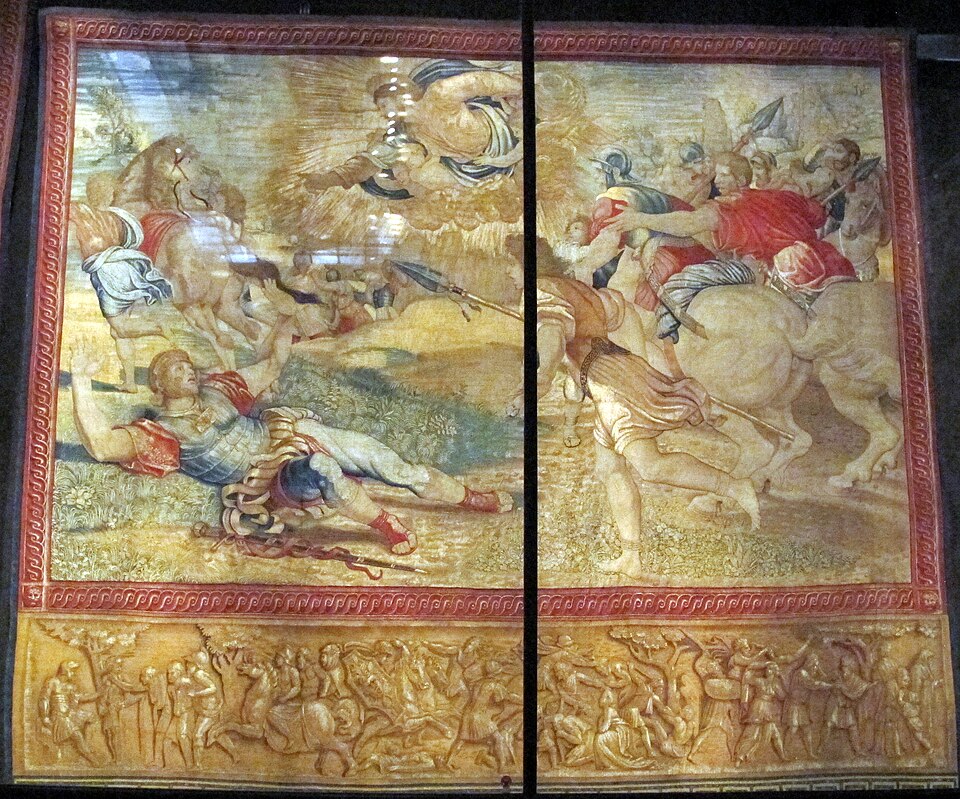
Raphael, Public
Domain, via
Wikimedia Commons
Conversion of Saint Paul, Vatican
(no cartoon
available) |
- Life of Paul:
- The Stoning of St Stephen (no cartoon).
- The Conversion of Saint Paul (no cartoon).
-
The Conversion of the Proconsul or The Blinding of Elymas
(Acts 13:6–12).
- The Sacrifice at Lystra (Acts 14:8).
- St Paul in prison (no cartoon).
- St Paul Preaching in Athens
(Acts 17:16–34).
- The descriptions that the Vatican
provides for the cartoons have no relation to the meaning
that Raphael painted them to depict, they are totally
different.
|
The seven cartoons now in London were bought from a Genoese collection in 1623 by King Charles I of England, then still Prince of Wales, using agents. He paid only £300 for them, a price that suggests they were regarded as working designs rather than works of art in their own right. Charles had in fact intended to make further tapestries from them at the Mortlake Tapestry Works near London, which he did, with new baroque borders by their designer Francis Cleyn, paying £500 each, but was well aware of their artistic significance..
(Wikipedia)
|
|
|













