|
ABEL GRIMMER - THE LOST CASTLE - PAGE 5
|
The New
World Arrives as
America |
Bric-k |
-
The Pilgrims founded the Plymouth Colony, later called Massachusetts,
and there were 13 colonies and each had a charter from the English King.
which defined the relationship between the colony and the English government.
- Unlike the French, who were treated to the rule of a single royal family with
4 monarchs (the Bourbons), the British government or ruling royal houses changed
6 times and had 12 separate heads of state during the colonial
period.
|
The Battle of Yorktown resulted in a decisive American and French victory, leading to the surrender of British General Cornwallis' army and effectively ending the major fighting of the American Revolutionary War. This victory prompted peace negotiations that resulted in the 1783 Treaty of Paris, which formally recognized the United States as an independent nation. (Assistant)
|

Forest through the
trees
|
- Most believe that after the Battle of Yorktown in
1781, the United States of America was born, but in reality,
it took a long time to transform the 13 colonies into a
unified nation.
- The new country faced years of economic
hardship
and state governments were widely disorganized.
-
Insurrections were common and the new Congress was ineffective
and had no power.
- While the Revolution was very popular
in the colonies, not all were in favor, and many of the
British Loyalists returned to Britain.
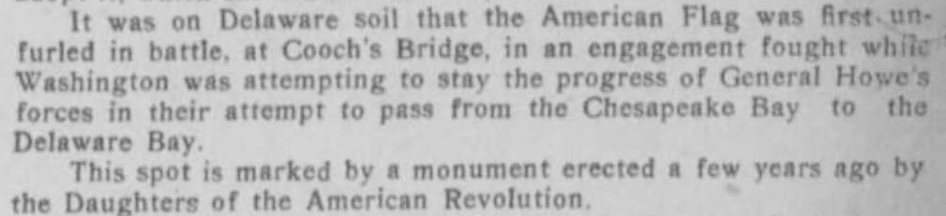
Wilmington Evening
Journal -
July 1, 1914 |
- The new American flag was first unfurled in Battle at
Cooch's Bridge in Delaware.
- This was an engagement
fought while George Washington was attempting to stay the
progress of General Howe's forces in the British attempt to pass from the
Chesapeake Bay to the Delaware Bay.
- Ever since, the
flag has made it's way to battles all over the world.
|
General
Howe was sent to North America in March 1775, arriving in May after the American War of Independence broke out. After leading British troops to a costly victory in the Battle of Bunker Hill, Howe took command of all British forces in America from Thomas Gage in September of that year. Howe's record in North America was marked by the successful capture of both New York City and Philadelphia.
(Wikipedia)
|
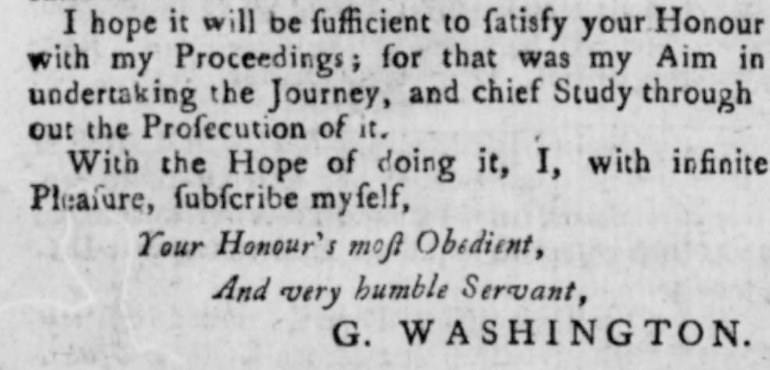
Annapolis Maryland Gazette - March 23,
1854 |
- What most don't realize is that General George
Washington was a British military man for decades, well into
his 40s, and it wasn't long after the Revolution
that America and Britain restored a trade and diplomatic relationship
under his presidential direction.
- Washington was working for the British government
and they ran the
colonies from an outfit that was first known as the Virginia
Company.
- He quit the job because they wouldn't promote
him to officer because he wasn't British, he was a colonist
working for the Brits.
- Not long after, the new
Continental Army arrived on the scene with Washington in the
catbird seat.
|
Despite their political conflict, the two men shared a passion for agriculture and were products of the same British Empire. After the war, George III famously remarked that Washington's decision to resign his commission instead of seizing power would make him "the greatest man in the world".
(Assistant)
|
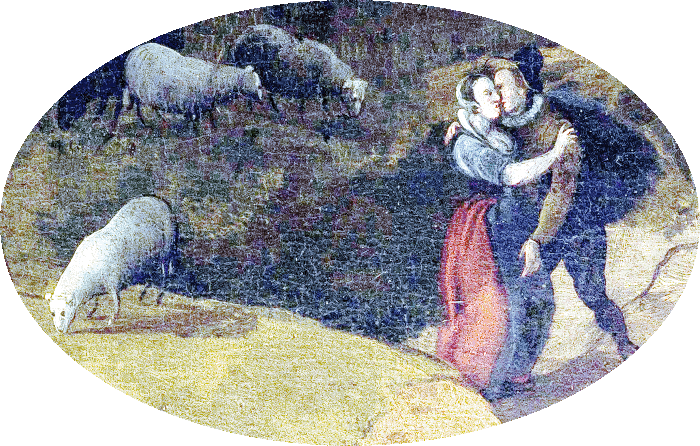
Virginia family |
- The Virginia Company of London was a division of the Virginia Company in charge of the actual colonization of the eastern coast of North America between latitudes 34° and 41° N.
- The portion of the company's territory north of the 38th parallel was shared with the Plymouth Company, with the stipulation that neither company found a colony within 100 miles of the other.
- The Virginia Company landed on April 26, 1607, and founded Cape Henry, near Virginia Beach and were promptly attacked by Native Americans so they moved north to Jamestown Island where they built a fort.
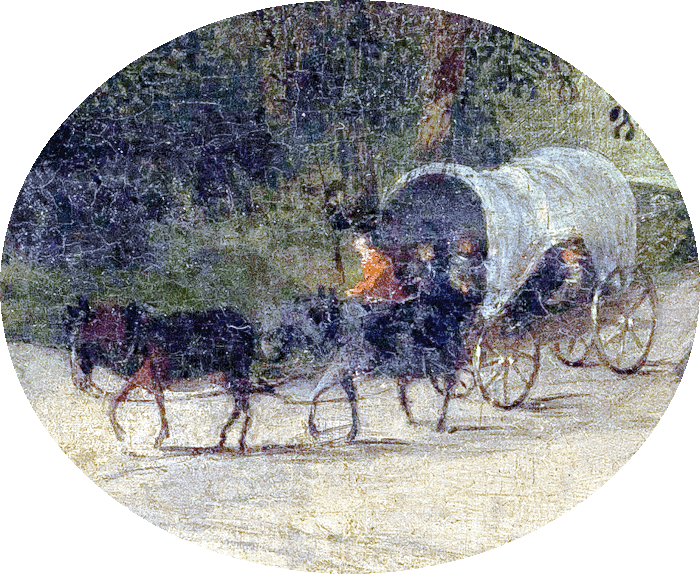
Westward bound |
- During that period in Renaissance England, wealthy merchants were eager to find investment opportunities.
- The merchants established trading companies made of investors, known as 'adventurers' who purchased shares of the company stock.
- More than 6,300 Englishmen invested in joint-stock companies between 1585 and 1630 and traded in far-flung places like Africa, Turkey, Russia, the East Indies, the Mediterranean and America.
- Investors in the Virginia Company hoped to profit from the natural resources of the New World.
- And that they did.

Big stick |
- There are estimates that 15-20% of the colonists were
British Loyalists and many of them were punished harshly by
gangs of so-called Patriots who wanted to harm them.
-
The truth is, only the elite had the luxury of keeping their
political choices hidden, however, circumstances made it so colonists
had to publicly choose a faction, although it might be easy to
ask, why didn't they just keep their mouths shut, they
probably couldn't.
- There were even separate neighborhoods
where the 2 factions resided so when you went home, everyone
knew what side of town you were on, or what newspaper you
subscribed to.
- As a result, when the British
started pulling out and returning to England, many Loyalists wisely went with them.

Big stick |
- During the colonial days, there were 3 kinds of English colonies in North America: Royal, Proprietary, and Charter.
- Royal Colonies were run by a governor and council
who were appointed by the king, and the colony was administered directly by the crown:
examples include Virginia and New Jersey.
- Proprietary Colonies
were run by a proprietor or group of proprietors, who received a land grant from the king, ran the colony
and they had the right to govern the colony, though they were still accountable to the king:
examples include Pennsylvania and Maryland.
- Charter Colonies were established under a corporate charter granted by the crown. The charter specified the rules of government, and the colonists had significant autonomy and could elect their own leaders:
some examples include Rhode Island and Connecticut.
|
The first colonies were established by the English,
with Jamestown, Virginia (1607) being the first
permanent English settlement. Following Jamestown, the
other colonies were founded over several decades,
including Massachusetts (1620), Maryland (1634), and
Georgia (1732), which was the last of the original
thirteen colonies.
(Assistant)
|
Oppressed |
- Toward the end of the American Revolution, Lord Frederick North resigned as the
British Prime Minister after attempting to end the war
through diplomatic means.
- He offered a conciliation that
promised if the British ended all oppression, the colonists should end
their rebellion.
- However, the problem is, when has there
ever been a government that's not oppressive, at least to some?
- Regardless,
the colonists did not take the 'deal' and Lord North was exhausted
by the tension between the two countries.
.jpg)
Nathaniel Dance-Holland, Public domain, via Wikimedia Commons
Lord Frederick North
- 1773 |
-
Frederick North, 2nd Earl of Guilford (1732-1792), better known by his courtesy title Lord North, which he used from 1752 to 1790, was Prime Minister of Great Britain from 1770 to 1782.
- He led the Kingdom of Great Britain through most of the American Revolutionary War.
- He also held a number of other cabinet posts, including Home Secretary and Chancellor of the Exchequer.
- North's reputation among historians has varied wildly, reaching its lowest point in the late 19th-century, when he was depicted as a creature of King George III and an incompetent who lost the American colonies.
|
Winston Churchill as Frederick North |
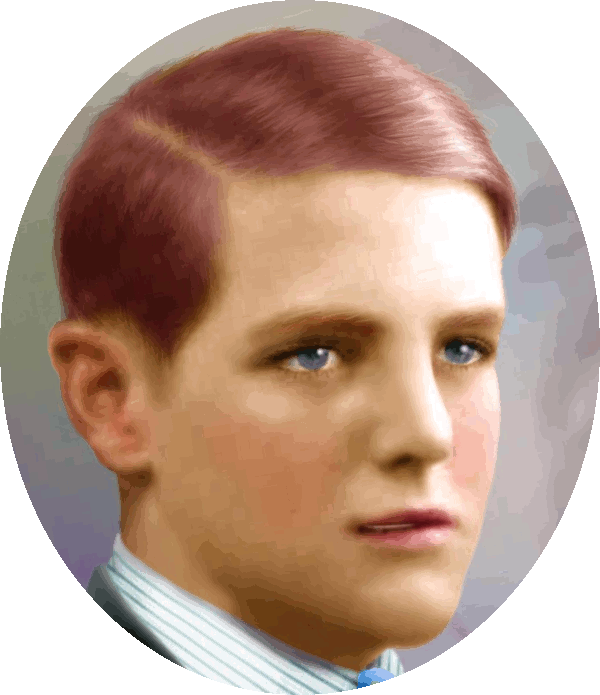 |
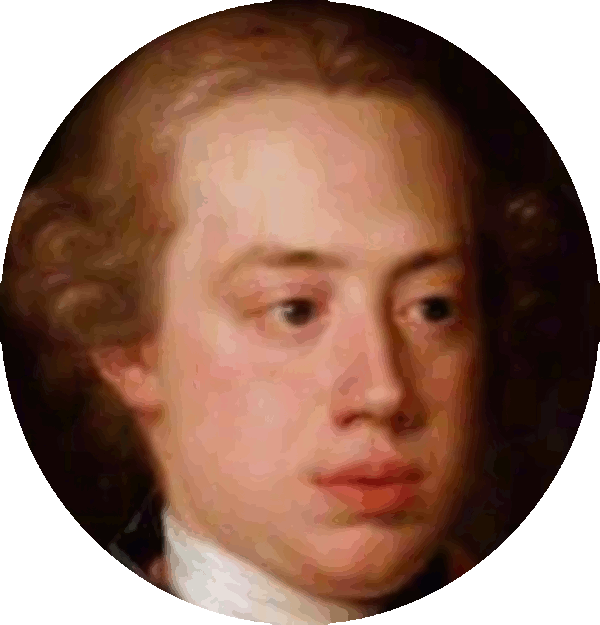 |
Winston Churchill
1874-1965
11/30
1/25
Prime Minister |
Frederick North
1732-1792
4/13
8/5
Prime Minister |
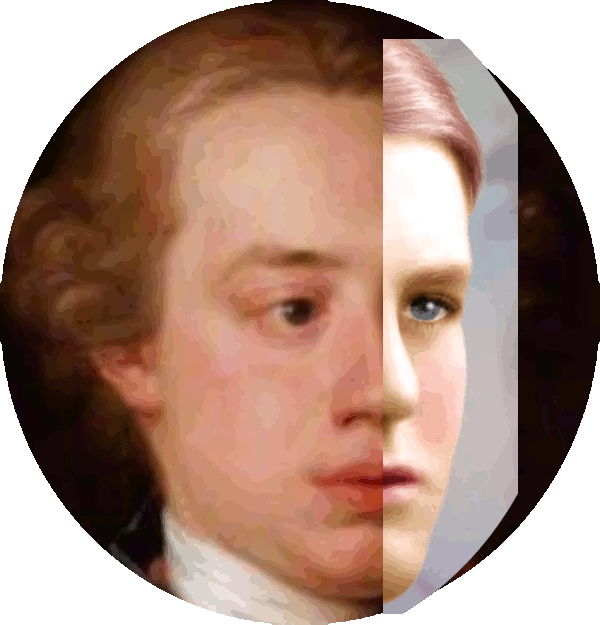 |
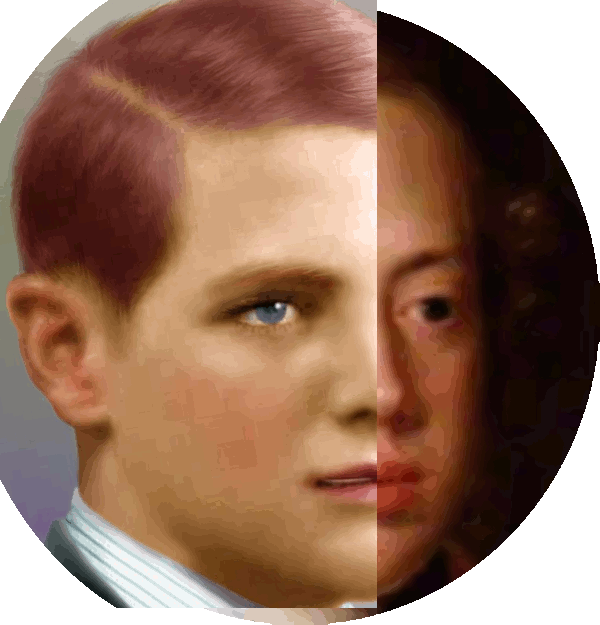 |
|
North by Northwest |
- It's said that when Cornwallis surrendered at Yorktown,
Lord North took the news like a bullet to the chest, repeatedly
exclaiming; 'Oh God, it is all over.'
- North was the second British prime minister to be forced out of office by a motion of no confidence; the first was Sir Robert Walpole in 1742.
- North resigned in disgrace on March 20, 1782, on account of the British defeat at Yorktown the year before.
|
Winston Churchill as Frederick North |
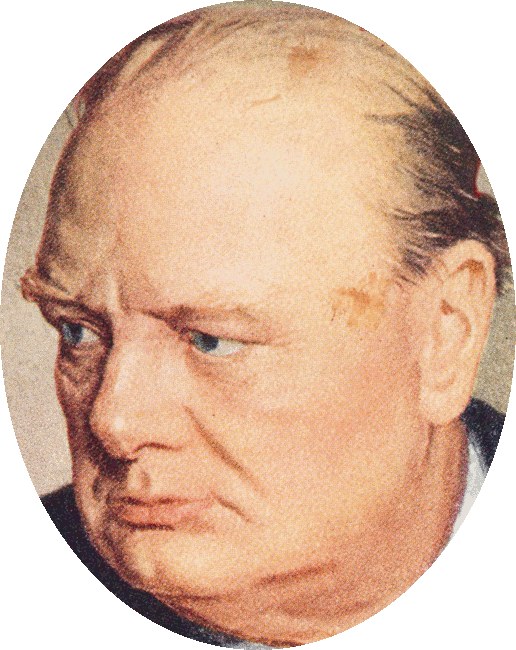 |
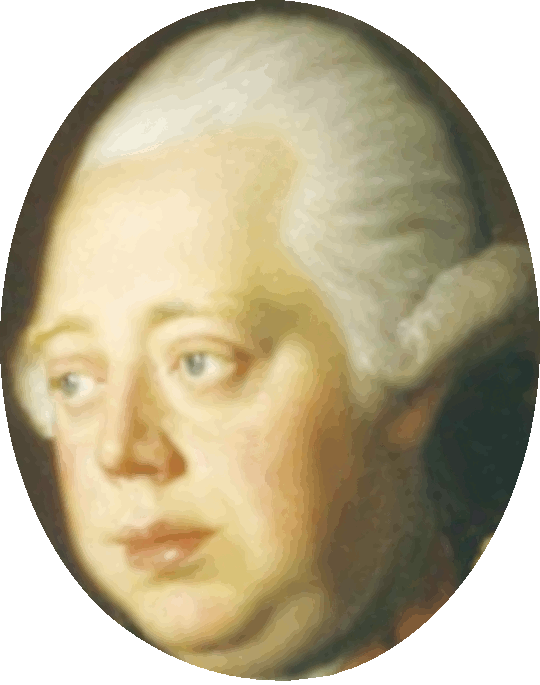 |
Winston Churchill
1874-1965
11/30
1/25
Prime Minister |
Frederick North
1732-1792
4/13
8/5
Prime Minister |
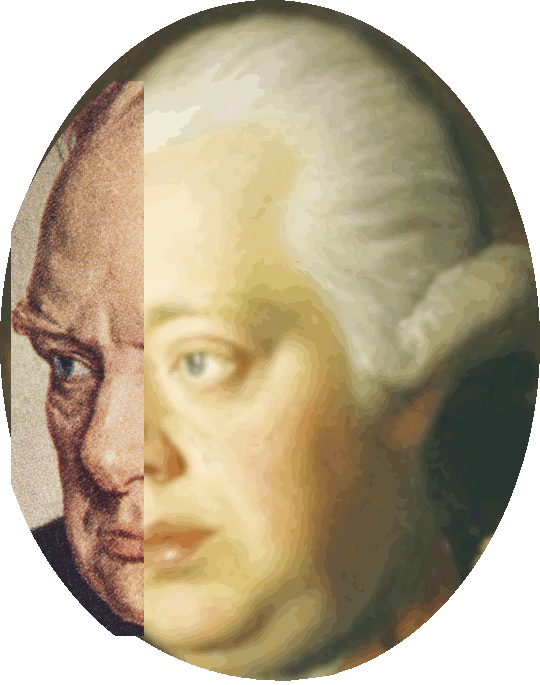 |
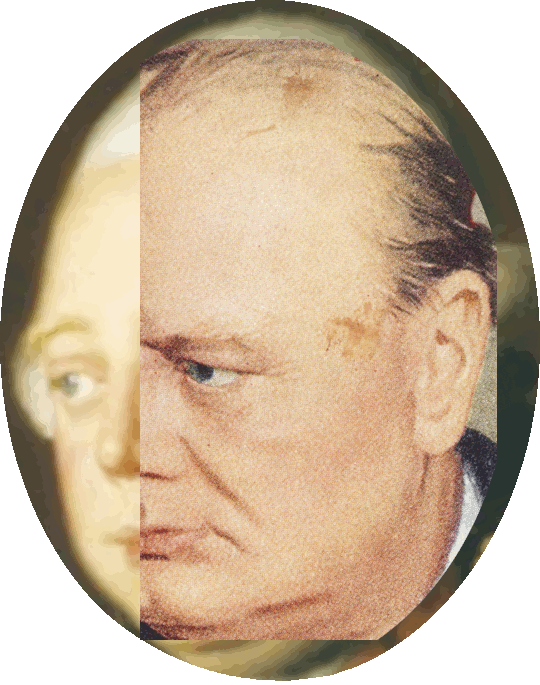 |
|
Winston Churchill's World War Disaster ... |
- North was an active speaker until he began to go blind in 1786.
- He succeeded his father as the 2nd Earl of Guilford on August
4, 1790, and entered the House of Lords, by which time he had entirely lost his sight.
- North is today predominantly remembered as the prime minister
'who lost America.'
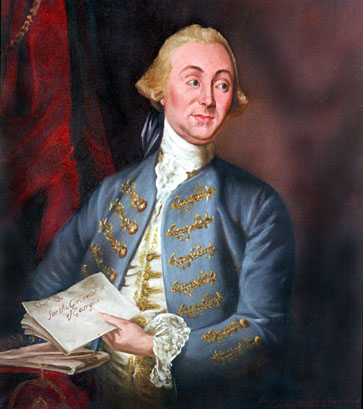
Andrea Soldi, Public domain, via Wikimedia Commons
Sir James Wright was
Georgia's last Royal
Governor |
- While the British waved the white flag and surrendered
at Yorktown on October 17, 1781, the
war was technically not over for quite some time after that.
- Britain's withdrawal from the colonies didn't happen
overnight, and it took quite a while to get all the British
and their troops out, as late as July 11, 1782.
- British
royal governor, Sir James Wright, and military personnel under
his command fled Georgia for South Carolina.
- His goal was
to escape the colonies via the Atlantic Ocean and several of
his ships went to New York, while others went to Florida and
the West Indies.
|
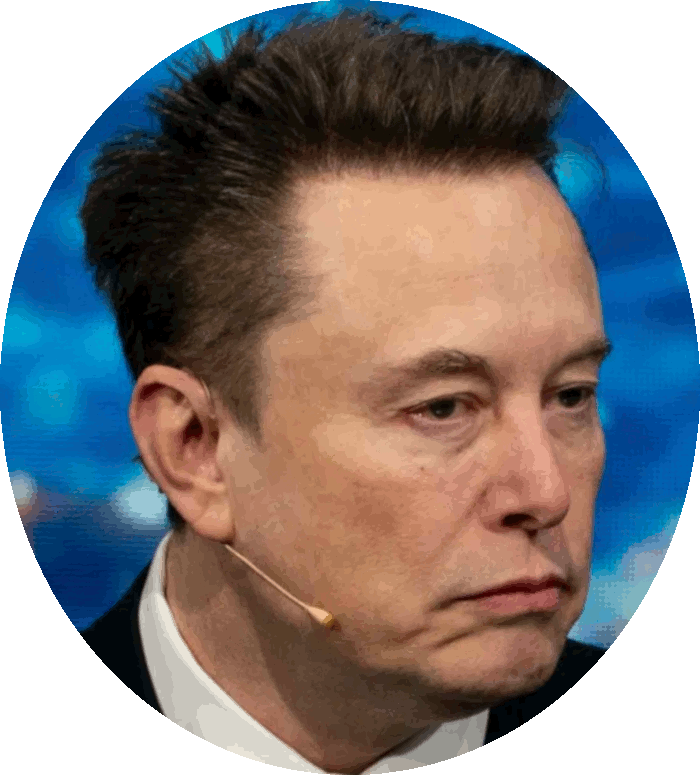
Elon Musk as Governor James Wright |
 |
 |
Elon Reeve Musk
1971
6/28 |
James Wright
1716-1785
5/8 11/20
Royal Governor |
 |
 |
|
Running on empty |
-
Wright's first troubles came with the Stamp Act of 1765. however, in spite of efforts by the Sons of Liberty to block its implementation, Georgia was the only colony to import and actually use the revenue stamps.
- Georgia did not send delegates to the First Continental Congress in 1774.
|
By 1778, Governor Wright convinced the government to lend him enough troops to once again attempt to take Savannah. After some short but sharp fights, he regained control of Savannah on 29 December 1778. While never fully in control of the state, he did restore large areas within Georgia to colonial rule, making this the only colony that was regained by the British once they had been expelled. (Wikipedia)
|
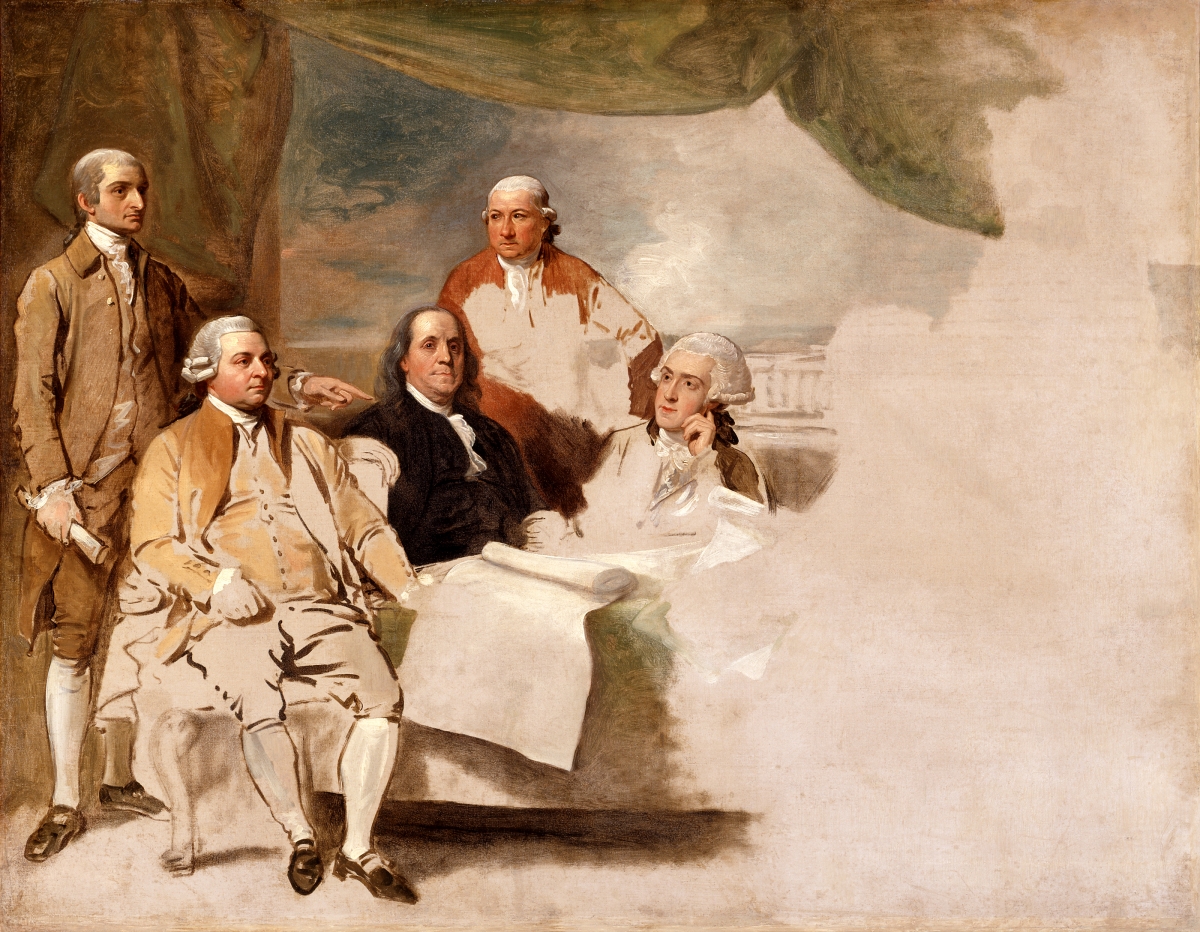
Benjamin West, Public domain, via Wikimedia Commons
Treaty of
Paris 1782-3 |
- When the war finally ended in 1782, peace talks were held in France and
it took the committee an
entire year to come to agreement.
- The British were represented by
Sir Richard
Oswald and the Americans by luminaries like John Jay, John
Adams and Benjamin Franklin.
|
Treaty of Paris, by Benjamin West (1783), shows the American commissioners who negotiated the 1783 Treaty of Paris. Temple Franklin is on the right. Left of him are Henry Laurens, Benjamin Franklin, John Adams, and John Jay. The British commissioners did not pose for West, and the picture was never finished. (Wikipedia)
|
|
Scottish |
.jpg)
William De Nune (British, 1712-1750), Public domain, via Wikimedia Commons
Sir Richard Oswald |
- In 1782, Richard Oswald,
a Scottish merchant, was selected by Lord Shelburne to open informal negotiations with the Americans, to be held in Paris.
- Because of his prior experience living in America and his knowledge of its geography and trade, he had been consulted frequently by the North ministry about matters concerning the war.
- Oswald is best known for being one of the British peace commissioners who negotiated the
Treaty of Paris in 1782.
|
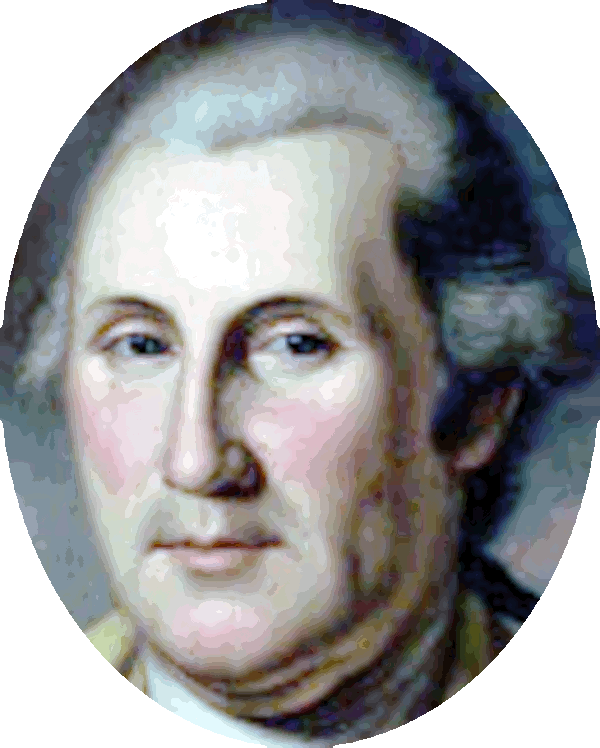
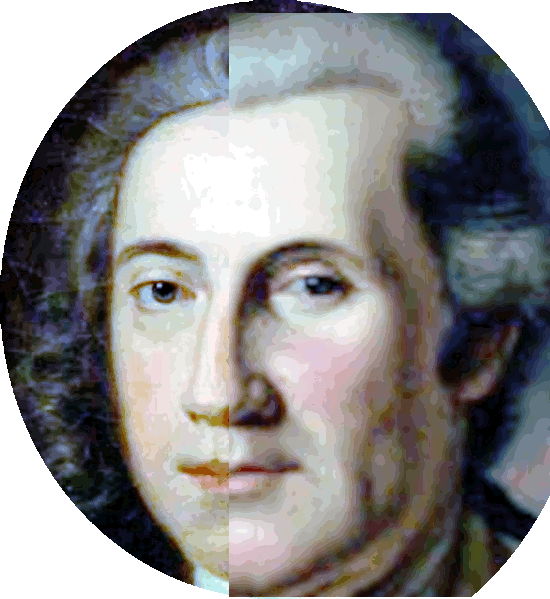
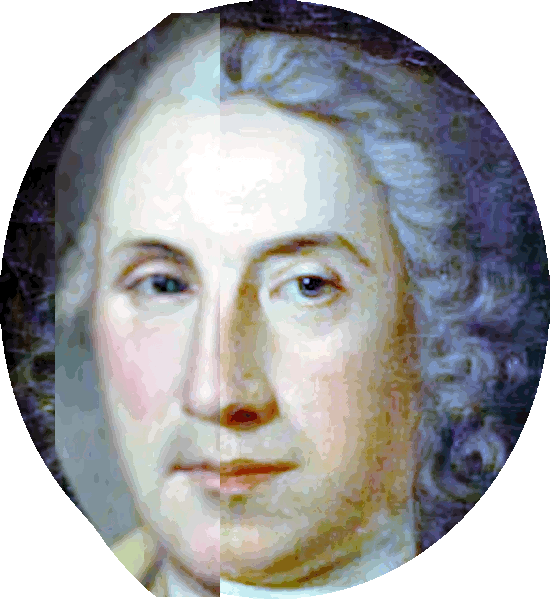
George Washington as Sir Richard Oswald |
 |
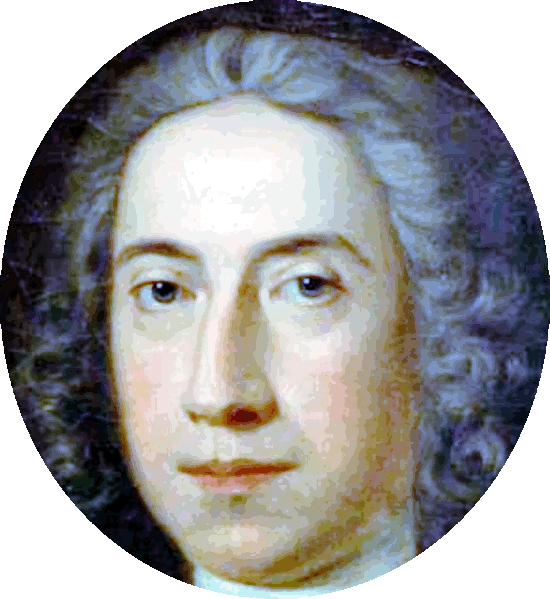 |
George Washington
1732-1799
2/22
12/14
President |
Richard Oswald
1705-1784
?
11/6
merchant
|
 |
 |
|
1st President |
- Richard Oswald (c. 1705-1784) was a Scottish merchant,
slave trader and diplomat.
- During the American Revolution, he served as an advisor to the North ministry on trade regulations and the best way to respond to the American War of Independence.
- He took on a forage contract for the British Army, having in 1756 the merchant James Buchanan (1696–1758) as guarantor.
- Oswald also prospered as a contractor during the Seven Years' War, particularly in the supply of bread in the German theater, and was praised by Ferdinand of Brunswick.
- Doesn't appear to be unbiased, in fact, it appears he had a
lot to gain (money).
|
American |
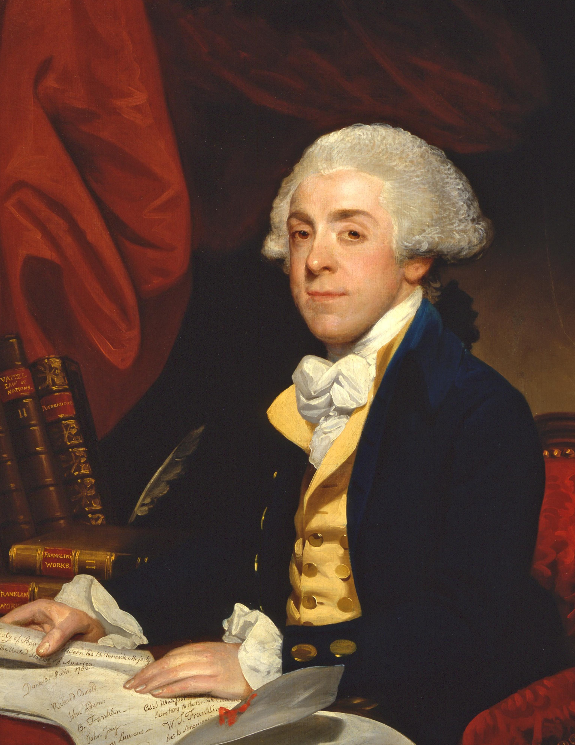
Mather Brown, Public domain, via Wikimedia Commons
William Temple
Franklin - 1782 |
-William Temple Franklin
(1760-1823), known as Temple Franklin, was an American diplomat and real estate speculator who is best known for his involvement with the American diplomatic mission in France during the American Revolutionary War.
|
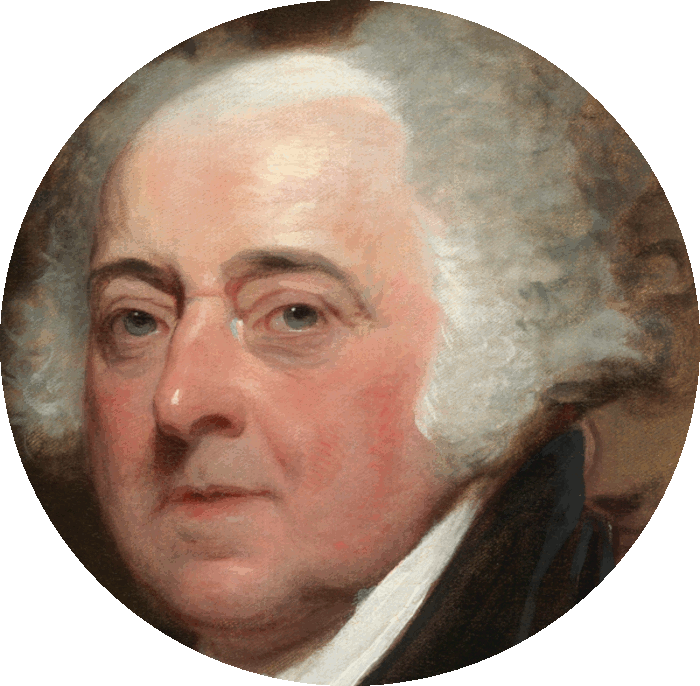
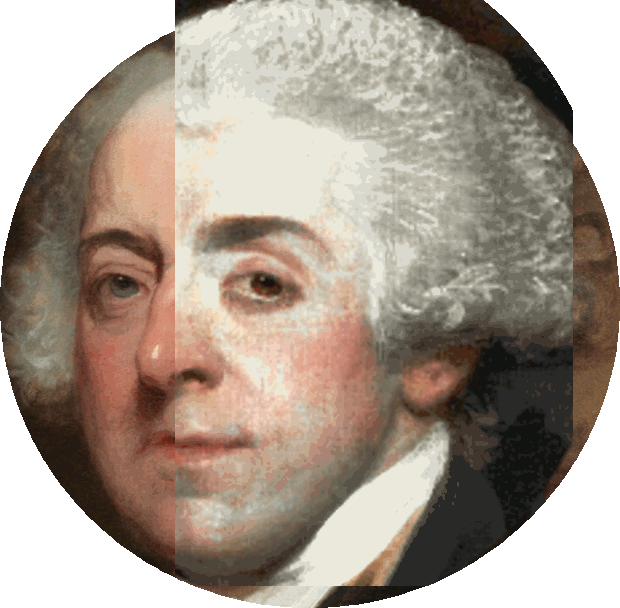
John Adams as William Temple
Franklin |
 |
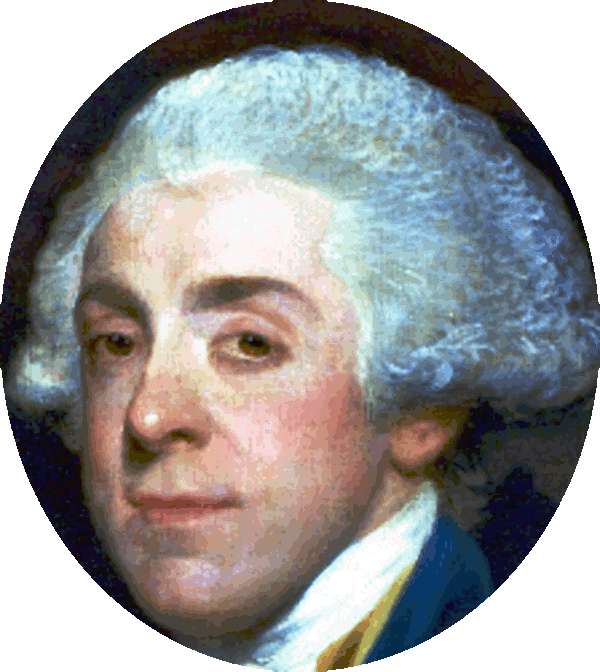 |
John Adams
1735-1826
10/20
7/4
President |
William Temple Franklin
1760-1823
2/22
5/25
Real estate speculator
|
 |
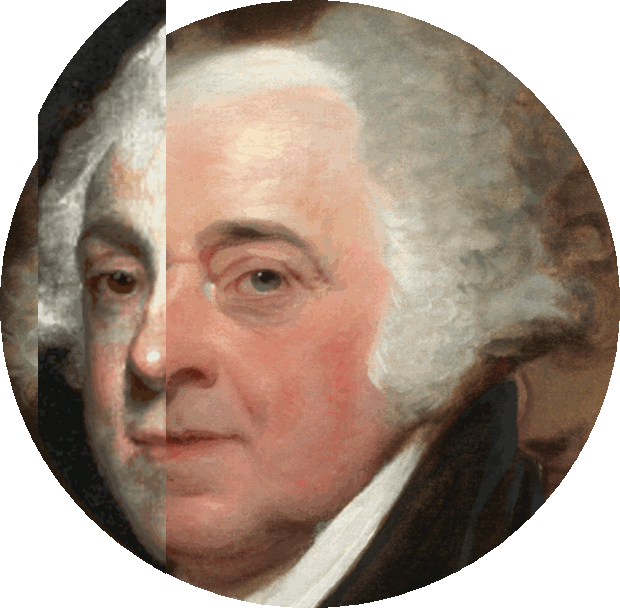 |
|
2nd President without a wig |
- Beginning at the age of 16, Temple Franklin served as secretary to his grandfather Benjamin Franklin, who negotiated and agreed to the Franco-American Alliance.
-
The agreements marked the official entry of the United States on the world stage, and formalized French recognition and support of U.S. independence that was to be decisive in U.S. victory.
|
The Treaty of Alliance (1778), also known as the
Franco-American Treaty, was a defensive alliance
between the Kingdom of France and the United States
formed amid the American Revolutionary War with Great
Britain. It was signed by delegates of King Louis XVI
and the Second Continental Congress in Paris on
February 6, 1778, along with the Treaty of Amity and
Commerce and a secret clause providing for the entry
of other European allies; together these instruments
are sometimes known as the Franco-American Alliance or
the Treaties of Alliance. (Wikipedia)
|
|
American |
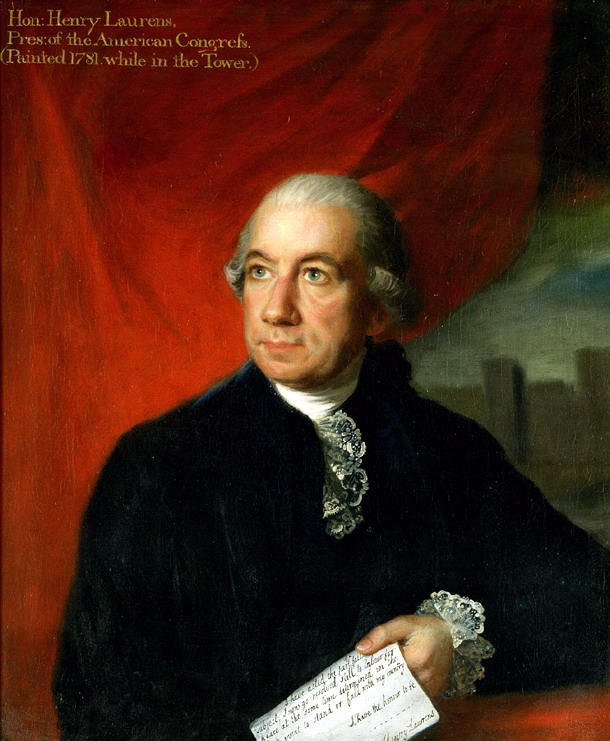
Lemuel Francis Abbott, Public domain, via Wikimedia Commons
Henry Laurens - 1781 |
- Henry Laurens (1724-1792) was an American Founding Father, merchant,
slave trader, and rice planter from South Carolina who became a political leader during the Revolutionary War.
- A delegate to the Second Continental Congress, Laurens succeeded John Hancock as its president.
- He was a signatory to the
Articles of Confederation and, as president of
Congress, presided over its passage.
|
Laurens' forebears were Huguenots who fled France after the Edict of Nantes was revoked in 1685. His grandfather Andre Laurens left earlier, in 1682, and eventually made his way to America, settling first in New York City and then Charleston, South Carolina. (Wikipedia)
|
|
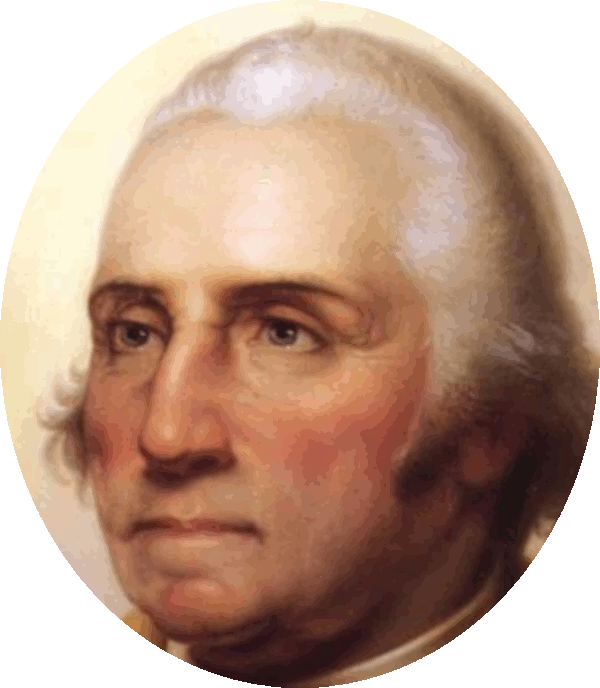
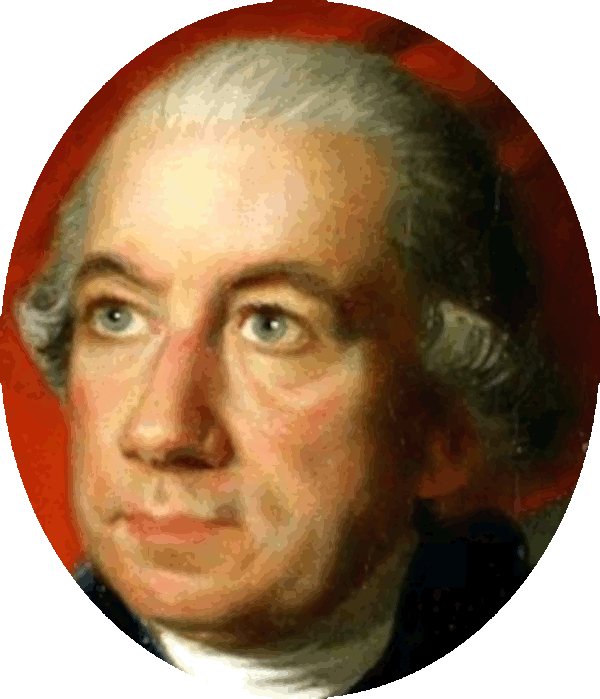
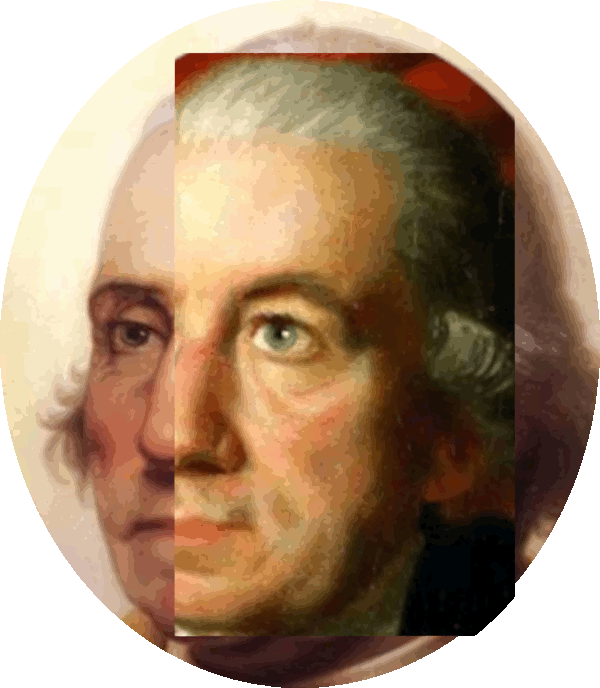
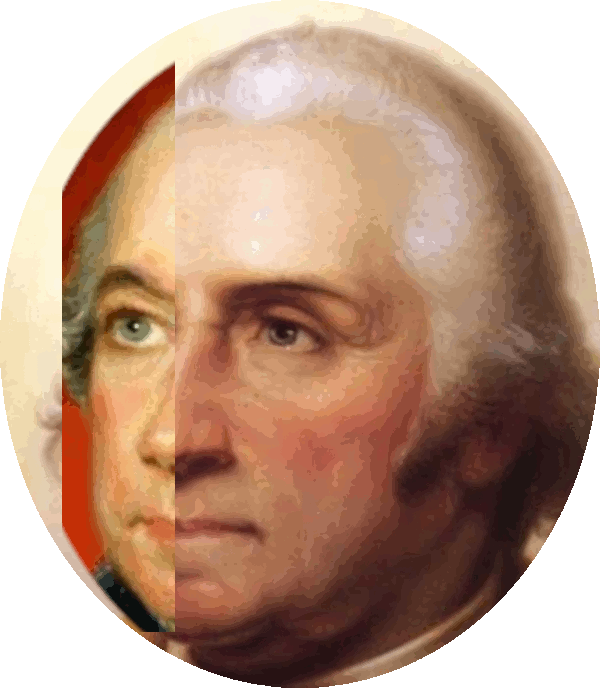
George Washington as Henry Laurens |
 |
 |
George Washington
1732-1799
2/22
12/14
President |
Henry Laurens
1724-1792
3/6
12/8
Slave trader
|
 |
 |
|
Slave trader |
- Laurens had earned great wealth as a partner in the largest slave-trading house in North America,
called Austin and Laurens.
- In the 1750s alone, this Charleston firm oversaw the sale of more than 8,000 enslaved Africans.
- His oldest son, John Laurens, was an aide-de-camp to George Washington and a colonel in the Continental Army.
- Slave trading and nepotism, great.
|
American |
.jpg)
Gilbert Stuart, Public domain, via Wikimedia Commons
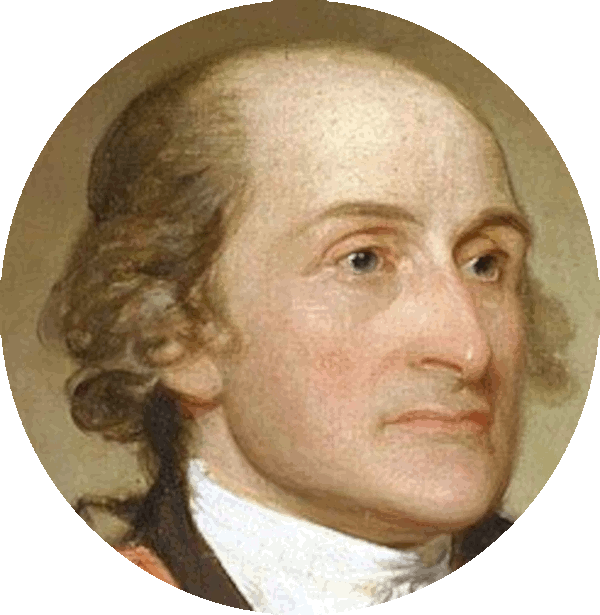
John Jay - 1794 |
- John Jay was a Founding Father, statesman, and diplomat best known as the first Chief Justice of the United States.
- He was also a key figure in the American Revolution, a co-author of
The Federalist Papers, the first Governor of New York, and served as Secretary of Foreign Affairs.
-
A proponent of strong, centralized government, Jay worked to ratify the
United States Constitution in New York in 1788.
- He was a co-author of
The Federalist Papers along with Alexander Hamilton and James Madison, and wrote
5 of the 85 essays.
|
After the establishment of the new federal government, Jay was appointed by President George Washington the first Chief Justice of the United States, serving from 1789 to 1795. The Jay Court experienced a light workload, deciding just four cases over six years. (Wikipedia)
|
|
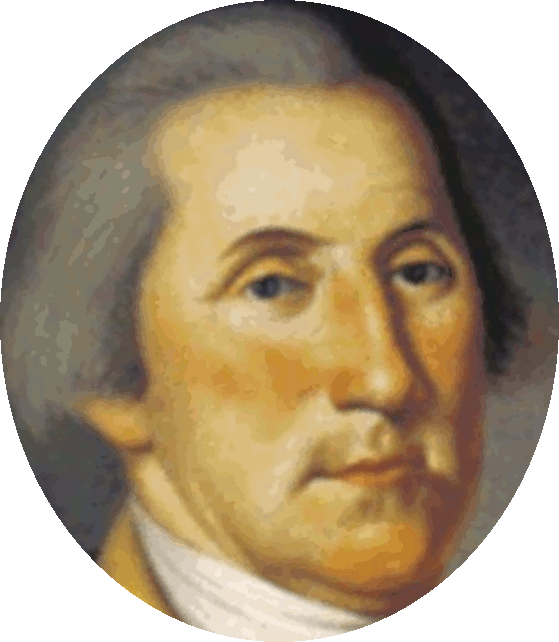
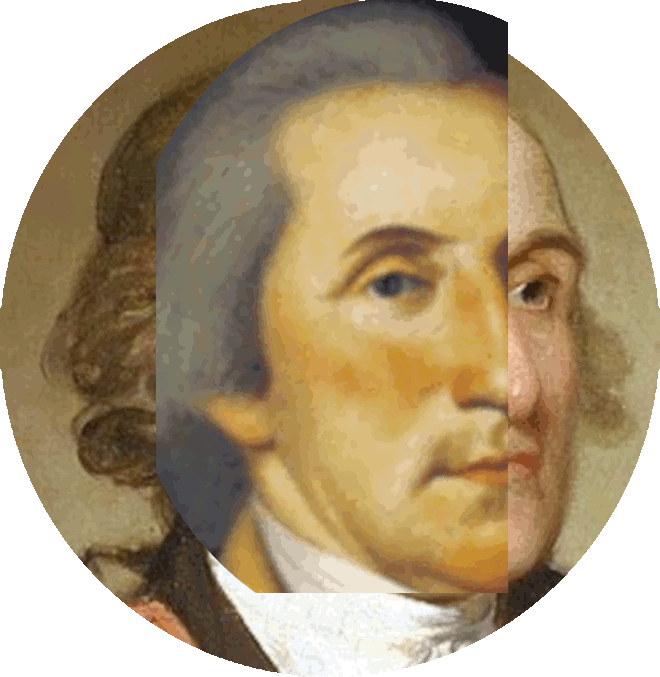
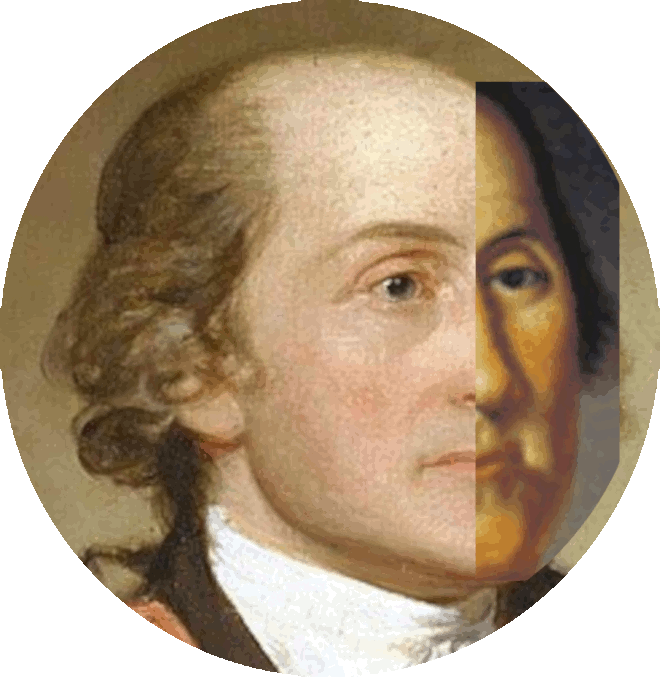
Ethan Allen as John Jay |
 |
 |
Ethan Allen
1738-1789
1/21
2/12
Military officer/politician |
John Jay
1745-1829
12/23 5/17
Chief justice
|
 |
 |
|
Incognito |
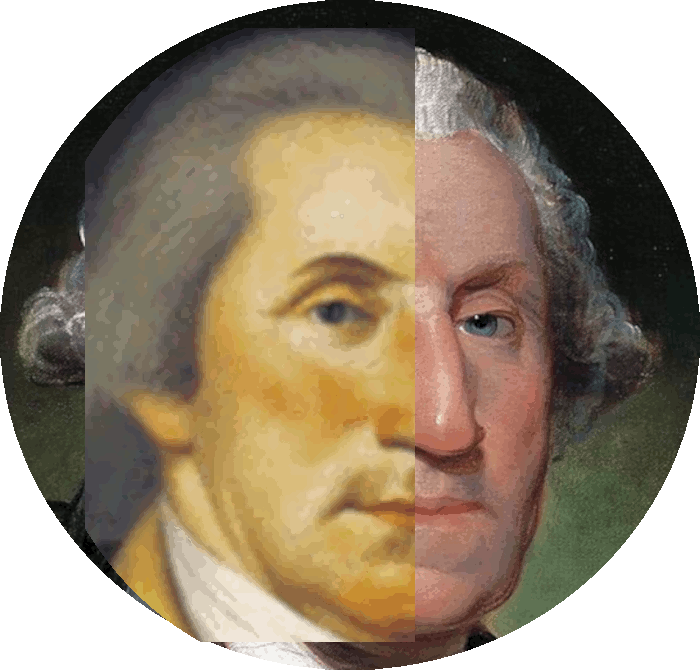
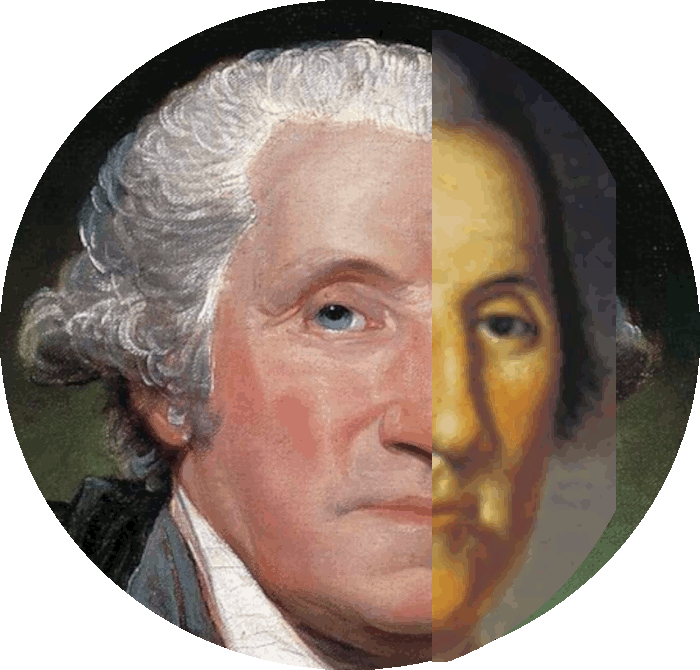
- It could be George Washington, not Ethan Allen, but that
is a mystery because this portrait has been used for both of them.
|
George
Washington as Ethan
Allen |
George Washington
1732-1799
2/22
7/14
President |
Ethan Allen
1738-1789
1/21
2/12
American poser |
 |
 |
|
Green Mountain Boys |
- John Jay directed U.S. foreign policy for much of the 1780s and was an important leader of the Federalist Party after the ratification of the United States
Constitution in 1788.
-The Jay family participated significantly in the
slave trade, as investors and traders as well as slaveholders.
- New York Slavery Records Index shows Jay's father and
paternal grandfather as investors in at least 11 slave ships
that delivered more than 120 slaves to New York between 1717
and 1733.
-
Jay served as the governor of New York from 1795 to 1801.
- Although he successfully passed gradual emancipation legislation as governor of the state, he owned
5 slaves as late as 1800.
- They did seem to have nice wigs back then.
|
In 1783, one of Jay's slaves, a woman named Abigail, attempted to escape in Paris, but was found, imprisoned, and died soon after from illness. Jay was irritated by her escape attempt, suggesting that she be left in prison for some time. To his biographer Walter Stahr, this reaction indicates that "however much [Jay] disliked slavery in the abstract, he could not understand why one of his slaves would run away." (Wikipedia)
|
Paris 1782 |
- John Jay himself purchased, owned, rented out and manumitted at least 17 slaves during his lifetime
although he is not known to have owned or invested in any slave ships.
- Despite being a founder of the New York Manumission Society, Jay is recorded as owning
5 slaves in the 1790 and 1800 U.S. censuses.
- He freed all but one by the 1810 census,
however, rather than advocating for immediate emancipation, he continued to purchase enslaved people and to manumit them once he considered their work to
'have afforded a reasonable retribution.'
- This is what they named the CUNY school of criminal
'justice' after it's just absurd.
|
Jay's Treaty (1794): Negotiated by John Jay to avoid war, the treaty with Great Britain was highly unpopular in the US but gave the nation a period of peace to consolidate and rearm. (Wikipedia)
|
|
American in France |
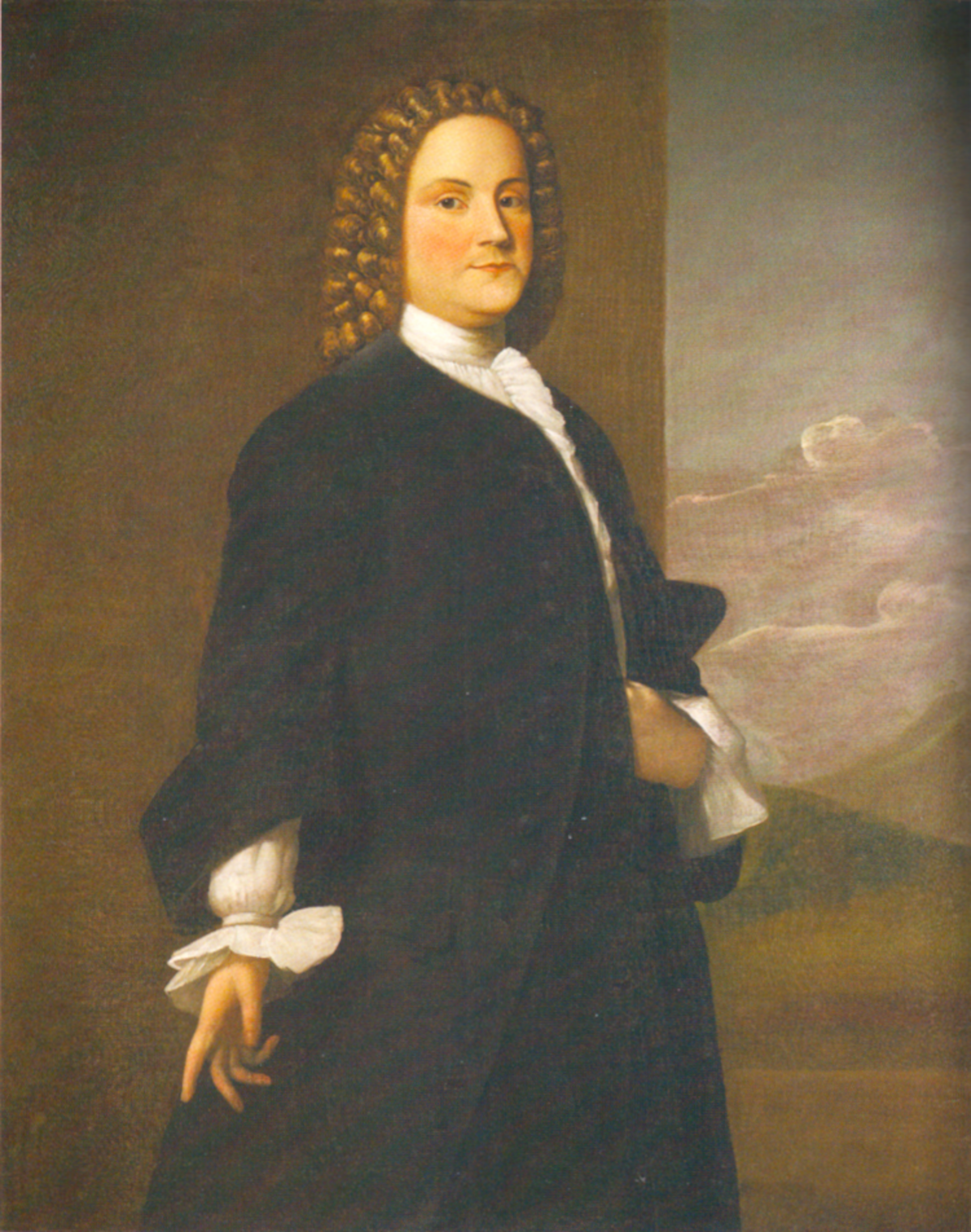
Robert Feke,
Public domain, via
Wikimedia Commons
Benjamin
Franklin c. 1746̵-1750
|
- Benjamin Franklin (1706-1790) was an American polymath: a writer, scientist, inventor, statesman, diplomat, printer, publisher and political philosopher.
- Among the most influential intellectuals of his time, Franklin was one of the Founding Fathers of the United States; a drafter and signer of
The Declaration of Independence; and the first postmaster general.
- He was also the first American diplomat
and he was the only person to sign all 3 of the most important
U.S. documents; the Declaration of Independence, the
Treaty of Paris for peace with Britain, and the Constitution.
|
At some points in his life, he owned slaves and ran "for sale" ads for slaves in his newspaper, but by the late 1750s, he began arguing against slavery, became an active abolitionist, and promoted the education and integration of African Americans into U.S. society. (Wikipedia)
|
|
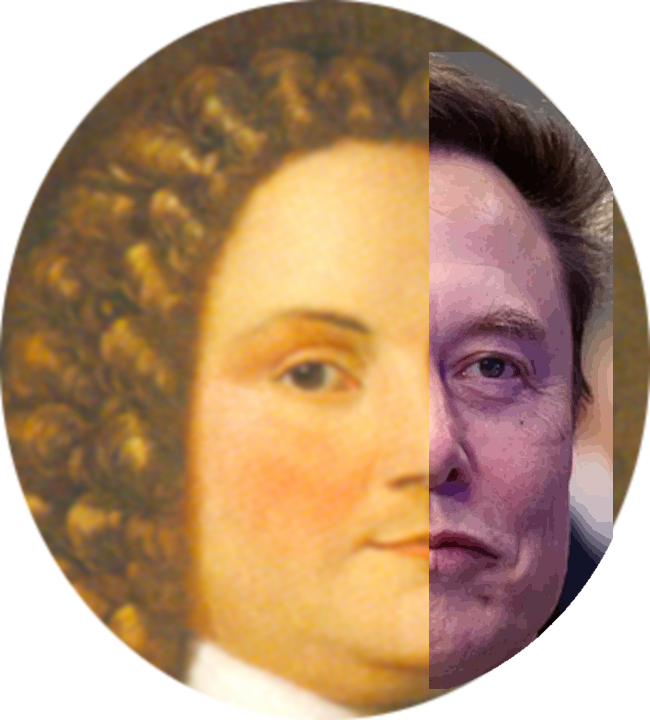
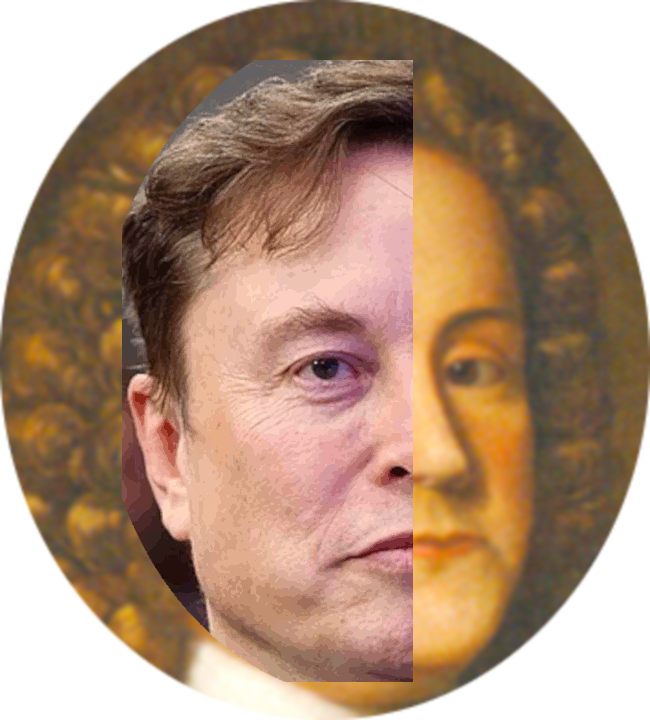
Benjamin Franklin as Elon Musk |
Benjamin Franklin
1706-1790
1/17 4/17 |
Elon Reeve Musk
1971
6/28
|
 |
 |
|
Whig |
- 'Famous' people who are thought to have (or have had) a 160 IQ score are Elon Musk, Stephen Hawking, Benjamin Franklin, and Bill Gates.
- Don't make us laugh please, shape-shifting demons, not
genius in any way.
- Franklin joined British Whig political groups in London, such as the Club of Honest Whigs, during his time as an agent for the colonies.
|
After 1767, he was associated with the
Pennsylvania Chronicle, a newspaper known for its
revolutionary sentiments and criticisms of the
policies of the British Parliament and the Crown. He pioneered and was the first president of the Academy and College of Philadelphia, which opened in 1751 and later became the University of Pennsylvania. (Wikipedia)
|
|
Benjamin Franklin as Elon Musk |
Benjamin Franklin
1706-1790
1/17 4/17
Publisher |
Elon Reeve Musk
1971
6/28
|
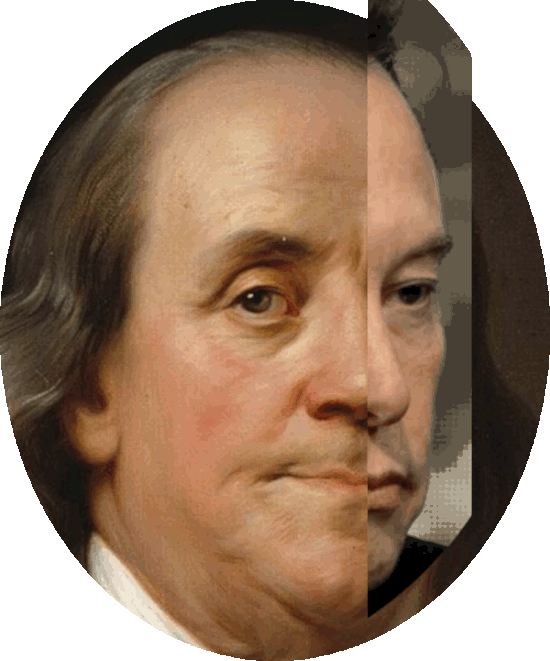 |
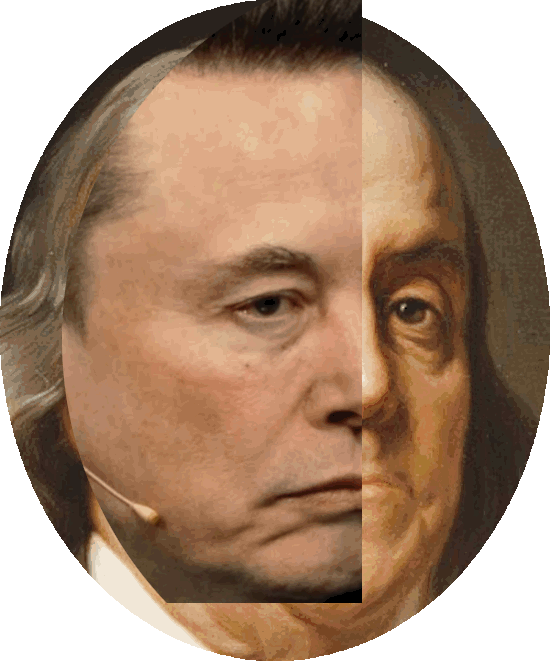 |
|
Fake news man |
- Franklin became wealthy publishing the Poor Richard's
(Dick's) Almanack, which he wrote under the pseudonym
(fake name) Richard 'Dick' Saunders.
- He was appointed
deputy postmaster-general for the British colonies in 1753, which enabled him to set up the first national communications network,
how handy.
- Franklin worked hard attempting to influence American moral life through the construction of a printing network based on a chain of partnerships from the Carolinas to New England, thereby inventing the first newspaper chain.
- Sounds like a monopoly and who gave him the right to
decide who or what is moral?
- It's sold to us in school like some kind of
'good' thing having Ben hanging around telling us how to think
and act.
|
Franklin had mixed success in his plan to establish an inter-colonial network of newspapers that would produce a profit for him and disseminate virtue. Over the years he sponsored two dozen printers in Pennsylvania, South Carolina, New York, Connecticut, and even the Caribbean. By 1753, eight of the fifteen English language newspapers in the colonies were published by him or his partners. (Wikipedia)
|
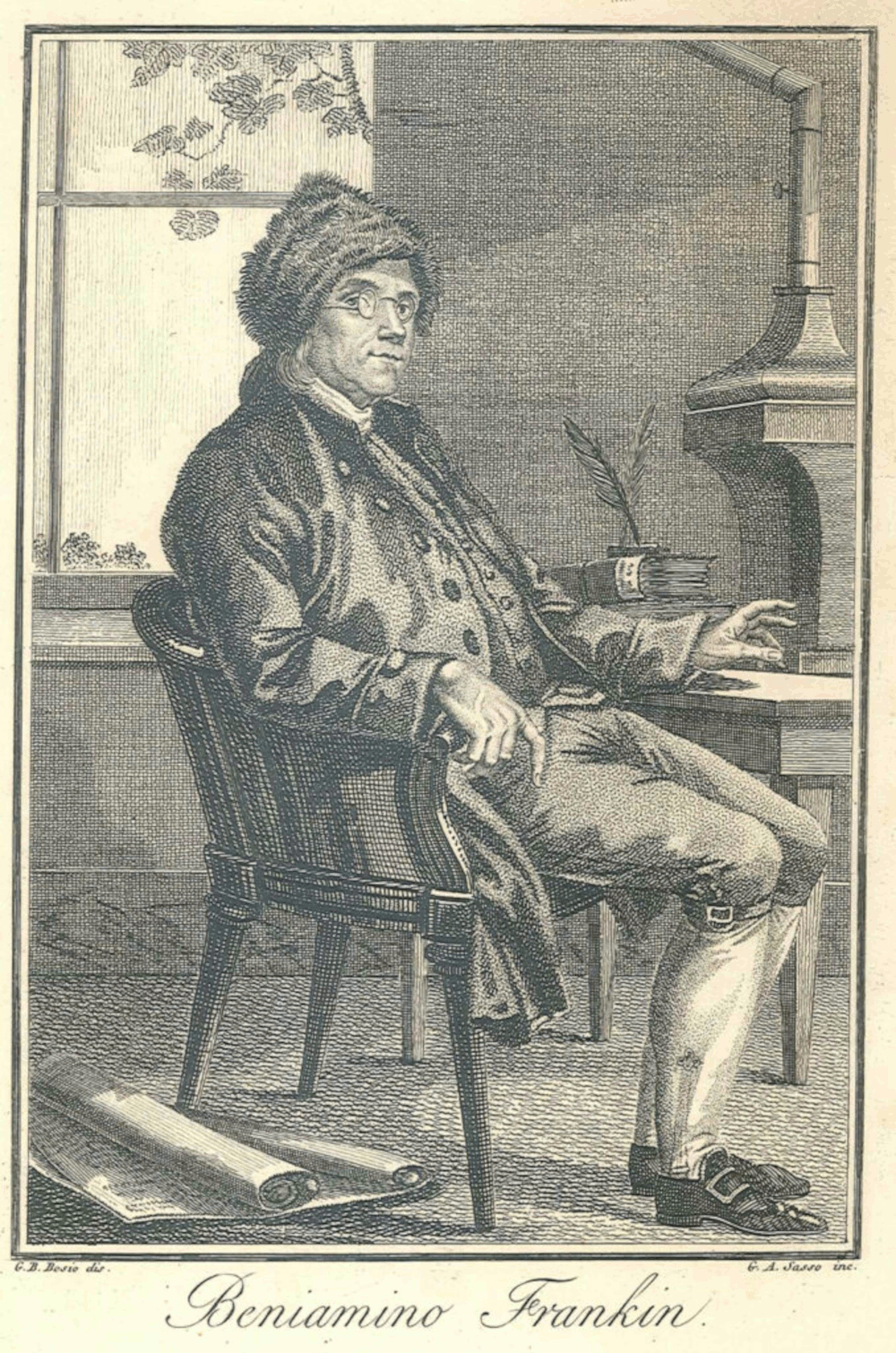
Beniamino Franklin (Milan, 1815), private collection
Dreaming up the news |
- Franklin has been called
'the most accomplished American of his age and the most
influential in inventing the type of society America
would become.'
- We can only guess.
- As a child growing up along the Charles River, Franklin recalled that he was
'generally the leader among the boys.'
- Sounds like he had
a huge ego.
- He worked for his father for a time, and at
age 12 he became an apprentice to his brother James, a printer, who taught him the printing trade.
- When Benjamin was 15, James founded The New-England Courant, which was the
3rd newspaper established in Boston.
|
When denied the chance to write a letter to the paper for publication, Franklin adopted the pseudonym of "Silence Dogood", a middle-aged widow. Mrs. Dogood's letters were published and became a subject of conversation around town. Neither James nor the Courant's readers were aware of the
ruse, and James was unhappy with Benjamin when he discovered the popular correspondent was his younger brother. (Wikipedia)
|
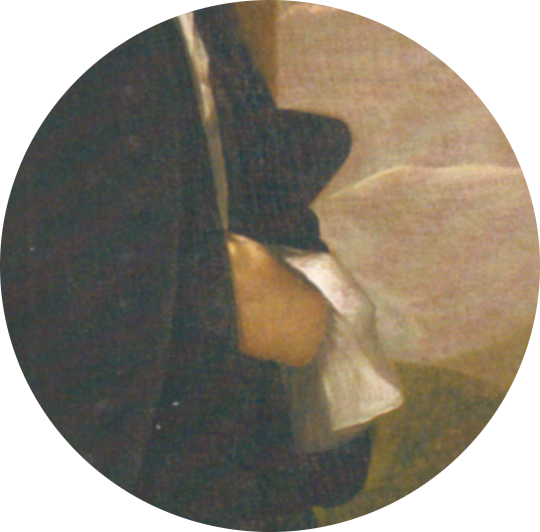
Franklin hidden
Masonic
hand |
- In 1730, Franklin was initiated into the local Masonic lodge.
- He became a grand master in 1734, indicating his rapid rise to prominence in Pennsylvania.
- The same year, he edited and published the first Masonic book in the Americas, a reprint of James Anderson's
Constitutions of the Free-Masons.
- Franklin was the secretary of St. John's Lodge in Philadelphia from 1735 to 1738.
|
In January 1738, "Franklin appeared as a witness" in a manslaughter trial against two men who killed "a simple-minded apprentice" named Daniel Rees in a fake Masonic initiation gone wrong. One of the men "threw, or accidentally spilled, the burning spirits, and Daniel Rees died of his burns two days later." While Franklin did not directly participate in the hazing that led to Rees' death, he knew of the hazing before it turned fatal, and did nothing to stop it. He was criticized for his inaction in The American Weekly Mercury, by his publishing rival Andrew Bradford. Ultimately, "Franklin replied in his own defense in the Gazette." Franklin remained a Freemason for the rest of his life. (Wikipedia)
|
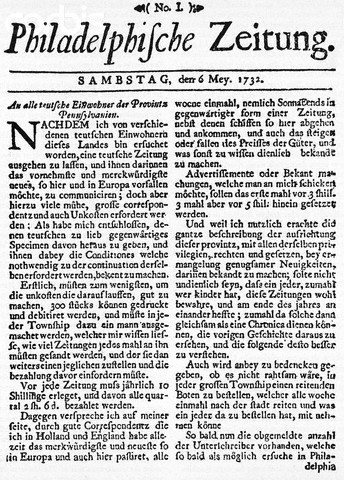
First edition of Franklin's Philadelphische Zeitung
1732 |
- In 1732, Franklin published the first German-language newspaper in
America called Die Philadelphische Zeitung, although it failed after only one year because
4 other newly founded German papers quickly dominated the newspaper market.
- In a 1751 pamphlet on demographic growth and its implications for the
13 Colonies, Franklin called the Pennsylvania Germans 'Palatine Boors' who could never acquire the
'Complexion' of Anglo-American settlers and referred to 'Blacks and Tawneys'
as weakening the social structure of the colonies.
-
Germans are very nice people, but they've been known to elect
horrible dictators as leaders.
|
Although he apparently reconsidered shortly thereafter, and the phrases were omitted from all later printings of the pamphlet, his views may have played a role in his political defeat in 1764. (Wikipedia)
|
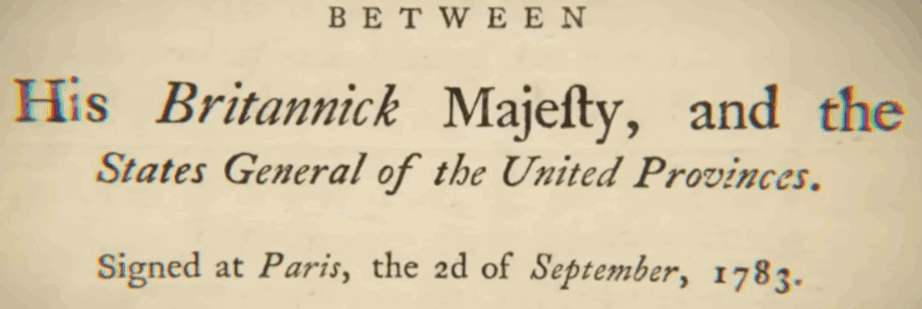
Peace accord |
- Both sides hammered out
preliminary articles of peace called the Treaty of Paris which were signed at the Hotel
d'York on November 30, 1782.
- This agreement brought
America and Britain closer to the conclusion of the conflict
and would become the basis for a treaty several years later.
- In 1783, the Continental Congress would ratify a
preliminary version of the treaty and after a few changes, the
final version was ratified on January 14, 1783.
- The
British then ratified the treaty on April 9, 1784, and on May
12, the ratified versions were exchanged in Paris.
Territory |
- The final Treaty of Paris was the result of many
months of negotiation and politics.
- In the terms, England
was required to recognize the former colonies as an
independent nation.
- The British were also required to
give the colonies control of the territory between the
Allegheny Mountains and the Mississippi River as well as allow
Americans to fish in Canadian waters.
- While the Americans
agreed not to persecute British Loyalists or block British
creditors from collecting debts owed by former colonists.
- The Americans also agreed to return a great deal of property
taken during the conflict.
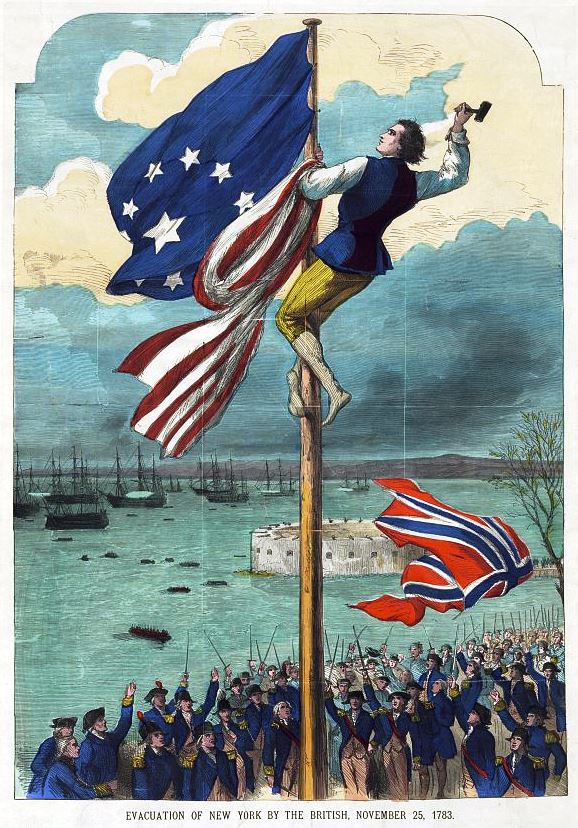
Public domain, via Wikimedia Commons
Greased the pole |
- In November 1783, the last British soldiers departed from
New York, and with them were thousands of loyalist and former
slaves.
- The event was celebrated in America and became a
holiday known as Evacuation Day, although the British were
somewhat bitter about it.
- As a parting shot before they left,
the Brits nailed their flag to a pole and greased the pole so it
would difficult to take down.
-
The flag was eventually removed by a soldier named John Van
Arsdale and he replaced the British flag with an American one
at Fort George.
- For years after, celebration of Evacuation Day would
typically include a reenactment of Van Arsdale's daring climb.
Economic crisis |
- In the 1780s, an economic crisis swept through
Massachusetts, forcing numerous farmers deep into debt.
-
The state refused to forgive the debts and many of the farmers
lost their property or were thrown in jail.
- Anger began
to foment and many of these farmers were the same
revolutionaries that had fought the British, and they
eventually took up arms against the new American government.
- When the Revolutionary War first started, Daniel Shays was
just a farmhand.
.jpg)
Richard Miller Devens, author. C. A. Nichols & Co. (Springfield, MA), publisher., Public domain, via Wikimedia Commons
Daniel Shays - 1778 |
- Daniel Shays (1747-1825) was an American veteran of the Revolutionary War who became the namesake of Shays' Rebellion in Massachusetts
from 1786-1787.
- He was a farmer and former army captain who joined other struggling farmers and veterans to protest high taxes and debt collection policies that were leading to property foreclosures.
- Upon returning home from the war, Shays had been summoned to court for unpaid debts, which he could not pay because he had
not been paid in full for his military service.
- Many argued that this created the 'need' for a federal
government with the ability to collect taxes to pay for wars,
however, this could have been accomplished through the states
who collect taxes to this day.
- Undoubtedly, the U.S.
would have been involved in a lot fewer wars and we wouldn't
have ended up in places like the Gaza strip nonsense.
|
Shays was alarmed to discover that many of his fellow
veterans and farmers were in the same financial
situation. At commoners' meetings veterans asserted
that they were treated unfairly upon release, and that
businessmen were trying to squeeze money out of
smallholders in order to pay their own debts to
European war investors. Many Massachusetts rural
communities first tried to petition the legislature in
Boston, but the legislature did not respond
substantively to those petitions. (Wikipedia)
|
|
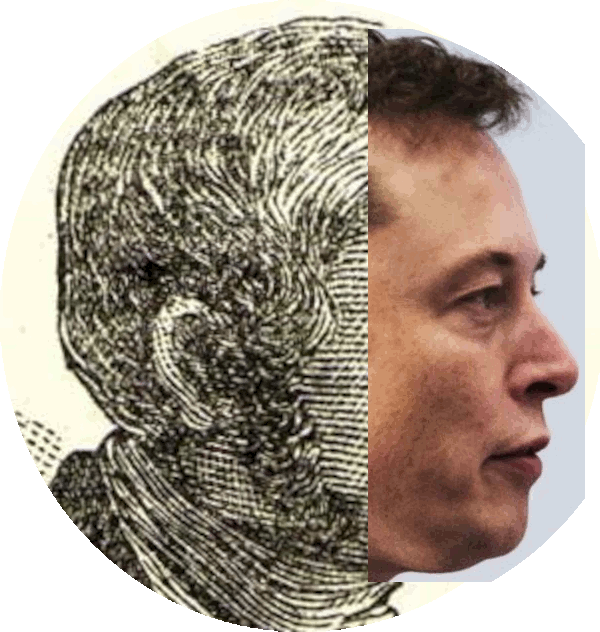
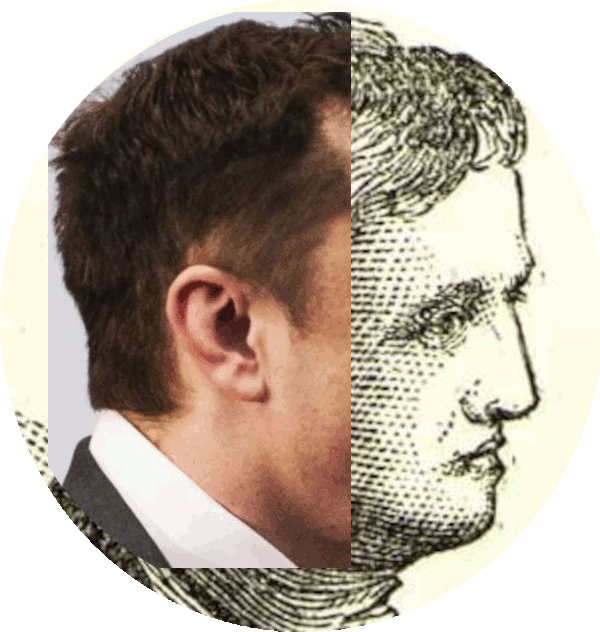
Daniel Shays as Elon Musk |
Daniel Shays
1747-1825
8/? 9/29
Soldier, rebel and
farmer |
Elon Reeve Musk
1971
6/28
|
 |
 |
|
Richard E. Byrd (REB-EL) |
- While Shays was a leader of the
uprising, his exact role and motivations are debated by
historians!!
- Someone has to start the perennial war and
take sides, although this new government was failing the
citizens.
- Kind of the same thing the Brits were doing,
taxation and no representation.
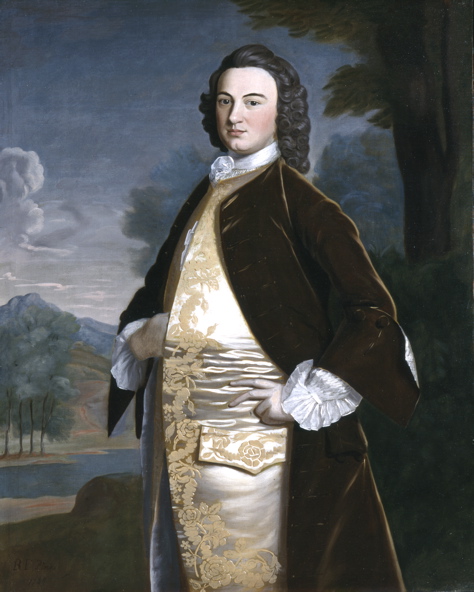
Robert Feke, Public domain, via Wikimedia Commons
Massachusetts
Governor James
Bowdoin II |
- By mid-January rebel leaders spoke of smashing the 'tyrannical' government of Massachusetts
and made a plan to seize the Springfield Arsenal.
- Shays
was a veteran and had seen action in many battles including Lexington, Concord,
Bunker Hill and Saratoga.
-
Many of these men took up arms against the government and
Shays found himself leading 4,000 rebels in a massive protest
against economic injustice and widespread abuses of civil
rights.
- The British assigned royal governor of Massachusetts, James Bowdoin, got
involved and assembled his own militia and proceeded to crush
Shays Rebellion.
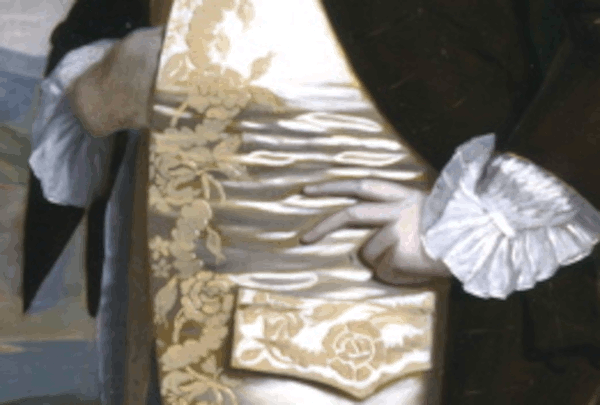
Governor
Bowdoin's busy
Masonic hands |
- Except, by siding against the citizens of his own state,
this guaranteed that Bowdoin was not elected again and he was
defeated in a landslide.
- In the end, after being
sentenced to death and then freed, Shays was vilified by the
Boston press (Ben Franklin's employees), who painted him as an archetypal
radical opposed to the government.
|
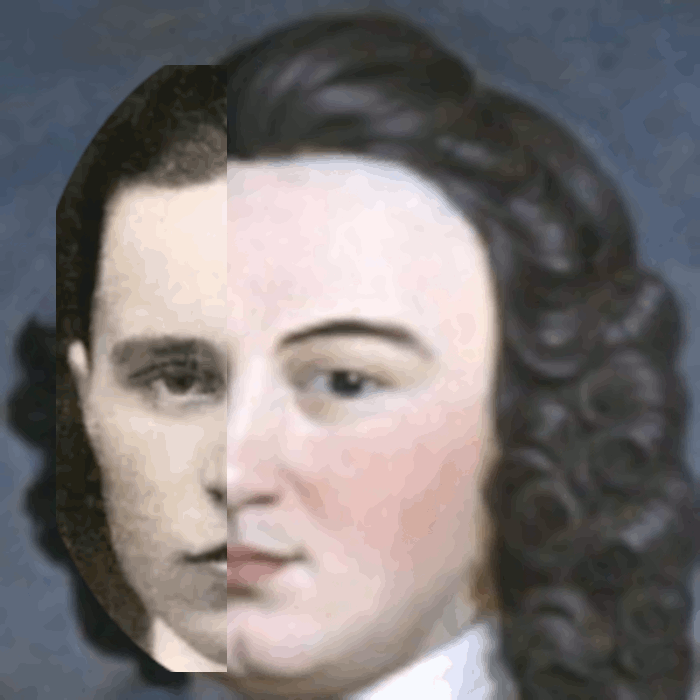
James Bowdoin (bow down) as Prescott
Bush |
James Bowdoin
1726-1790
8/7 11/6
Governor |
Prescott Sheldon Bush
1895-1972
5/15
10/8
Nazi supporter
|
 |
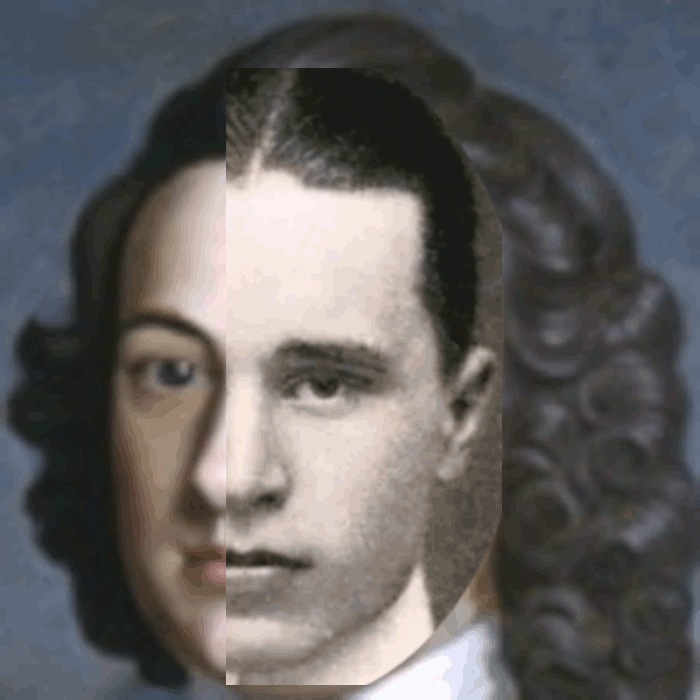 |
Boston Massacre liar
hard to match the
correct angles on old photos |
- Bowdoin also had extensive business interests
although he was often characterized as a merchant, and he engaged in the Atlantic trade, his principal interest was in land.
- His inheritance included major tracts of land, most of which he kept, in present-day Maine as well as in the agriculturally rich Elizabeth Islands off the state's south coast.
- Bowdoin expanded his holdings, eventually acquiring property in all of the New England states except Rhode Island.
|
Born in Columbus, Ohio, Prescott Bush graduated from Yale College and served as an artillery officer during World War I. Bush was admitted to the Zeta Psi fraternity and Skull and Bones secret society.
Bush was a founder and one of seven directors
(including W. Averell Harriman) of the Union Banking
Corporation (holding a single share out of 4,000 as a
director), an investment bank that operated as a
clearing house for many assets and enterprises held by
German steel magnate Fritz Thyssen, an early supporter
of Adolf Hitler and financier of the Nazi Party. (Wikipedia)
|
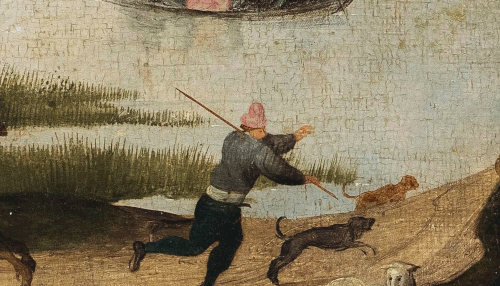
River squatter |
- Bowdoin was one of the managing proprietors of a large territory on the Kennebec River, where he was frequently involved in legal proceedings with squatters on the land, and with competing land interests.
- The dealings with squatters in particular left Bowdoin
with a dislike of the lower classes in Massachusetts society,
something that affected his politics.
|
Two separate rivers in Maine: the Kennebec River and the Kennebunk River. The Kennebec is a large river that flows from Moosehead Lake to the Atlantic Ocean, while the Kennebunk is a smaller, tidal river near the towns of Kennebunk and Kennebunkport, known for its navigable length for kayaking and boat traffic. (Assistant)
|
Articles of
Confederation |
- In 1777, representatives of the 13 states drafted
the original document that would outline American society and
they called it the Articles of Confederation.
- However,
after America finally won its independence and became a
functioning nation, it quickly became clear to the politicians that the articles
were badly in need of some revision.
-
This document was the first government framework for the United States, in effect from 1781 to 1789,
and it established a weak central government with most power retained by the states.
- Its weaknesses, such as the inability to tax or regulate commerce effectively, led to its replacement by the
U.S. Constitution, which created a stronger federal government.
- Oh great, we see where that went, they wanted power to tax
the people and start perennial wars.

Fancy pants |
- A growing concensus emerged made up of politicians who
decided that a more formal constitution was needed.
- On
February 21, 1787, the confederation Congress called for a
convention to propose a new form of government.
- However,
when did the citizens ever approve any of this, they believed
that fought and won the Revolution for their freedom.
-
Delegates were sent to Philadelphia to craft the new governing
document.
- Over the next several months, various plans for
the new federal government were presented and debated.
-
Eventually, compromises were reached and after a signing
ceremony on September 17, 1787, the United States
Constitution was completed.

Factions formed |
- While the U.S. Constitution is considered the backbone
of American democracy today, it wasn't an immediate hit with
everyone (and still isn't because it's laws made by a few rich
white men, and
actions that benefited them).
- Look at our 'legal' tax
system today and decide who benefits from it, not the little
guy, only the Founders who created the document who were
wealthy merchants, lawyers and land owners.
- It took
several years for all 13 of the states to ratify the document
and it's questionable how that even happened.
- For
example, not all the states ratified the formation of the
Internal Revenue Service (IRS)
but somehow that was inflicted on us (and as citizens we had
zero input, just like the Constitution).
- It's
time we all rethink what's good; freedom or some rich men's
laws that help them earn big bucks and control everything.
Ratifying |
- While there weren't formal political parties yet, factions
quickly emerged around those in favor of the new constitution.
- Those who were for the U.S. Constitution were known as
Federalists or Cosmopolitans, and those against it were called
anti-Federalists, or Localists.
- Notice how the 'anti's'
were made out to be lesser than the righteous 'Cosmopolitans'
kind of like the local hicks, not the Harvard crowd.
- The first 5 states to
ratify were Delaware, Pennsylvania, New Jersey, Georgia and
Connecticut.
- Several of the other states had serious
misgivings because the document failed to protect basic human
rights such as freedom of speech, and religion.
- To
rectify the situation, 10 amendments known as the Bill of
Rights were added as a 'forced' afterthought.
|
Big Brother
Arrives |
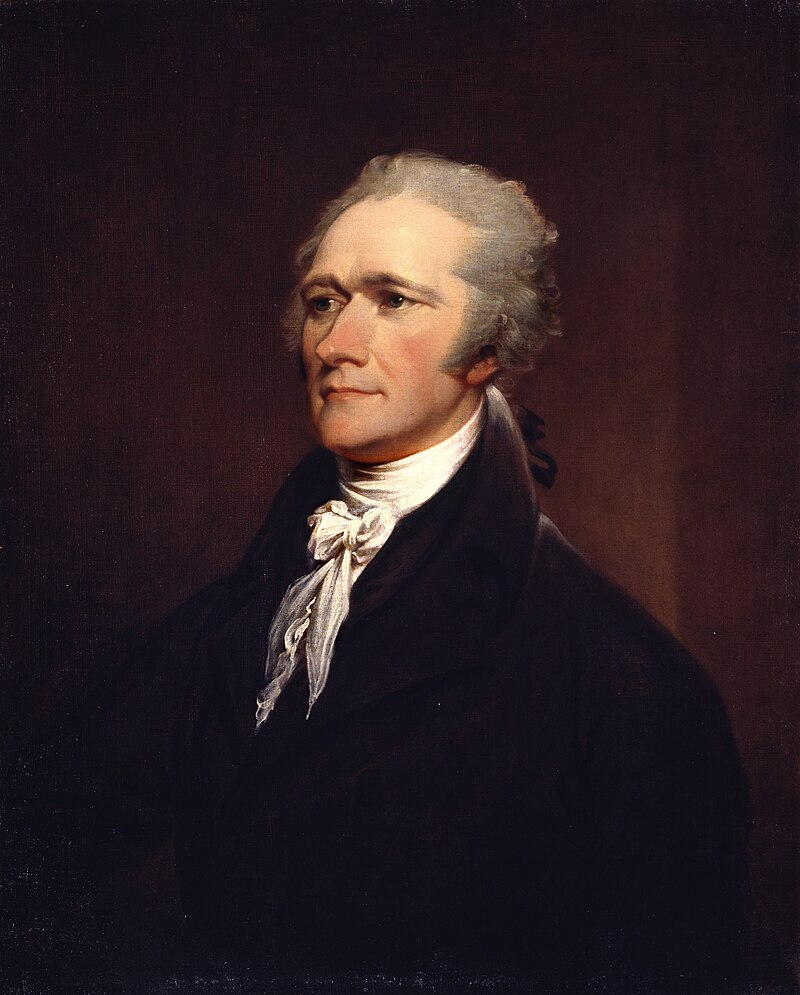
John Trumbull, Public domain, via Wikimedia Commons
Alexander Hamilton
1794 |
- Meanwhile, Alexander Hamilton, James Madison and John Jay
undertook a relentless campaign to convince New York, then a
firmly anti-Federalist state, to support the new big
government plan.
- Someone who did advocate for an 'elected monarchy' was
Alexander Hamilton (c.1755-1804) who many claim was a
double-agent and British spy.
- In his speech at the Constitutional Convention, he detailed the need for a
'governor' who was elected for life.
- His presentation wasn't for any kind of economic gain??, but rather an intricately limited monarchy.
- Some of this structure is present in Washington now.
-
Hamilton founded the Federalist Party and already by 1793 they were
involving themselves in a foreign war in Haiti and
had already drafted 'their' constitution.
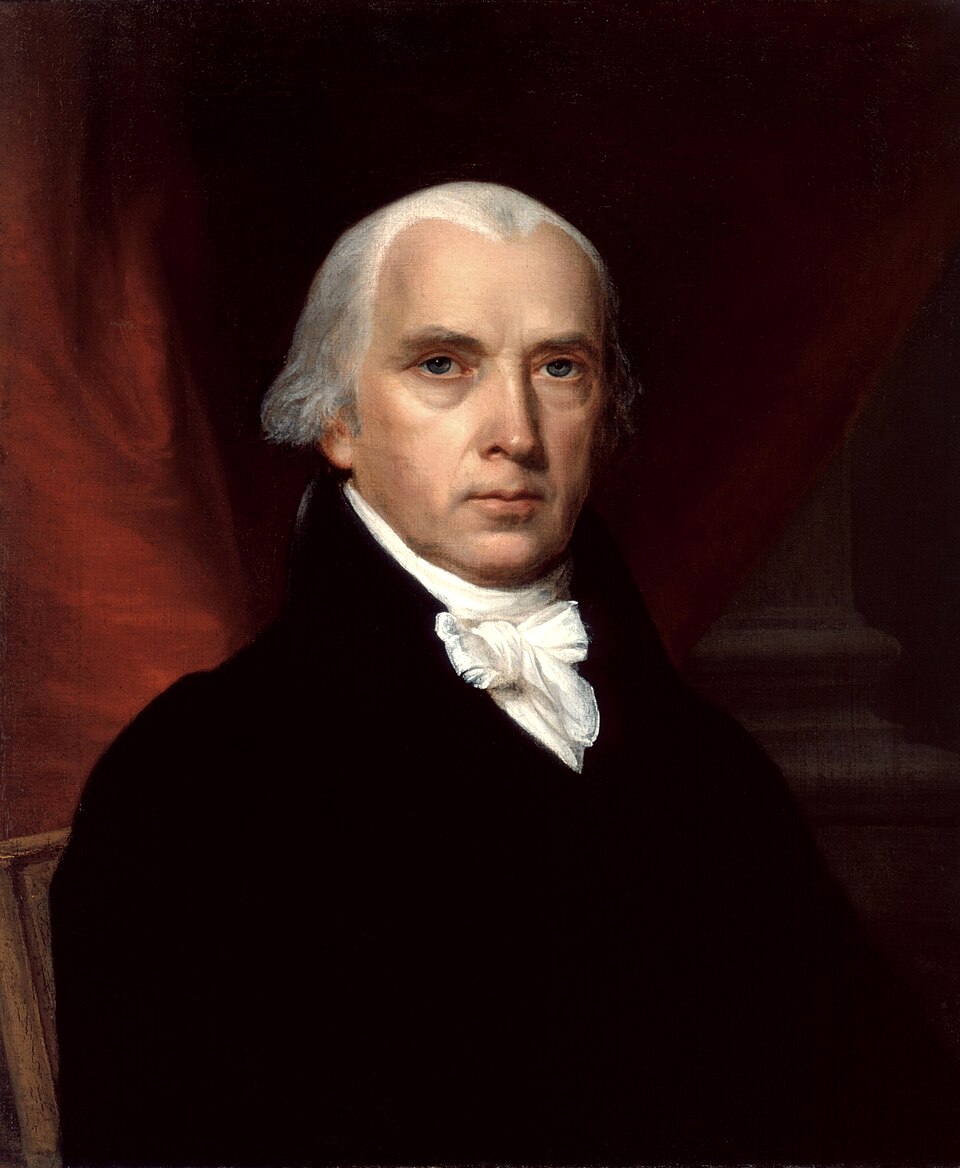
John Vanderlyn, Public domain, via Wikimedia Commons
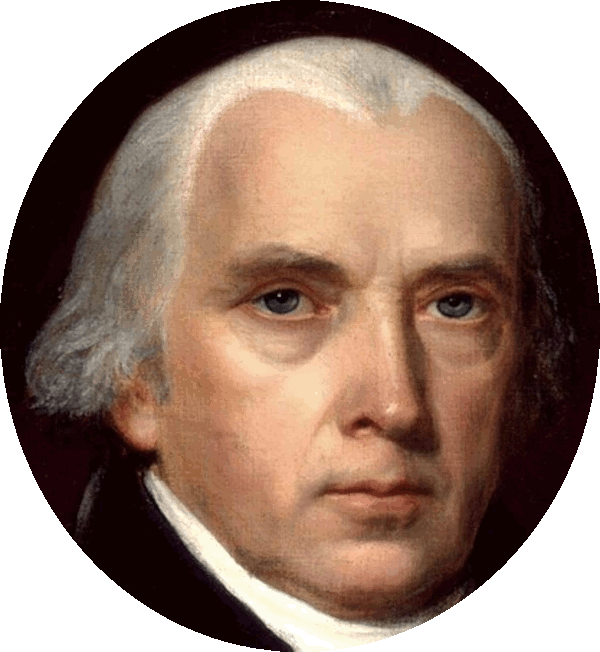
James Madison - 4th
president |
-
The three men wrote numerous essays under the pseudonym
'PUBLIUS' and today these are know as the Federalist
Papers.
-
These papers are often cited by the U.S. Supreme Court as
evidence of the framers own contemporary understanding of the
language in the Constitution.
- By its own terms,
the minimum number of states required to ratify the document
was 9 out of 13.
- After much public debate, that number was agreed
upon on June 21, 1787, and by the end of July, another 2
states signed on.
- The process of starting up the new
government began.
|
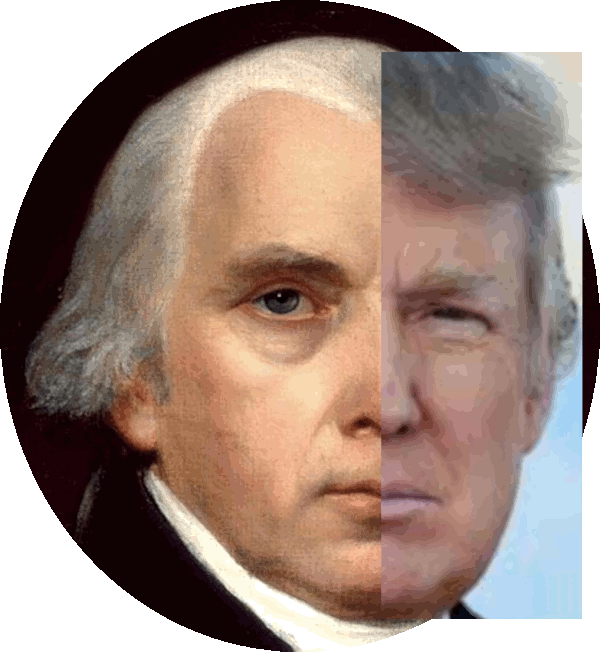
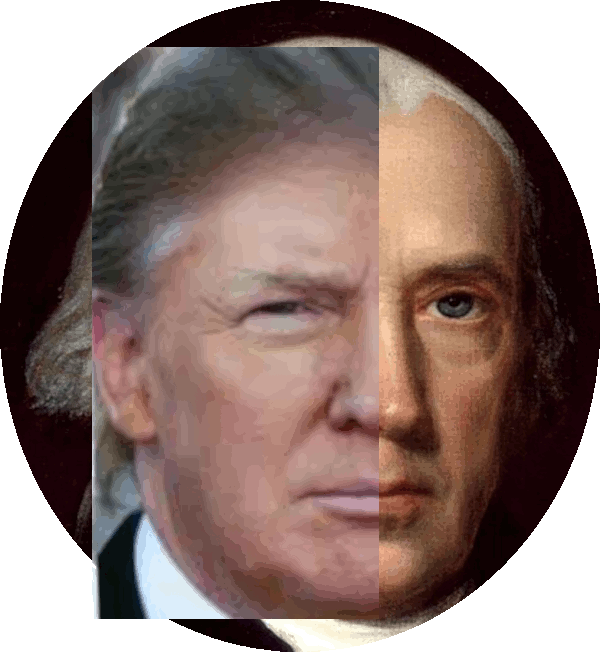
James Madison as Donald Trump |
James Madison
1751-1836
3/16 6/28
President |
Donald John Trump
1946
6/14
Head
creep
|
 |
 |
|
Those eyes |
- James Madison (1751-1836 ) was an American statesman, diplomat, and Founding Father who served as the
4th president of the United States from 1809 to 1817.
-
He was born into a prominent slave-owning planter family in Virginia. In 1774, strongly opposed to British taxation, Madison joined with the Patriots.
- Madison was popularly acclaimed as the "Father of the Constitution" for his pivotal role in drafting and promoting the
Constitution of the United States and the Bill of Rights.
- Dissatisfied with the weak national government established by the
Articles of Confederation, he helped organize the Constitutional Convention, which produced a new constitution designed to strengthen republican government against democratic assembly.
- So he's telling us, 'NO free speech for any of you.'
- As
president, Madison led the United States into the War of 1812.
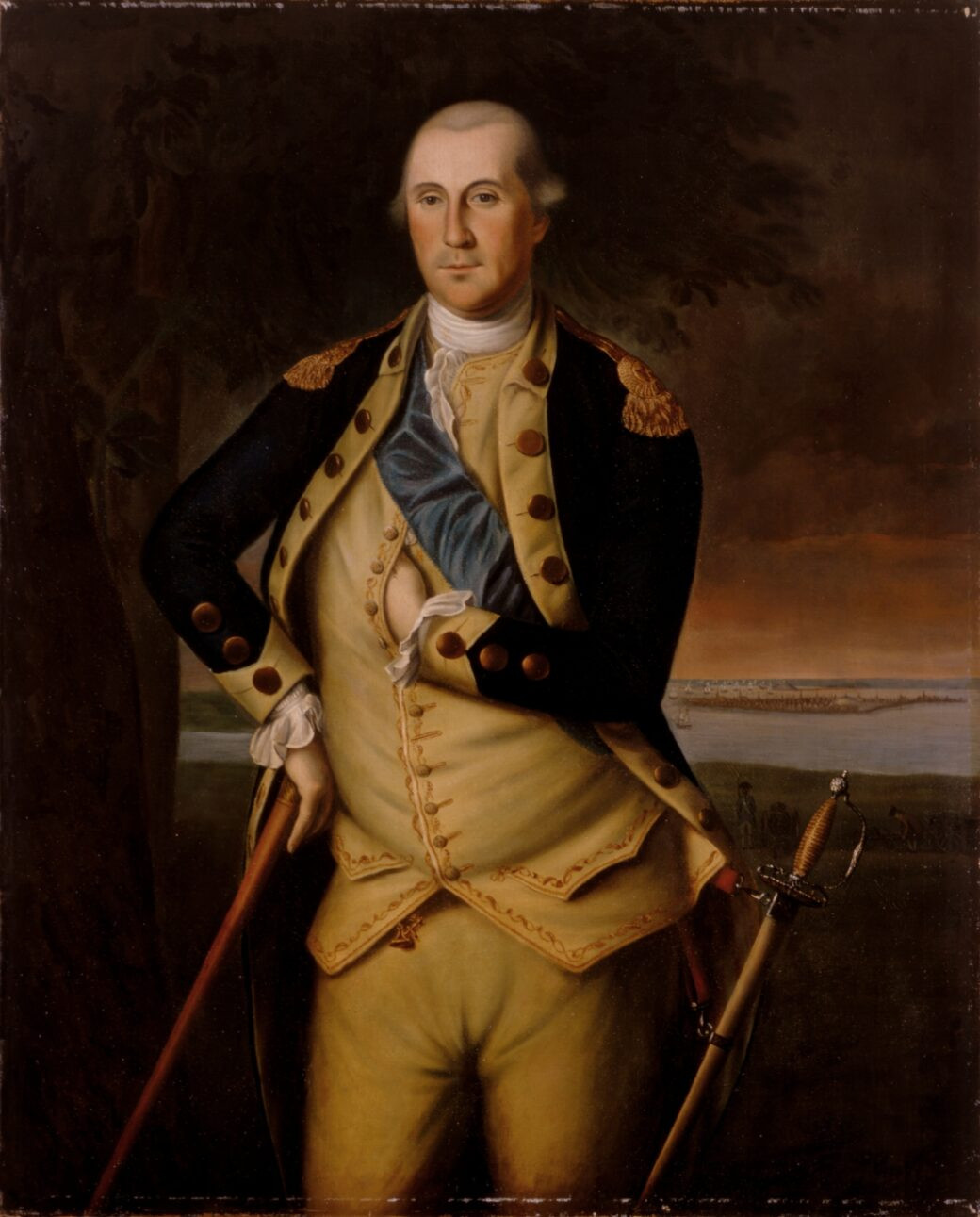
Charles Willson Peale - White House Collection
in Public domain
General George
Washington - 1776 |
|
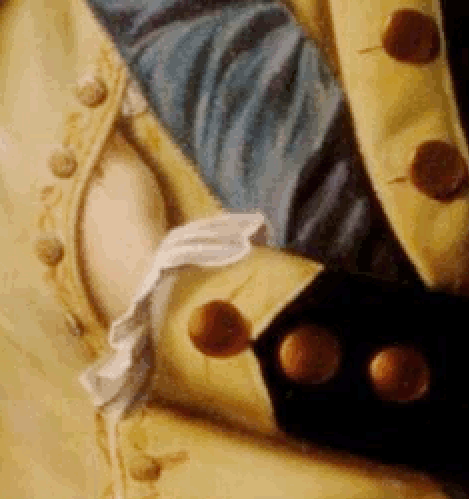
- This portrait of George Washington was painted by Charles Willson Peale in 1776, shortly before the Second Continental Congress convened and issued the
Declaration of Independence.
- Washington wears the light blue sash of Commander in
Chief, a commission he received in June 1775.
- He concerned himself with the buttons, trimmings, and all manner of details of his uniform
and even powdered his hair to enhance the sense of dignity.
- But it's really all just worthless bling.
George's Masonic
hidden hand |
- One month after the Treaty of Paris was signed,
George Washington had resigned as commander of the U.S. Army.
-
This was viewed as a patriotic act that showed his commitment
to his country over any of his personal desire for power, and
made him more popular than he already was.
- Washington returned to
his home at Mount Vernon in Virginia and remained there until
his countrymen made it clear they wanted him to enter the
forthcoming presidential election in 1787.
- They wanted him as the
first president of their new country.
|
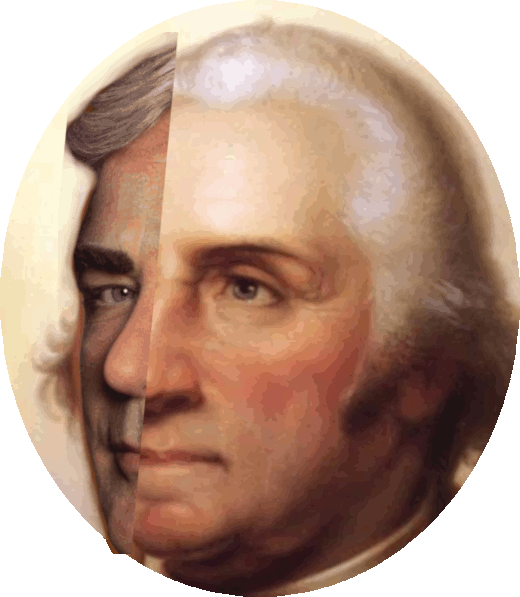
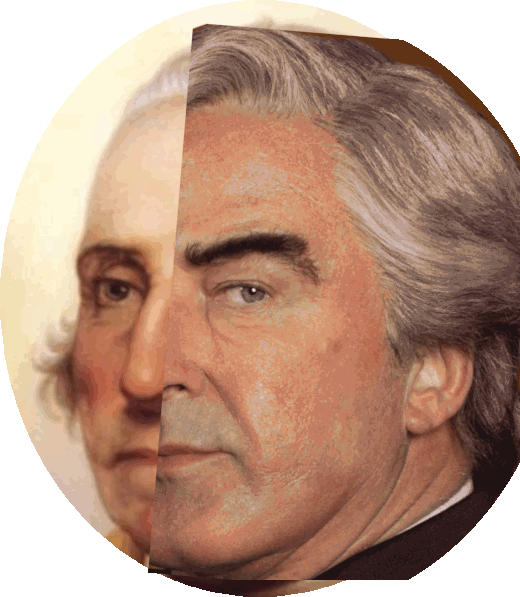
George Washington as John DeLorean |
George Washington
1732-1799
2/22 9/14 |
John Zachary DeLorean
1925-2005
1/6
3/19
|
 |
 |
Back to the future
a little nose work done
it's too flat |
- The country held its first presidential
election under the new Constitution in 1789.
- The rules of
this election were extremely different than the laws governing
elections today.
- For example, only white male property
owners were allowed to cast votes.
- The candidate who
received the 2nd highest amount of votes became the Vice
President.
- This was an arrangement that didn't work out
too well and was soon changed.

Another boy wonder |
- In addition to General George
Washington, there were 7 other candidates in that first
election, including; John Adams, John Jay, John Rutledge, John
Hancock, Samuel Huntington, Benjamin Lincoln and George
Clinton, who was the governor of New York.
- But it came as
a surprise to no one, that Washington was elected by an
overwhelming majority.
- He was favored by both parties,
something that is inconceivable today.
.jpg)
Ezra Ames, Public domain, via Wikimedia Commons
George Clinton -
1814 |
- George Clinton (1739-1812) was an American soldier,
statesman, and a prominent Democratic-Republican in the
formative years of the United States.
- Clinton served as
the 4th vice president during the 2nd term of Thomas
Jefferson's presidency and the 1st term of James Madison's
presidency from 1805 until his death in 1812.
- He also
served as the 1st governor of New York from 1777 to 1795 and
again from 1801 to 1804; his tenure makes him the
2nd-longest-serving governor in U.S. history.
- Clinton
was the first vice-president to die in office, and the first
of two to hold office under two consecutive presidents.
|
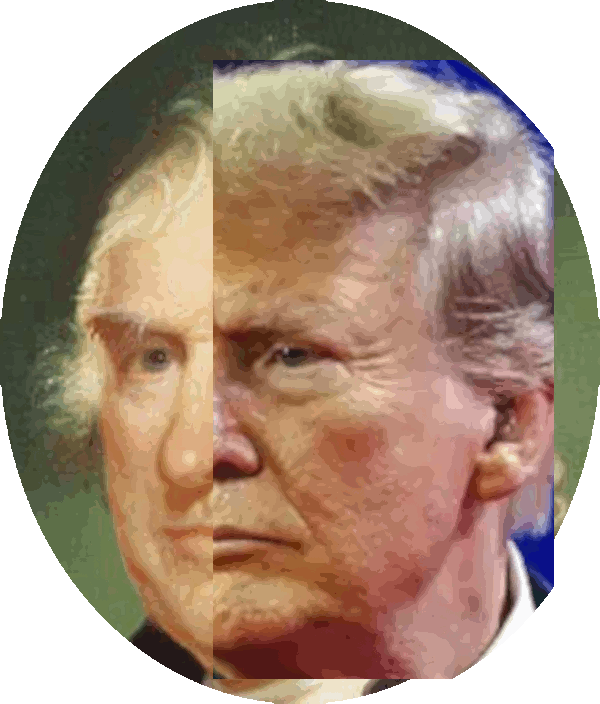
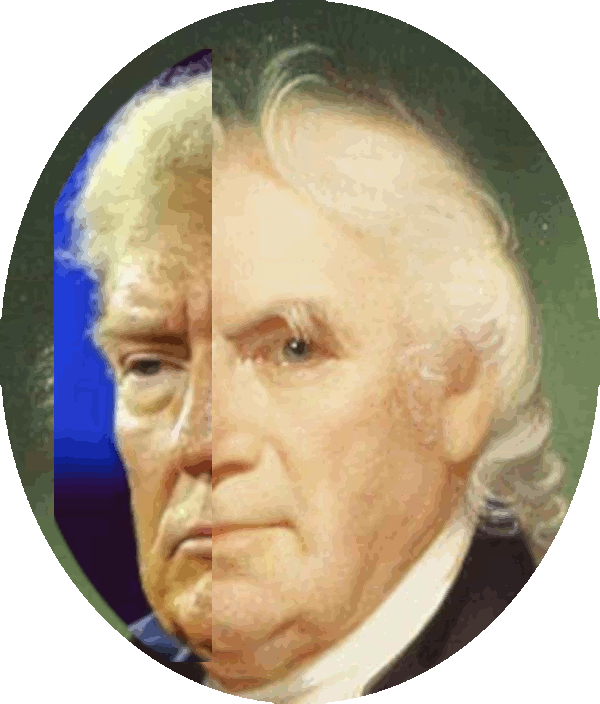
George Clinton as Donald Trump |
George Clinton
1739-1812
7/26 4/20
VP |
Donald John Trump
1947
6/14
|
 |
 |
|
Fluffy |
- Clinton was known for his hatred of Tories and used the seizure and sale of Tory estates to help keep taxes down.
- A supporter and friend of George Washington, he supplied food to the troops at Valley Forge, rode with Washington to the
1st inauguration and gave an impressive dinner to celebrate it
(nepotism).
- He was an original member of the New York
Society of the Cincinnati and served as its president
from 1794 to 1795 (a society that promoted installing a
monarchy/king like Britain).
- Clinton died on April 20, 1812, of a heart attack, leaving the office of vice president vacant for the first time in U.S. history.
- Clinton's nephew, DeWitt Clinton, continued the Clinton New York political dynasty after his uncle's death.
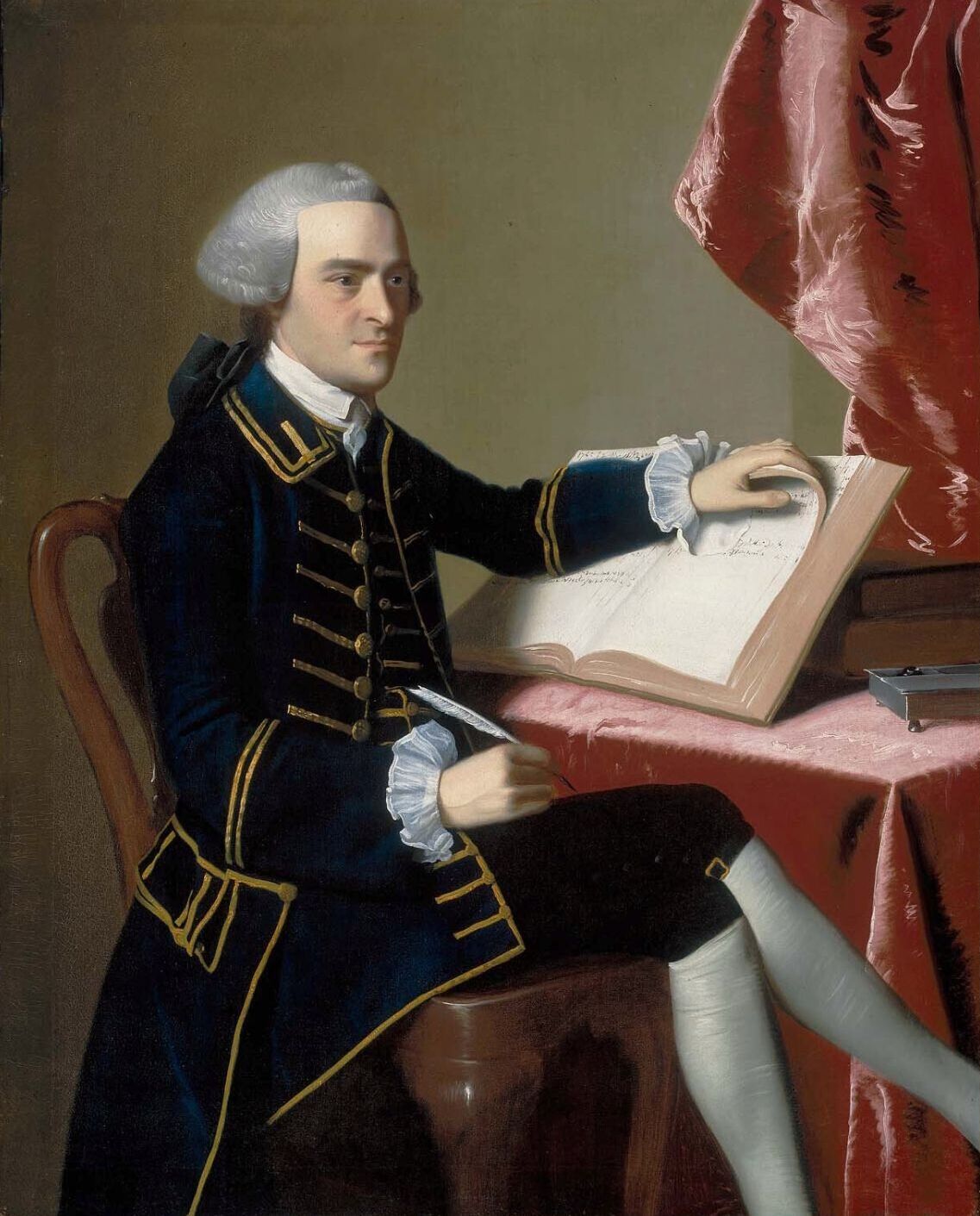
John Singleton Copley, Public domain, via Wikimedia Commons
John Hancock 1765 |
- John Hancock (1737-1793) was an American Founding Father, merchant, statesman, and prominent Patriot of the American Revolution.
- He was the longest-serving president of the Continental Congress, having served as the
2nd president of the Second Continental Congress and the 7th president of the Congress of the Confederation.
- His large and stylish signature on the U.S. Declaration of Independence
led to John Hancock or Hancock becoming a colloquialism for a
person's signature.
- As in, 'sign your John Hancock on the
dotted line.'
- In March 1765, Hancock inherited his
very first political position from
an uncle on the distinguished Boston Board of Selectmen, of
which there were only 5 members, definitely nepotism.
|
The Second Continental Congress was the government that organized the Revolutionary War and declared independence, while the Congress of the Confederation was its successor, established by the Articles of Confederation. The main difference is the governing document; the Second Continental Congress acted as a provisional government until the Articles of Confederation were ratified in March 1781, at which point the body formally became the Congress of the Confederation. The Congress of the Confederation was a unicameral legislature with a weaker central government than the one established by the later U.S. Constitution. (Assistant)
|
|
John Hancock
as General Thomas
Gage |
John Hancock
1737-1793
1/12 10/8 |
General Thomas Gage
1718/9-1787
3/10
4/2
British |
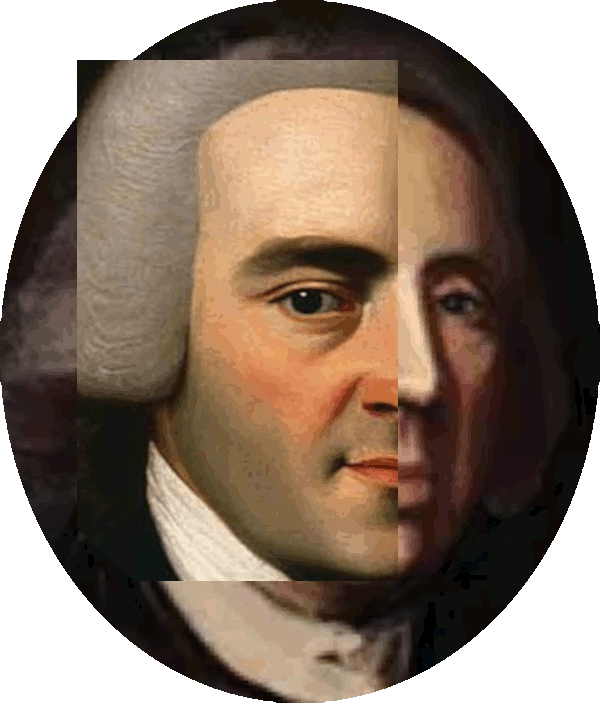 |
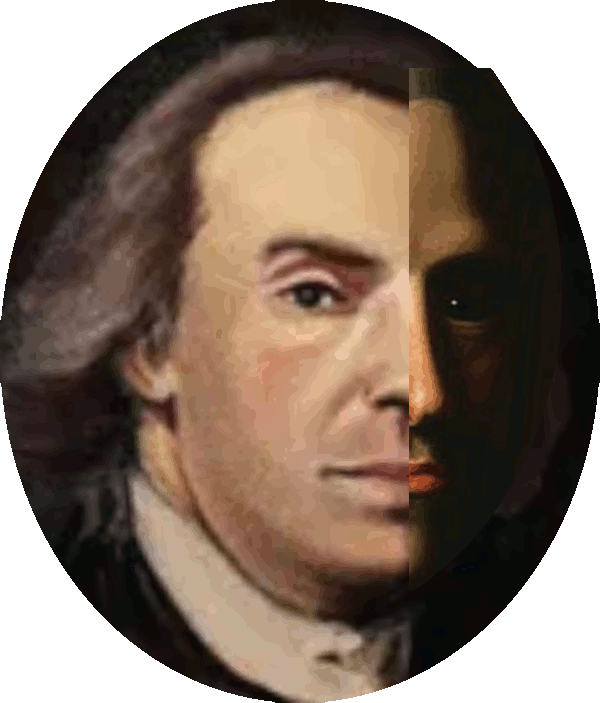 |
Highbrows are easy to change
and so are wigs |
- The Hancocks lived a comfortable life and owned one slave to help with household work.
- He became a member of the Masonic Lodge of St. Andrew in
October 1762, which connected him with many of Boston's most
influential citizens.
- John Hancock and Thomas Gage were adversaries during the American Revolution, with Hancock as a key Patriot leader and Gage as the commander-in-chief of British forces in North America.
- They had many interactions.
|
When Thomas Hancock (uncle) died in August 1764, John
inherited the business, Hancock Manor, two or three
household slaves, and thousands of acres of land,
becoming one of the wealthiest men in the colonies.
The household slaves continued to work for John and
his aunt, but were eventually freed through the terms
of Thomas Hancock's will; there is no evidence that
John Hancock ever bought or sold slaves.
(Wikipedia) |
|
President
One |
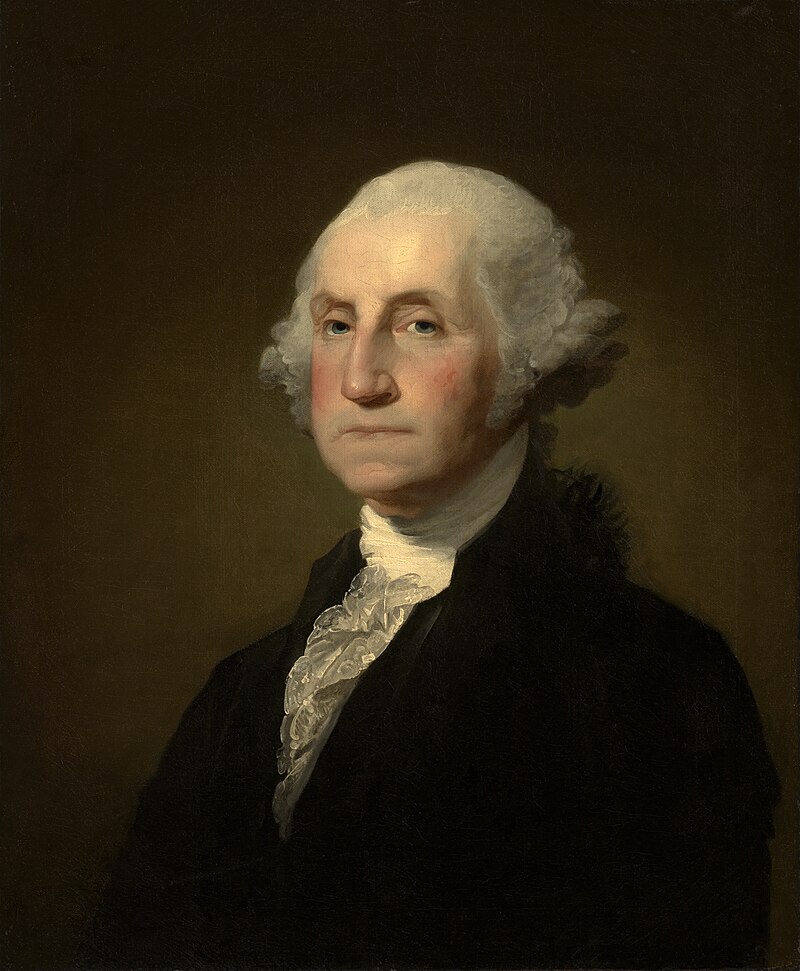
Gilbert Stuart,
Public domain, via
Wikimedia Commons
Williamstown Portrait of George Washington
1803 |
- George Washington (1732-1799) was born on February 22,
1732, and was a Founding Father and the 1st president of the United States, serving from 1789 to 1797.
- He was sworn into office on April 30, 1789, and from
then on was known as the 'Father of our country' and he served
2 terms.
- Appointed as commander of the Continental Army in 1776, Washington led Patriot forces to victory in the American Revolutionary War against the British Empire.
- By the time the war began, King George III had been in power
for 16 years.
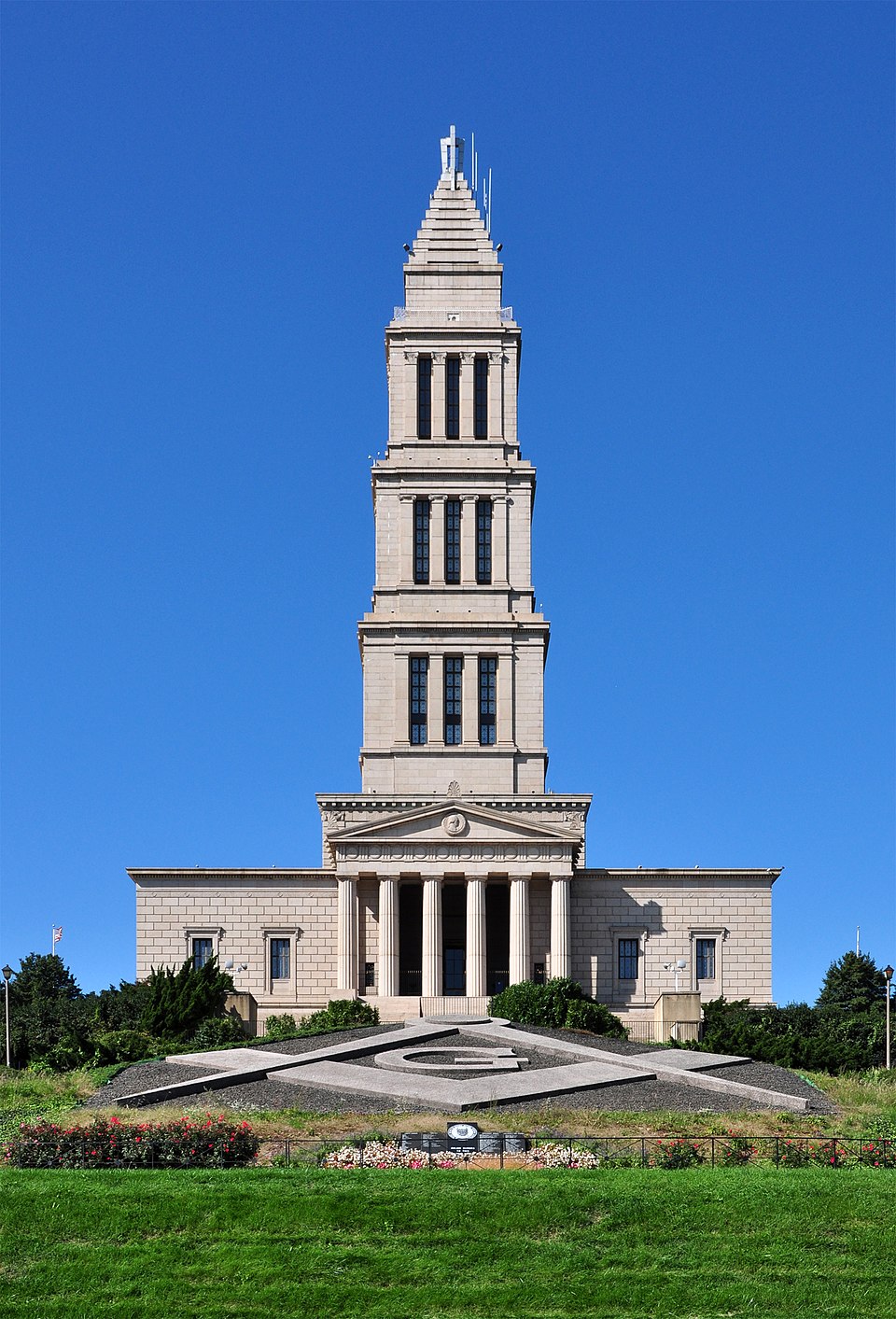
Joe Ravi, CC BY-SA 3.0 , via Wikimedia Commons
George Washington Masonic National Memorial in Alexandria, Virginia |
- Washington joined Freemasonry in the Lodge at Fredericksburg, Virginia.
- Jefferson was 20 years old when he received the first degree of Entered Apprentice on November 4, 1752,
and he paid the lodge 2 pounds and 3 shillings to join.
- Ten days after turning 21, on March 3, 1753, he was passed to the second degree of Fellowcraft.
- On August 4, 1753, he was raised to the third degree of Master Mason.
- The lodge’s surviving minute book records Washington
attending only two more meetings: September 1, 1753, and
January 4, 1755.
|
President
Two |
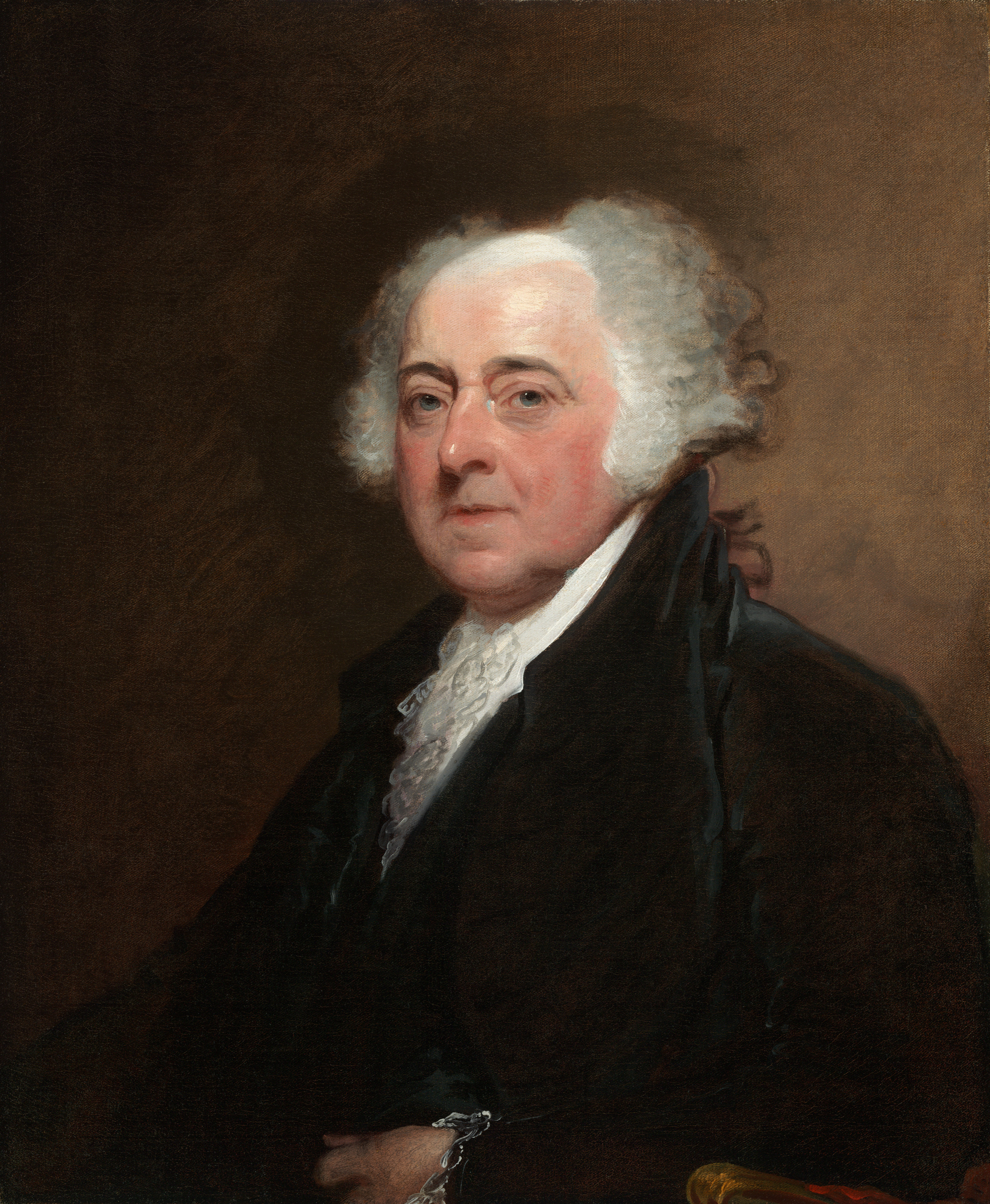
Gilbert Stuart, Public domain, via Wikimedia Commons
Atlas of independence |
-
John Adams (1735-1826) was a Founding Father and the second president of the United States from 1797 to 1801.
- Adams was the eldest of the 3 sons of Deacon John Adams and Susanna Boylston of Braintree, Massachusetts.
- His father was only a farmer and shoemaker, but the Adams family could trace its lineage back to the
1st generation of Puritan settlers in New England.
- Adams graduated from Harvard College and had his own law
practice.
- He became the first US Minister to Great
Britain in 1785, presenting his credentials to King George
III, but left in frustration 3 years later due to a cool
reception, according to the Office of the Historian.
|
I must study Politicks and War that my sons may have liberty to study
Mathematicks and Philosophy. (John Adams)
|
|
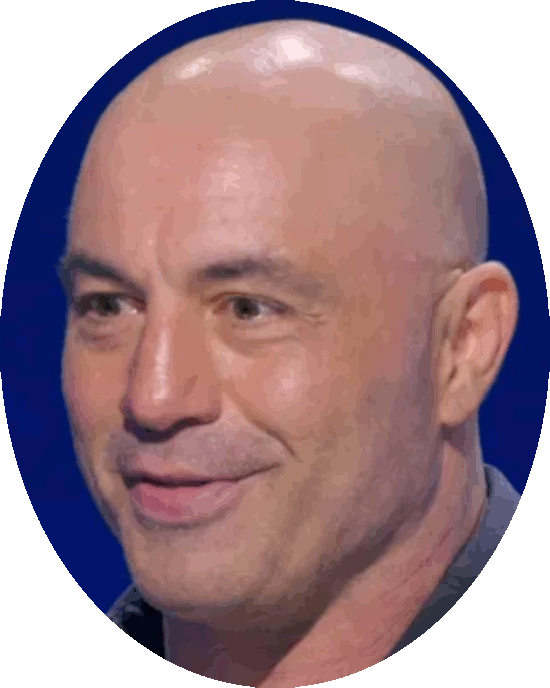
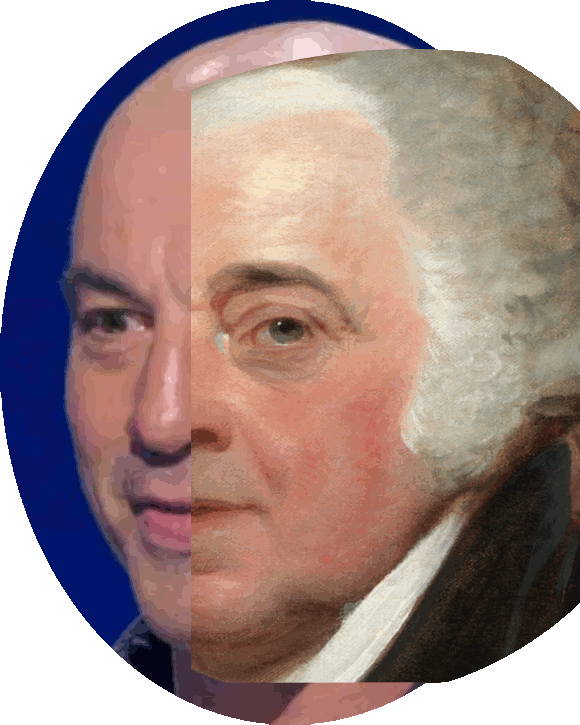
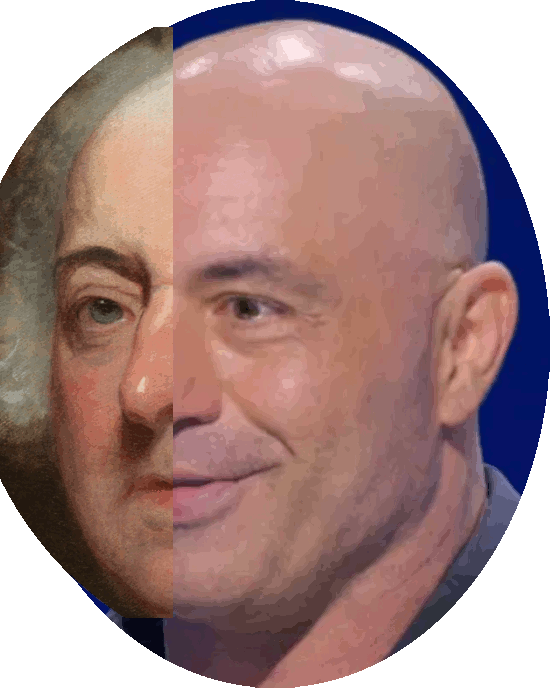
Joe Rogan as John Adams |
 |
|
Joseph James Rogan Jr.
1967
8/11 |
John Adams
1735-1826
10/20
7/4
President |
 |
 |
|
2nd President |
- In
1789, as a result of the 1st 'federal-type' election,
Adams becomes vice president
under President George Washington.
- He was a member of the Federalist party and supported a
central government rather than states rights.
- In 1796
he was elected as the 2nd president
in a narrow majority over
Thomas Jefferson.
- Two years into his term in 1798, Congress passed the Alien and Sedition Acts.
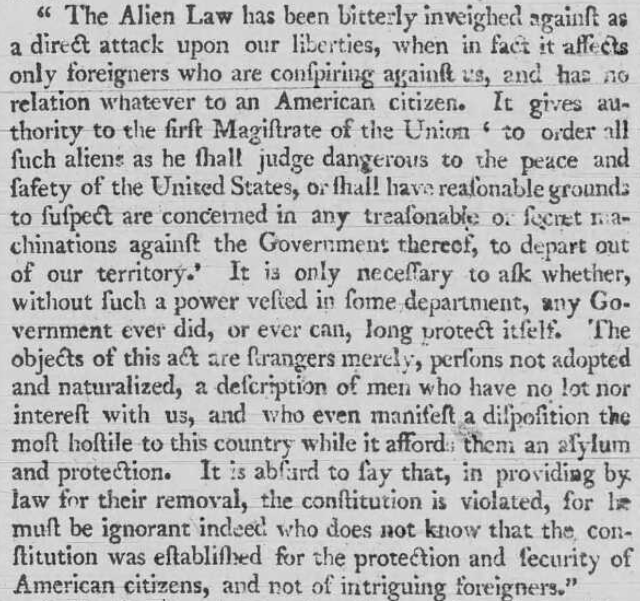
Savannah Georgia Gazette -
November 1, 1798
|
- The Alien and Sedition Acts were a series of 4 laws passed in 1798 by the Federalist-controlled Congress, primarily to limit criticism of the government and suppress political opposition during a time of tension with France.
- The acts increased the residency requirement for citizenship, allowed the president to deport aliens, and made it a crime to publish
'false, scandalous, and malicious' writings about the government.
-Though controversial, 3 of the acts expired or were repealed after the Federalist Party's defeat in 1800, while the
Alien Enemies Act, which deals with the status of non-citizens from hostile nations during wartime, remains on the books today.
|
Many Americans disliked the Alien and Sedition Acts because they were seen as a violation of civil liberties, particularly the First Amendment's protection of free speech and a free press. Critics also viewed the acts as an unconstitutional overreach of federal power and a partisan attempt to suppress the Democratic-Republican opposition, as the Sedition Act specifically targeted criticism of the Federalist government and was enforced by Federalist judges. (Assistant)
|
|
President
Three |
.jpg)
Rembrandt Peale, Public domain, via Wikimedia Commons
Thomas Jefferson |
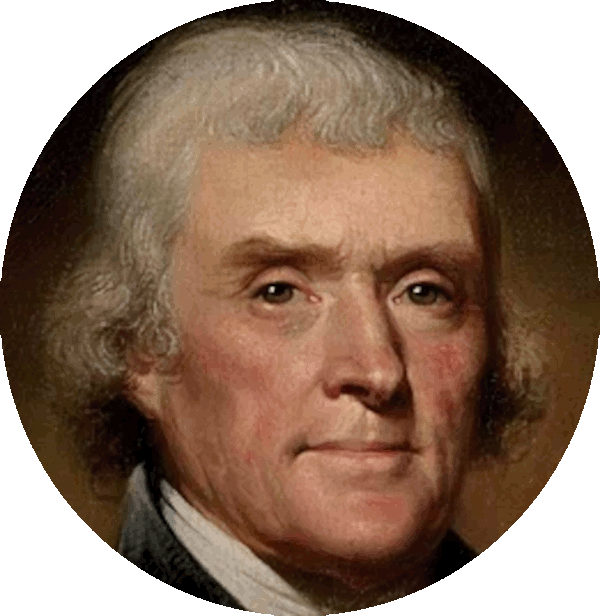
- Thomas Jefferson (1743-1826) was an American Founding Father and the
3rd president of the United States from 1801 to 1809.
- He did not have a middle name. It was common for people during that era not to have a middle name, as the practice was not widespread until much later.
- Jefferson was the primary author of the
Declaration of Independence.
- He was the nation's first U.S. secretary of state under George Washington and then the nation's
2nd vice president under John Adams.
- Jefferson was a leading proponent of democracy, republicanism, and natural rights, and he produced formative documents and decisions at the state, national, and international levels.
|
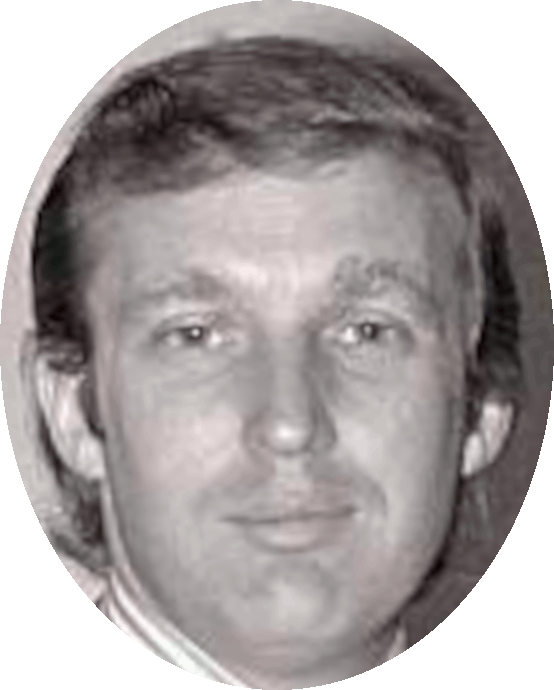
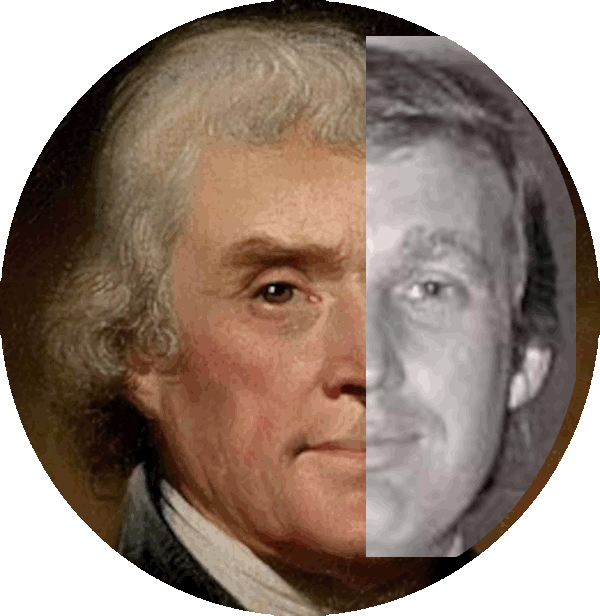
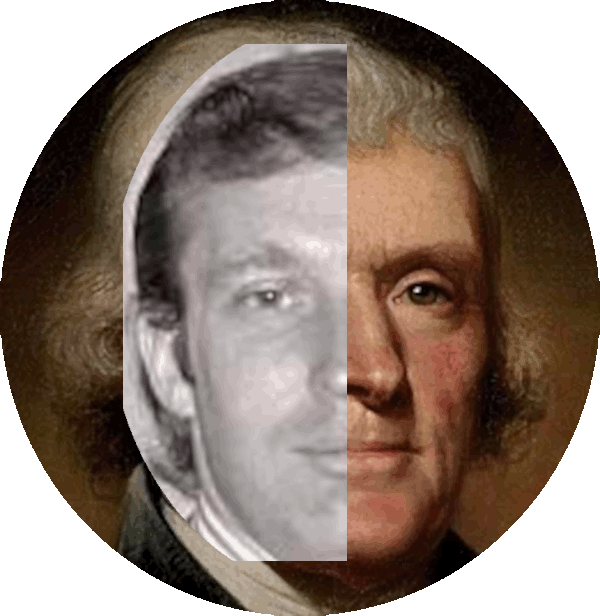
Donald Trump as Thomas Jefferson |
 |
 |
Donald John Trump
1946
6/14 |
Thomas Jefferson
1743-1826
4/13
7/4
Planter class |
 |
 |
|
3rd President |
- In 1761, at the age of 18, Jefferson entered the College of William & Mary in Williamsburg, where he studied mathematics and philosophy with William Small.
- Under Small's tutelage, Jefferson encountered the ideas of British empiricists, including John Locke (1632–1704), Francis Bacon (1561–1626), and Isaac Newton
(1643-1727).
- During his 1st year in college, Jefferson spent considerable time attending parties and dancing and was not very frugal with his expenditures.
- In his 2nd year, regretting that he had squandered away time and money in his first year, he committed to studying
15 hours a day.
|
British empiricists were a group of 17th and 18th-century philosophers, including John Locke, George Berkeley, and David Hume, who argued that knowledge comes primarily or exclusively from sensory experience, rather than from innate ideas. They are known for their focus on experience, induction, and probability, and their work heavily influenced the development of modern thought in areas like science, politics, and ethics. (Assistant)
|
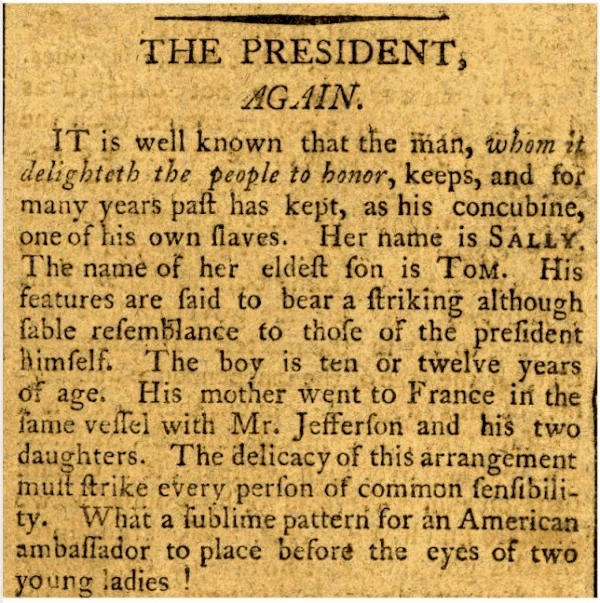
James Callender -
Public Domain
Thomas Jefferson’s affair with Sally Hemings |
|
- Thomas Jefferson’s 1800 race against John Adams for president was the first negative political campaign in American history.
- Jefferson turned the tide, however, when he hired a hatchet man named James Callender to do his bidding.
- During the campaign John Adams was called a fool, criminal, hypocrite, and a tyrant.
- Jefferson was labeled a libertine weakling, a coward, and an atheist.
- Martha Washington herself chimed in and told a clergyman that Jefferson was
'one of the most detestable of mankind.'
|
Fortunately for Jefferson, Callender was pretty good at his job. He convinced countless countrymen that Adams was desperate for war against France — which was entirely untrue. Nonetheless, the public bought it, guaranteeing Jefferson’s victory.
Of course, that didn’t protect Callender from being incarcerated for slander. When the unscrupulous hatchet man regained his freedom in 1801, Jefferson arrogantly denied paying him the sizable debt he was owed. So Callender broke the news of his affair with Sally Hemings. Callender even revealed that Jefferson had lived with her in France and that she birthed five of his children. (allthatsinteresting.com)
|
Lusty |
- Multiple lines of evidence, including modern DNA
analyses, indicate that Jefferson fathered at least six
children with Sally Hemings (1773-1835) over the course of several decades at
Jefferson's Monticello estate, and historians now broadly
agree that he was the father of her surviving children.
- Jefferson began sexual relations with Hemings when she was an adolescent, likely when she was between the ages of 14 and 16, while he was in his mid-40s and exercised near total legal, economic, and physical control over her life.
- Sally Hemings was born about 1773 to the enslaved Elizabeth
'Betty' Hemings
and John Wayles (1715-1773) a colonial American planter, slave trader and lawyer in colonial Virginia..
|
Martha Jefferson died during her marriage in 1782. In 1787, at 14, Hemings accompanied Jefferson's daughter to Paris where they joined Thomas Jefferson. In Paris, Hemings was legally free, as slavery was not legal in France. At some time during her 26 months in Paris, Jefferson is believed to have begun intimate relations with her. As attested by her son, Madison Hemings, Sally agreed with Jefferson that she would return to Virginia and resume her life in slavery, as long as all their children would be freed when they came of age.
(Wikipedia)
|
Paris in France |
- The formerly enslaved Isaac (Granger) Jefferson described Hemings' physical appearance as
'Sally was mighty near white. Sally was very handsome, long
straight hair down her back.'
- Sally was the 6th child of
Betty Hemings an enslaved woman who was taken as a concubine
by John Wayles and Jefferson was married to
Wayles legitimate daughter, Martha Skelton Wayles (1748-1782),
a half-sister to Hemings who was three-quarter white although
enslaved.
- Sally met Jefferson on a trip to Paris with
Jefferson's daughter after he was widowed, where she was
considered a freewoman and it's thought the relationship began
while she was there.
|
As an enslaved person, Hemings could not refuse sexual access without risk of punishment, sale, or violence, and any absence of recorded force reflects the structural secrecy and power imbalance inherent in slavery rather than evidence of voluntariness. Many historians and scholars therefore describe Jefferson’s actions as sexual exploitation or rape within chattel slavery. Four of Hemings' children survived into adulthood and were freed by Jefferson or his will as they came of age. Hemings died in Charlottesville, Virginia, in 1835 in the home of her freed sons.
(Wikipedia)
|
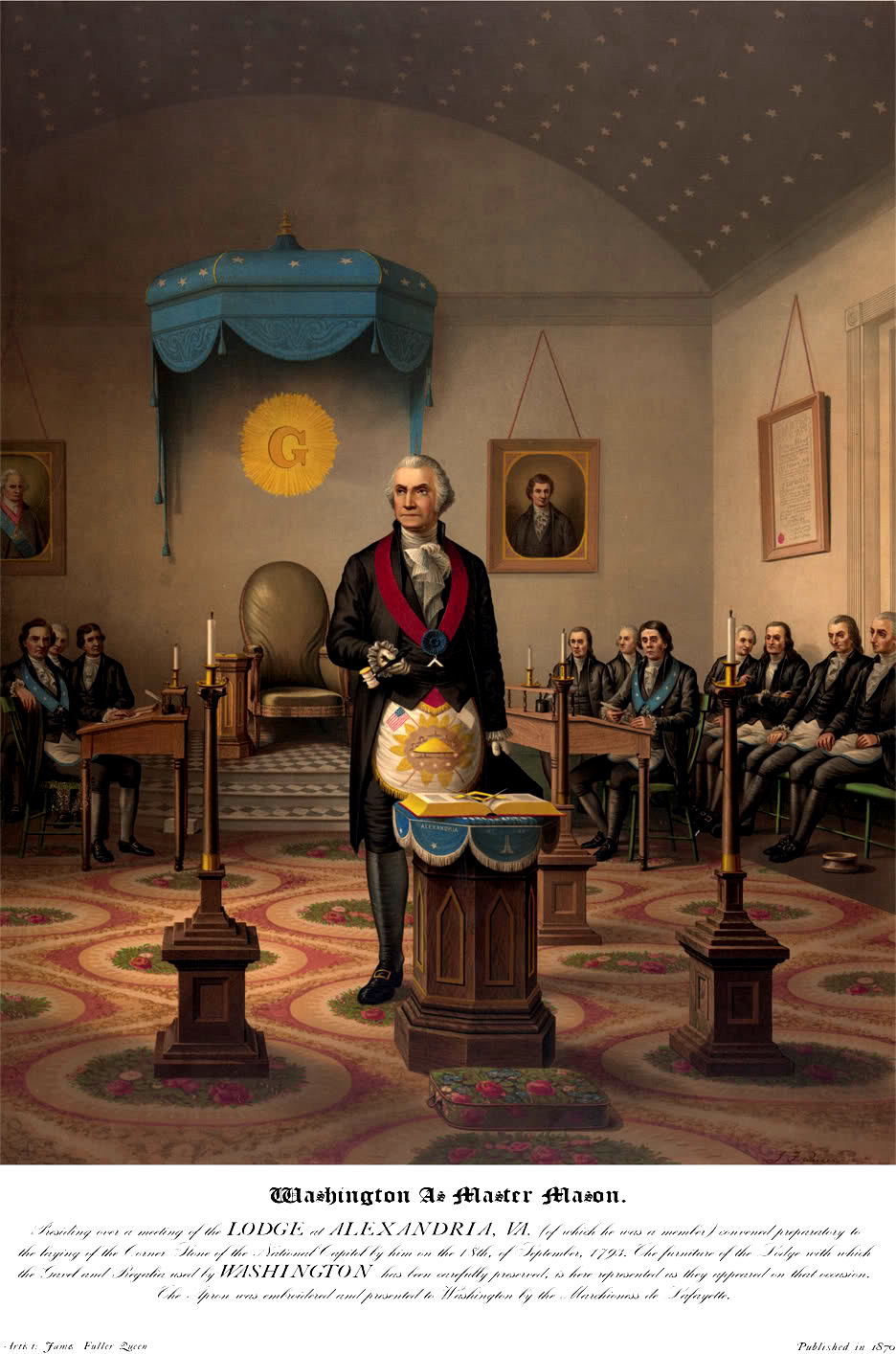
Creator:James Fuller Queen, Public domain, via Wikimedia Commons
George Washington as
Master of his Lodge |
- While at William & Mary, Jefferson became a member of the Flat Hat Club, the nation's oldest secret society, a small group whose members included St. George Tucker, Edmund Randolph, and James Innes.
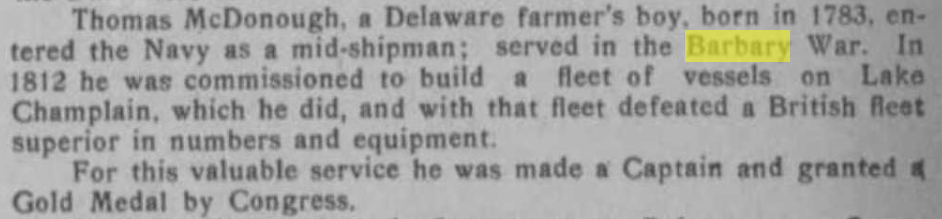
Wilmington Evening
Journal -
July 1, 1914 |
|
- After the American Revolution, the U.S. could no longer rely on European powers to protect its shipping from North African pirates who demanded tribute.
- The
First Barbary War (1801–1805) was a separate conflict fought against the other Barbary States, primarily Tripoli, for the same reason.
- The United States fought against the state of Tripoli, with support from other Barbary States like Algiers, Tunis, and Morocco.
- Tripoli demanded higher tribute from the U.S. after the our
government refused to pay them 'bribes' any longer, and President Thomas Jefferson decided to use military force instead.
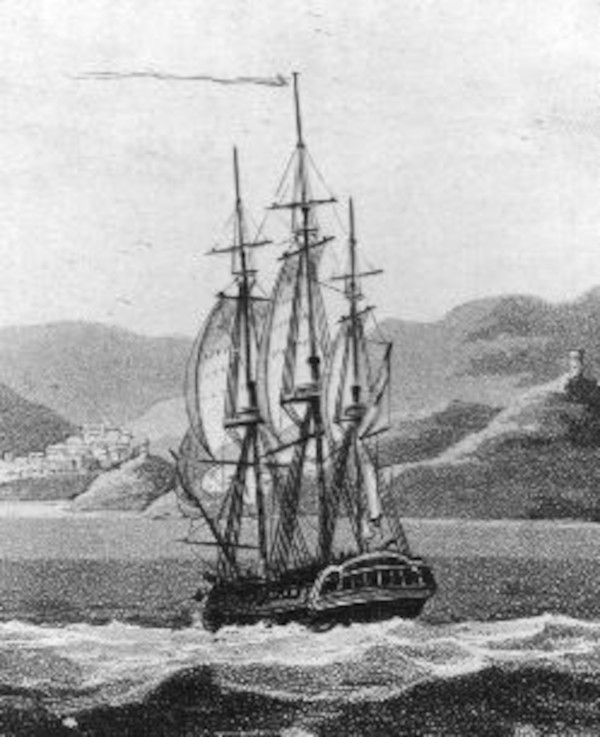
USS Philadelphia
1899 |
|
- In 1805, President Thomas Jefferson's First Barbary War against Tripoli concluded with a peace treaty, ending the conflict that began in 1801.
- The war was a response to Tripoli's declaration of war after Jefferson refused to pay increased tribute for the cessation of pirate raids on American shipping in the Mediterranean.
- The conflict was the first overseas war for the U.S. and saw notable actions, including the burning of the captured
USS Philadelphia by Stephen Decatur and the storming of Derna.
- In a significant military action, a small U.S. Marine and mercenary force led by Captain William Eaton marched across the desert to capture the city of Derna, raising the U.S. flag for the first time on foreign soil.
|
The U.S. frigate USS Philadelphia was captured by the Tripolitans in 1803 after running aground on a reef while blockading Tripoli. The ship and its crew were captured after Captain William Bainbridge surrendered, and the crew was imprisoned for over a year. The ship was later destroyed by the U.S. Navy in a daring raid led by Stephen Decatur in 1804 to prevent the enemy from using it. (Assistant)
|
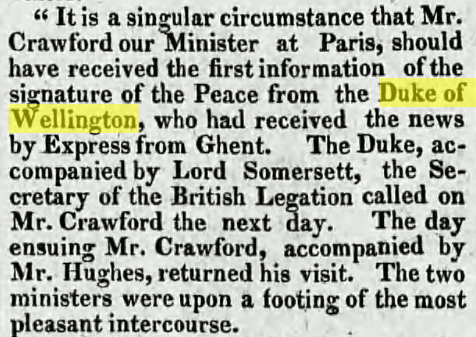
Huntington Gazette -
March 23,
1815
|
- The Algerine War is the Second Barbary War (1815–1816), which was fought between the United States and the city-state of Algiers to end tribute payments and piracy.
- Both wars were caused by Barbary pirates seizing American merchant ships and demanding tribute, but they were two distinct conflicts.
|
New Branches
of Government
Established |

Three branches |
- There are three branches of the U.S. government specified in
the U.S. Constitution; Executive, Judicial and
Legislative and these provide a separation of powers.
- The
Executive branch is the presidential powers and they carry out
the laws.
- Judicial branch is the Supreme Cour and they
were not allowed to create law, just approve it.
- The
Legislature was the formation of the new Congress who were the
lawmakers.

Establishment |
- At the end of the Revolutionary War, the structure of Congress was based on the
Articles of Confederation, which established a single-house legislature called the Congress of the Confederation.
- Each state had one vote, regardless of population, and there was no separate executive or judicial branch.
- This unicameral structure reflected the states' desire to preserve their own sovereignty, but it created a weak central government with limited power, leading to the later creation of the bicameral Congress under the
U.S. Constitution.
Ipankonin, Public domain, via Wikimedia Commons
Seal of the United States Congress |
-
A congressional form of government is a system where the legislative and executive branches are separate, with a Congress that makes laws and an executive branch that carries them out.
- The United States uses this model, with the Congress divided into two chambers: the House of Representatives and the Senate.
- This structure is designed to prevent any one branch from becoming too powerful by creating a system of checks and balances.
-
Together, the Senate and House have the authority under
Article I of the U.S. Constitution to make and pass or
defeat federal legislation.
Louis Dreka, Public
domain, via
Wikimedia Commons
Seal of the United
States Senate |
- The United States Senate is a chamber of the bicameral United States Congress; it is the upper house.
- The Senate has exclusive power to confirm U.S. presidential appointments, to approve or reject treaties, and to convict or exonerate impeachment cases brought by the House.
- Each of the 50 states is represented by two senators who serve staggered
6-year terms, for a total of 100 members.
- The 17th Amendment requires that vacancies in the Senate be filled by special election.
|
From its inception in 1789 until 1913, senators were appointed by the state legislatures of their respective states. Since 1913, however, following ratification of the Seventeenth Amendment senators have been elected by statewide popular vote. (Wikipedia)
|
Ipankonin, Public domain, via Wikimedia Commons
Seal of the United States House of Representatives |
- The United States
House of Representatives is a chamber of the bicameral United States Congress; it is the
lower house.
- Together, the House and Senate have the authority under Article
I of the U.S. Constitution in enumerated matters to pass or defeat federal government legislation, known as bills.
- Those that are also passed by the Senate are sent to the president for signature or veto.
- The House's exclusive powers include initiating all revenue bills, impeaching federal officers, and electing the president if no candidate receives a majority of votes in the Electoral College.
- Members of the House serve a fixed term of 2 years, with each seat up for election before the start of the next Congress.
- Special elections may also occur in the case of a vacancy.
|
Crisis in
the Constitution |
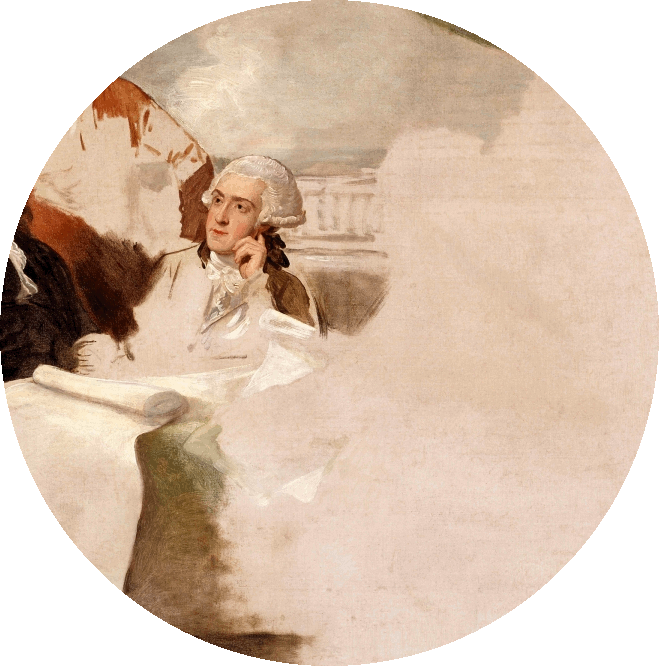
No checks and balances |
-
The U.S. Constitution is widely considered a good thing for establishing a stable government with a separation of powers and a system of checks and balances, but it also has significant flaws, particularly regarding its initial protection of rights for all people.
- Its strengths include creating a lasting framework for
government that has evolved through amendments to address
changing needs, guaranteeing fundamental rights, and balancing
majority rule with minority rights.
- However, it initially enshrined and protected practices like slavery, a major flaw that has been
partially addressed through subsequent
amendments, but never fully addressed.
- Hold on a minute, it set up a lasting
framework for government in the U.S., how's that working out?
Not too good?
- Truth is, they've been using your taxes to
fund all their wars.

Crisis in democracy
Man's world |
- In 1964,
77% of Americans had trust in the American government and
today that's down to 22%, with only 4% who believe that the
political system 'works well.'
- The Economist
Democracy Index has downgraded the U.S. from a full
democracy to a flawed democracy, but it's hard to say how much
of that is caused simply by more people waking up.
- As
example, many females and non-whites have discovered how few rights
the U.S. Constitution granted them, whereas in earlier
years, they just accepted things the way they were.
Congressional worms |
- Young
women expected the Equal Rights Amendment (ERA) to pass over 50 years ago and the
politicians put it on ice and it was brushed off as 'we men
don't think it's good for you because we'll just draft you and send you to
war.'
- This took place during a time they were drafting
young men into their Vietnam war which none of us ever figured
out what we were even doing there.
- Making money for them
of course, these 'defense contractors' have got to go.
|
"Congressional worms" refers to the serious threat of the New World Screwworm (NWS) to U.S. livestock and wildlife, prompting U.S. Congress members to introduce legislation like the STOP Screwworms Act (H.R. 3392, S. 1751) to fund facilities and strategies, such as sterile fly production, to prevent its spread from Mexico and Central America into the United States. This bipartisan effort involves building sterile fly factories, enhancing border surveillance, and collaborating internationally to combat the parasitic fly whose larvae infest living flesh, posing huge economic risks to agriculture. (Assistant)
|

Not working very
well |
- Some 40% of democrat voters, and 50% of republican voters
feel the U.S. should split into two nations, red and blue.
- Well that's a bit much considering some of these states
flip-flop their alliances depending on who's running, and many
candidates switch parties as well along the way.
- Perhaps
the best thing is to dump this corrupt 2-party system that
promotes division and choose candidates, instead of political parties
run by fat cats.
- Voting along 'party line' just hasn't
worked out well because you get candidates you don't agree
with at all.
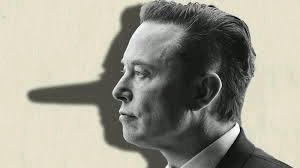
Doge we sure didn't
vote for him or his
'office' |
- However,
some historians believe that this crisis in democracy is
caused by the U.S. Constitution, a 250 year old
document, with a number of fundamental flaws.
- The first flaw is the undemocratic presidential
elections, including the candidates we 'get' to pick from, the
fat cats.
- Article II, Section I of the Constitution
contains one of the world's most important rules, and that is
that the executive power should be vested in a President of
the United States.
- Namely, the rule of how the world's
richest and most powerful country decides who will be
president and commander-in-chief.
- A core principle of
democracy is majority rule, meaning that the political party
that receives the most votes wins, and gets to govern to
reflect the will of the people.
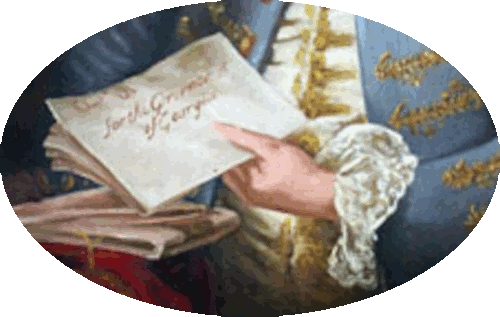
Just more Masonic
demonic rulers |
- However, this is not how
the U.S. Constitution decides who gets to be president
because it's not the one who gets the most votes, but instead,
the candidate who gets the most electoral votes.
- This
has been presented to Americans as helping rural areas with
fewer voters, so that they're not undercut and overwhelmed by voters in
large cities in their states.
- Because rural areas are
generally conservative, and large cities are liberal.
- And this all happened
because these corrupt leaders impoverished everyone around the
world, especially after WWII, and then moved them to American
cities where they vote for the 'liberal' welfare system that
props them up.
- Something we can't really blame them for
but will be easy to change if we move these fat cats (who love
to gerrymander) out of the way and find meaningful things for
all these people to do which is what they really want.
|
Gerrymandering, defined in the contexts of representative electoral systems, is the political manipulation of electoral district boundaries to advantage a party, group, or socioeconomic class within the constituency. (Wikipedia)
|
Their book |
- The electoral system can
also produce a winner who actually received fewer votes,
effectively replacing majority rule, with minority rule.
- For example, in the 2000 election, the
Democrat
candidate, Al Gore Jr., received half a million more votes
than the electoral winner, George W. Bush.
- Some might
not be aware that in the 2016 election, Hillary Clinton
received 3 million more votes than Donald Trump who received
more electors.
- In other words, just since the beginning
of this millennium, this happened twice and the candidate with
the most votes lost.
|
The Electoral College is a process, not a place. The Founding Fathers established it in the Constitution, in part, as a compromise between the election of the President by a vote in Congress and election of the President by a popular vote of qualified citizens. The Electoral College process consists of the selection of the electors, the meeting of the electors where they vote for President and Vice President, and the counting of the electoral votes by Congress. (archives.gov)
|
Ruling over you |
- The reverse situation almost occurred twice more, just
since 2000, for example, in the 2004 election, George W. Bush
received 3 million more votes than John Kerry, but if he had
received 60,000 fewer votes in Ohio, a swing state, Kerry
would have won.
- In 2020, Joe Biden received 7 million
more votes than Trump, but if just 42,900 votes in states like
Arizona, Georgia and Wisconsin had been different, Trump would
have won.
|
Electoral votes are allocated among the States based on the Census. Every State is allocated a number of votes equal to the number of Senators and Representatives in its U.S. Congressional delegation—two votes for its Senators in the U.S. Senate plus a number of votes equal to the number of its Congressional districts.
Each State (which includes the District of Columbia for the Electoral College) decides how to appoint its electors; however, they must do so according to law enacted before Election Day. Currently, all States use the popular vote results from the November general election to decide which political party chooses the individuals who are appointed. (archives.gov)
|
Strangled by
politicians |
- The main reason for this is because the Constitution gives smaller states a
disproportionately large number of electors in the Electoral
College.
-
And Congress granted the District of Columbia (DC) the same
status as a state under the 23rd Amendment, which comes in handy whenever the
politicians want to swing the vote, they have more say than a
normal sized state, how handy.
- Wyoming which as about
half a million people, receives 3 electors which is one for
every 195,000 people, while California, a state of 40 million
people, has 54 electors, or one for every 720,000 citizens.
- Meaning that a vote from Wyoming is worth almost 4
California votes.
Winner take all
rules |
- If this wasn't enough, many states have 'winner take all
rules' which magnifies the unfairness.
- For example,
Wisconsin and Maryland both have 10 electoral votes and in
2016, Hillary Clinton won Maryland with a huge 26 point margin
and thereby secured Maryland's 10 electors.
- Meanwhile,
Donald Trump won Wisconsin but it was a really tight race and
he received less that 1% more votes than Clinton, but he also
received all 10 electors despite such a narrow win.
-
Proving that regardless of how small the win is, you get all
the electors.
Wigged out |
- The result of all this is truly absurd and shows that
in theory, it is possible to win the presidential election, by
receiving as little as 23% of the popular vote.
- Yet if
you step into your child's classroom, or read the news, they
will glorify 'how fair' this electoral system is, when it's
not fair at all.
- But another major flaw of the electoral
college is that the state representatives can vote for whoever
they want, not who the voters wanted, and
this happens all the time.
- Totally invalidating all their
citizens votes.

Smug politician |
- Another thing, these 'candidates' are all the same demons
that have been sitting in the royal seats since the beginning
of time on earth and they've got us under a veil so we can't
see.
- They line up outside Congress' door and don't have
real jobs although there are a few good ones attempting to
work for us, it's hard to do when you're the minority.
-
But another thing is, they don't really care who wins because
they run both sides of this corrupt game, it's all an
illusion.
- Because really what difference does it make
(according to Hillary) they win, not you.
Works for them, not
you |
- Article I, Section III of the Constitution sets out that the
U.S. Senate which is the most powerful wing of Congress, that
each state should have 2 Senators, chosen by the Legislature,
for 6 year terms.
- But once again, this is regardless of
how big each state is, so Rhode Island had the same number of
Senators as Texas or California.
- When the Constitution
was written in 1787, the difference between the most populous
state in the union, Virginia, and the least populous state,
Delaware, was 9 to 1.

Overrepresentation |
- Today, the difference between the most populous state,
California, and the least populous, Wyoming, is 68 to 1.
-
And this means that small states are overrepresented in Senate
since the very beginning, but this overrepresentation has
gotten much worse.
- During the last session of Congress,
there were 50 Democrat Senators and 50 Republican Senators,
but the Democrats represented 42 million more voters than the
Republicans.
Filibustering |
- This absurdity turned even more absurd when
the 'filibuster' was introduced in 1970 because it's a
ridiculous procedural rule that makes it possible for a small
minority of Senators to halt all work in the Senate.
-
Allowing Senators with less than 25% of the population to
block virtually any legislation.
|
A filibuster is a parliamentary procedure in the U.S. Senate that allows one or more senators to delay or block a vote on legislation by extending debate. Ending a filibuster requires a process called cloture, which needs 60 votes to pass, effectively making 60 votes the de facto minimum to pass most legislation. The tactic can lead to gridlock and is controversial, with supporters arguing it encourages bipartisanship and opponents contending it obstructs progress. (Assistant)
|
Dogged down |
-
According to Article V it's not possible to change the
Constitution unless two-thirds of both houses of Congress and
three-quarters of the states approve.
- This is obviously,
extremely difficult to achieve.
- But most of us do agree
that a constitution should be a lot more difficult to change
than other laws.
- However, the U.S. Constitution
is so difficult to change that during the last 200 years, it's
been changed only 15 times, even when overwhelming majorities
of citizens support change, it is usually impossible to achieve.
Money grab |
- As example, over 70% of Americans believe that gun
control laws are more important that protecting gun ownership,
yet it has been impossible to introduce much stricter gun
control laws.
- This is because the 2nd Amendment of the
Constitution has been interpreted to prevent that.
-
Similarly, 72% of Americans want to limit money in politics,
yet the 1st Amendment has been interpreted to prevent many
campaign finance laws.
- The result of that is now only the
very rich 'elites' can ever run for these higher positions,
because they receive such an overwhelming amount of money to
campaign with.
- Thus, in order to implement stricter gun
laws or to limit money in politics, the U.S. Constitution
would need to be changed.
- But, because the Founders made
it nearly impossible to do so, reforms that are supported by
the vast majority cannot be implemented.
|
The 2024 presidential election was the second most expensive since at least 1998. In total, $5.5 billion dollars was spent on the race by presidential candidates, political parties and independent interest groups trying to influence federal elections, according to Open Secrets. Adjusted for inflation, that’s $2.2 billion less than the 2020 race, the most expensive on record. When congressional races are factored in, the cost of 2024 campaigns jumps to $15.9 billion. (pbs.org)
|

Unchecked and
unbalanced Supreme
Court |
- According to Article III, Section I of the
U.S.
Constitution, judges of the Supreme Court shall, during
good behavior, serve for life, and once you're in the court,
you stay there until you die.
- The Founders wanted judges
to rule for life because they believed that if judges can't
lose their jobs, then they will be more independent because
they won't need to succumb to political pressures or political
opinion.
- They did recognize, however, that judges
appointed for life could end staying too long, even after
they've become ineffective or corrupt.

Seated judge |
- But since the Founders, in the words of Alexander
Hamilton believed that the Supreme Court would always be the
least dangerous branch of government, with no influence over
either the word or the purse, they opted for lifetime tenure
despite the risks (and many of them were lawyers in line for
the job).
- However, today it seems obvious that the
Founding Fathers fundamentally underestimated how much power
the Supreme Court and its judges would end up wielding.
-
In the breathtaking 1803 Marbury versus Madison, the case that
to this day is studied by constitutional law students across
the world, the Supreme Court gave itself the awesome power to
declare laws unconstitutional, something that should only be
done in Congress.
|
In the words of Chief Justice John Marshall; it is emphatically the providence and duty of the judicial department to say what the law is, and because the Constitution is more or less impossible to change, the Supreme Court's power to declare laws unconstitutional confers immense power on the court, power that today, neither Congress, nor the White House can properly countervail on behalf of the people. (Andre
Acevedo, The Market Exit)
|
Immense power |
-
There are plenty of examples of how the Supreme Court has
wielded this immense power.
- In Bush v. Gore concerning
the 2000 presidential election, the court effectively decided
the outcome of the election, by halting a vote recount in
Florida, leading to a victory for George W. Bush.
-
Through its decisions in Buckley, Bellotti and Citizens
United, the Supreme Court, effectively ushered America into
the neo-liberal era by allowing corporations to spend
unlimited amounts of money in U.S. elections.
- In Dobbs,
the court overturned Roe v. Wade, eliminating the
constitutional rights to abortion.
- So in issue after
issue, it's not the American people or their elected
representatives, but the 9 judges on the Supreme Court who
have the final say.
|
As the famous legal scholar, Alexander Bickel once commented, the least dangerous branch of the American government is the most extraordinarily powerful court of law the world has ever known. (Andre
Acevedo, The Market Exit)
|
Seniorly |
- In light of this immense power that the court now
wields, it's clear that the Founders decision to allow judges
to serve for life was a mistake.
- A mistake that has
compounded as life expectancy has increased from around 38 years
when the Constitution was written to around 78 years today.
- From the time it was written until 1970, the
average tenure on the court was 15 years and even that is
arguably a long time to wield such immense power.
- But for
the Justices who have been appointed since 1970, the average
tenure is now 27 years and it's getting longer.
- When
Clarence Thomas was confirmed as a Justice in 1991, he was age
43 and if he serves to he's 90, the age at which Justice John
Paul Stevens retired, then Thomas will have been in the job
for 47 years.
- It's obvious the Founders put too much
power in the hands of too few people for far too long.

Current crisis |
- If 23% of the popular vote can choose the president, and
senators representing 25% of the people can halt legislation,
and not even a majority of the population can even attempt to
change the Constitution, and 9 judges who sit there for life
can declare any law unconstitutional, something's very wrong.
- The common thread
among these 4 major flaws is that they enable a minority to rule
over a majority.
- As constitutional scholar, Erwin
Chemerinsky has noted, the U.S. is the only country in the
world that chooses its chief executive this way, and the only
nation where a person who loses the popular vote can win.
-
He makes the case that the undemocratic flaws have led to the
current crisis of U.S. democracy.
Masonic boys club |
- The U.S. Constitution is not explicitly against women, but it also does not explicitly guarantee equal rights based on
gender.
- Females were simply left out of the Constitution and considered unequal and
blacks were also snubbed, at least they obtained equal
rights to some degree via the Civil Rights Act of 1964, once again leaving
white women out of things.
- While the 19th Amendment granted women the right to vote, it did not solve all issues of sex-based discrimination.
- The Equal Rights Amendment (ERA) was proposed to explicitly prohibit discrimination on account of sex, and while it has been ratified by the required number of states, its official status as the 28th Amendment is not yet fully recognized due to legal and political disputes
(by men of course).
- The excuse they used in 1972,
decades ago, was that they
would be able to draft females into their wars so they'd
better not pass it.
- At that time, the U.S. Senate was
concerned with whether women could wear pantsuits to work.
|
The ERA was passed by Congress in 1972, but the deadline for state ratification passed in 1982. The ERA's official recognition as the 28th Amendment is currently a subject of legal and political debate, with some arguing that the original deadline makes the ratification invalid.
(Assistant)
|
Mob rule |
-
The U.S. Constitution has another two major contradictions: the historical one between the ideals of liberty and the institution of slavery, and a potential logical flaw known as
'Gödel's loophole.'
- The slavery contradiction is a moral one, while Gödel's loophole is a self-referential paradox concerning the amendment process (Article V) that, if exploited, could allow for the legal subversion of the democratic structure, though its specifics are not known because the logician never documented it.
- But really, it's very easy to see because through these
amendments, lawyers have rewritten the document and turned
America from a Democratic Republic into a 'democracy' (mob
rule).
- We now have a president who is using his highly
paid lawyers to change the rules so he can run 3 terms.
|
"Mob rule" in America refers to a situation where a group acts violently or unlawfully, overriding the legal and governmental authority. Historical examples include the January 6th Capitol riot, the lynching of the late 19th century, and the Salem Witch Trials. The term is also used in political discourse to describe perceived threats to the established order, with recent examples including protests against immigration policies and debates about the electoral system.
(Assistant)
|
Washington's enslaved personal
servant |
- Liberty vs. slavery: the Constitution was founded on principles of liberty and equality but simultaneously protected the institution of slavery through various compromises.
- This created a fundamental contradiction between the nation's stated ideals and its reality for enslaved people.
-
In one portrait of George Washington, he is shown standing on a bluff above the Hudson River with his enslaved personal servant, William
'Billy' Lee, attending his horse.
Stepped on |
- The Constitution's original protection of slavery and
non-protection of women's rights, continues to haunt racial
and gender relations in the U.S.
- So why should everyone
around the world be concerned with what Americans do with
their governing laws?
- Because unless the superpowers of
the world decide to do the right thing, it becomes a problem
not just for the people in the U.S. but for the entire world
because American law is now held as the standard.
Pied Piper |
- America's citizenship mess involves a complex history of shifting naturalization laws
and discriminatory policies, such as targeting immigrants by race or perceived political affiliation.
- Additionally, recent increased scrutiny has created fear and
uncertainty for naturalized citizens, even those born here, with ongoing debates over denaturalization, dual citizenship, and stricter processing.
- Key issues include denial barriers such as expensive fees,
unreasonable tests and an artificially created backlog.
-
There is also the threat of potential revocation for fraud or past crimes,
and political weaponization by current day demonic presidents
who have created arbitrary new rules and launch personal character assessments
(assassinations), making the path and security of citizenship feel precarious for many.
|
In essence, the "mess" is a mix of legal
complexities, historical discrimination, and
contemporary policy shifts that challenge the security
and accessibility of U.S. citizenship, making it feel
less like a guaranteed right and more like a privilege
subject to political winds.
(Assistant)
|

Naturalization Act of 1790 |
- The Naturalization Act of 1790 was the first U.S. law defining who could become a citizen, limiting naturalization to
'free white persons' with good moral character, requiring 5 years residency, and renouncing foreign allegiance.
- This landmark act established a federal standard for citizenship but explicitly excluded non-white people (like African Americans, Native Americans, and Asians) and indentured servants, reflecting the racial biases of the early republic while also encouraging immigration for national development.
-
In practice, only white, male property owners could naturalize and acquire the status of citizen, whereas women, nonwhite persons, and indentured servants could not.
- While at the same time, many non-whites
and females were already residing in
this country long before 'white men' ever arrived here.
|
In essence, the Act marked a crucial step in defining American citizenship but also enshrined racial discrimination in federal law from the nation's inception.
(Assistant)
|

High water mark |
- The Naturalization Act of 1795 changed the residency requirement for citizenship from
2 years to 5 years.
-
It was repealed in 1798 by the Naturalization Act of 1798, which lengthened the residency requirement to 14 years.
- In 1802, the Naturalization Law of 1802 was passed, which repealed the 1798 act and restored the
5-year residency and 3-year declaration of intent periods established by the 1795 act.
-
In 1870, the right of citizenship was extended to those of African origin.
-
The Trump administration significantly changed the U.S. citizenship test, making it harder with more questions, tougher standards, and deeper civics content.
- These changes were initially reversed by the Biden administration in early 2021, only for the Trump administration to reinstate the stricter 2020 version in late 2025, effective October 20, 2025, increasing the pool of questions and requiring more correct answers.
|
Why did John Adams pass the naturalization act?
Although the law was passed under the guise of protecting national security, most historians conclude it was really intended to decrease the number of citizens, and thus voters, who disagreed with the Federalist Party.
(Assistant)
|
'Ideal' citizen or
buffoon |
- John Adams' major controversies centered on his presidency (1797-1801), particularly the undeclared naval
'Quasi-War' with France, sparked by the XYZ Affair (French agents demanding bribes), which led to the deeply unpopular
Alien and Sedition Acts, restricting speech and press, fueling partisan divides, and ultimately costing
Adams reelection in 1800, though he maintained neutrality and built the Navy, avoiding full-scale war
(then).
- The Alien and Sedition Acts (1798) was
passed by Federalists, these laws criminalized criticism of the government, targeting Democratic-Republicans and earning Adams accusations of despotism, despite their temporary nature.
-
The historical sedition act is no longer in effect, as it expired in 1801 and was never renewed.
however, the concept of sedition is still criminalized in the U.S. through laws like seditious conspiracy in Title 18 of the U.S. Code, though these laws are difficult to enforce due to First Amendment protections for free speech.
Doesn't meet his
own 'test' for citizenship |
-
Status as a natural-born citizen of the United States is one of the eligibility requirements established in the
U.S. Constitution for holding the office of president or vice president.
- This requirement was intended to protect the nation from foreign influence,
however, no laws were ever passed and no one really knows what
it means because it's so arbitrary.
- The U.S. Constitution uses but does not define the phrase
'natural born Citizen' and various opinions have been offered over time regarding its exact meaning.

The only thing the
Constitution ever said about it |
- The consensus of early 21st-century constitutional and legal scholars, together with relevant case law, is that natural-born citizens include, subject to exceptions, those born in the United States.
- As to those born elsewhere who meet the legal requirements for birthright citizenship, the consensus emerging as of 2016 was that they also are natural-born citizens.
- The 14th Amendment does not address the issue of presidential eligibility or use the phrase natural-born citizen
as it states, "All persons born or naturalized in the United States, and subject to the jurisdiction thereof, are citizens of the United States and of the State wherein they reside."
|
The natural-born-citizen clause has been mentioned in passing in several decisions of the United States Supreme Court, and by some lower courts that have addressed eligibility challenges, but the Supreme Court has never directly addressed the question of a specific presidential or vice-presidential candidate's eligibility as a natural-born citizen. Many eligibility lawsuits from the 2008, 2012, and 2016 election cycles were dismissed in lower courts due to the challengers' difficulty in showing that they had standing to raise legal objections.
(Assistant)
|
'Elite' BS |
- Which comes to an even bigger question, how much of this
'law' do we even want or need if it offers protection only for
these 'elites' who have used it to steal from us and every
imaginable crime they could commit against the American
people, and it also appears that the Founders knew about all
this and they were protecting themselves, not us.
- For
example, they didn't willingly address any other rights but
their own as white land-owning males.
- And we see them
doing things like tearing down our White House without any
permission.
- Definition of 'elite' is those who have
restricted us, and stolen the most from us.
|
To me, the U.S. Constitution is like the high-wheeler
bicycle. It was revolutionary when it first appeared,
but when people realized that a bicycle with equal
sized tires was safer and more efficient, they stopped
using high-wheelers. And the Constitution, like the
high-wheeler was revolutionary when it first appeared
but it has foundational flaws and no longer meets the
demands of modern society. So perhaps its time for the
people of the U.S. to get a new bicycle. (Andre
Acevedo, The Market Exit)
|
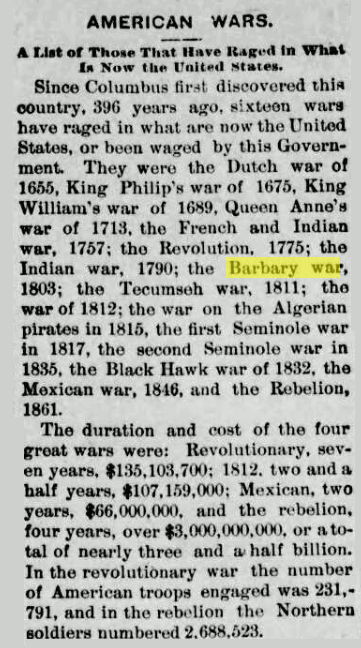
Centralia Daily Sentinel -
May 31, 1889
And
the beat goes on
|
- By 1889, some 396 years after Columbus purportedly
discovered America, the wars were raging on and there had
already been 16 of them.
- They were the Dutch war of 1655,
King William's war of 1689, Queen Anne's war of 1713, the
French and Indian war of 1757, the Revolution of 1775, the
Indian war of 1790, the Barbary war of 1803, the
Tecumseh war
of 1811, the War of 1812, the war on the Algerian pirates in
1815, the first Seminole war in 1817, the second Seminole war
in 1835, the Black Hawk war of 1832, the Mexican war
in 1846,
and the Rebellion in 1861.
- The cost of these wars was
HUGE with 7 years of the Revolution at $135,103,700 and the
Rebellion cost over $3,000,000,000 in 1889 dollars, that's 3
billion.
-
The Civil War and the Masonic
Knights of the Golden
Circle.
|